


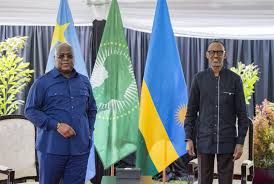
Rwanda has announced its decision to withdraw from the Economic Community of Central African States (ECCAS), signaling escalating diplomatic tensions linked to the ongoing conflict in eastern Democratic Republic of Congo (DRC), where Rwanda-backed M23 rebels have launched a major offensive this year.
Rwanda had anticipated assuming the rotating chairmanship of the 11-member regional bloc during a summit held Saturday in Equatorial Guinea. However, the bloc opted to retain Equatorial Guinea in the role—a move Rwanda’s foreign ministry condemned as a breach of its rights within the organization.
In a strongly worded statement, Kigali criticized what it described as the “instrumentalisation” of ECCAS by the DRC and said it saw “no justification for remaining in an organization whose current functioning runs counter to its founding principles.” It remains unclear whether Rwanda’s exit from the bloc will take immediate effect.
The office of Congolese President Félix Tshisekedi welcomed the decision by ECCAS, stating that the bloc had “acknowledged the aggression against the Democratic Republic of Congo by Rwanda and ordered the aggressor country to withdraw its troops from Congolese soil.”
Earlier this year, the M23 rebel group captured several strategic towns in eastern Congo, leaving thousands dead and heightening fears of a broader regional conflict. Efforts by African leaders, the United States, and Qatar to mediate a peace deal are ongoing.
The DRC, the United Nations, and several Western governments have accused Rwanda of backing M23 by providing military support. Kigali has repeatedly denied the allegations, claiming its actions are in self-defense against Congolese forces and ethnic Hutu militias linked to the 1994 genocide in Rwanda that killed approximately one million people, primarily ethnic Tutsis.
ECCAS, founded in the 1980s, was established to promote economic cooperation, security, and regional integration among Central African states. Rwanda’s departure from the bloc could have far-reaching implications for regional diplomacy and security coordination.