

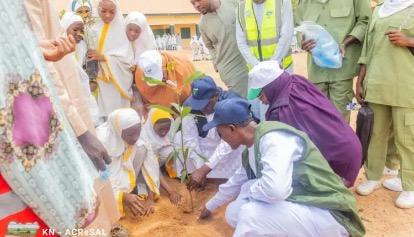
The Agro-Climatic Resilience in Semi-Arid Landscapes (ACReSAL) project has commenced the second phase of its Climate Change Education (CCE) initiative in Kano State, Northwest Nigeria.
The campaign, held at the Girls Science and Technical College, Kano, is part of the “Catch Them Young” programme aimed at raising young environmental advocates and promoting sustainability.
This is contained in a statement issued on Tuesday in Kano by the Communication Officer of Kano-ACReSAL, Mrs. Maryam Abdulkadir.
The statement said the initiative was designed to equip students with knowledge and practical tools to tackle climate-related challenges early in life.
It quoted the Acting Project Coordinator, Dr. Abdulhamid Bala, as saying that climate change continues to pose a serious threat to environmental sustainability globally.
Bala stressed the need for urgent and strategic action to mitigate its impact, adding that ACReSAL was focusing on schoolchildren as critical agents of change.
He urged the students to serve as environmental ambassadors by promoting awareness in their communities.
According to him, the initiative aligns with the state government’s ongoing climate action drive under Governor Abba Kabir Yusuf, especially the transition to solar energy.
He cited the solarisation of Ministries, Departments, and Agencies (MDAs), as well as public street lighting projects, as examples of the government’s commitment.
The statement said environmental experts from academia and the ACReSAL project team facilitated interactive sessions with students on the causes, impacts, and mitigation strategies of climate change.
Among the facilitators were Dr. Ummi Khaltum Muhammad of the Centre for Dryland Agriculture, Bayero University Kano, and Prof. Muhammad Alhaji of Kano University of Science and Technology (KUST), Wudil.
To further entrench climate education, an Environmental Club was established in the school to drive awareness among students and in surrounding communities.
The project also donated 100 improved fruit tree seedlings to the school for planting to improve vegetation cover.
The statement said the seedlings would be managed by the Climate Change Ambassadors and school authorities.
It added that Information, Education, and Communication (IEC) materials were also distributed to sustain awareness and engagement.