

Gloria Essien Abuja
The Speaker of the House of Representatives, Rt. Hon. Abbas Tajudeen, has commended the administration of President Bola Ahmed Tinubu, for implementing bold and transformative reforms aimed at revitalising Nigeria’s economy.
According to the Speaker, the Tinubu-led government has introduced far-reaching policies that are stabilising the national economy, strengthening investor confidence, and significantly improving the ease of doing business in the country.
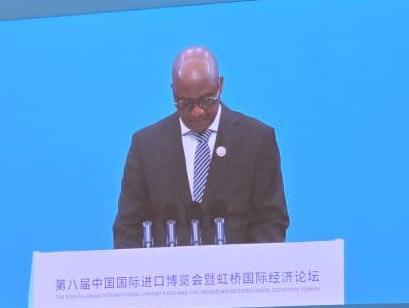
At the opening ceremony of the China International Import Expo (CIIE), 2025, at the National Exhibition and Convention Centre, Shanghai, China, Speaker Abbas said the Nigerian National Assembly is working assiduously to back the reforms through strong legislation.
“These reforms, backed by strong legislative support, are creating opportunities for innovation and local production. The National Assembly has advanced key bills to support this vision, including legislation mandating a minimum of 30 per cent local value addition before export and reforms to make the Nigeria Export–Import Bank more responsive to exporters’ needs.
“These measures are designed to help Nigerian businesses take full advantage of platforms such as the China International Import Expo,” Speaker Abbas said.
Abbas also noted that the Nigerian Parliament plays an important role in strengthening the country’s relationship with China, saying under his leadership, the 10th House established the Nigeria–China Parliamentary Friendship Group, which has become a model for legislative diplomacy and cooperation.
“Through this platform,” he added, “our two parliaments regularly engage to promote trade, technology, and cultural exchange. In the past year, we have welcomed high-level delegations from China, including Mr. Zhang Qingwei, Vice Chairman of the Standing Committee of the National People’s Congress, and Mr. Hu Chunhua, Vice Chairman of the Chinese People’s Political Consultative Conference.
“These exchanges have produced a framework for sustained legislative collaboration and deepened the institutional foundations of our partnership.”
Speaking on the trade volume between China and Africa, the Speaker said, “In the first eight months of 2025 alone, China–Africa trade reached 222.05 billion dollars, representing a 15.4 per cent increase from the previous year.
“For Nigeria, China remains our largest trading partner, with deep investments in critical sectors such as transport, telecommunications, energy, and manufacturing. Yet, we recognise that trade must be mutually beneficial.
“We must move beyond a structure in which Africa exports raw materials and imports finished goods toward a partnership that prioritises industrialisation, technology transfer, and value addition.”
On the recent designation of Nigeria as a Country of Particular Concern by the United States President Donald Trump, the Speaker said, “We affirm that freedom of religion and belief is protected under our Constitution and emphasise the need for direct engagement with the U.S. government to communicate Nigeria’s position through dialogue.”
“I call on the United States to work with Nigeria as we tackle the real causes of tension, including poverty, exclusion, and insecurity. We can only make real progress by working honestly and collaboratively. Together, we must strengthen peace, promote democracy, and create a fairer and more stable world,” he said.
Speaker Abbas noted that following the CIIE, “We must also confront the broader question of balance in global trade. True prosperity will only come when every nation, large or small, has a fair chance to grow and compete.
“For Nigeria, achieving this balance means developing our industrial base, strengthening infrastructure, and improving market access for our finished products. We call on our partners, including China, to continue supporting African economies through technology transfer, investment in processing industries, and fair trade policies that reward productivity and innovation,” he said.
He said as the Nigeria–China relationship has matured into a comprehensive strategic partnership rooted in trust and shared aspiration, the National Assembly will continue to enact laws and support policies that make the cooperation more productive, balanced, and sustainable.