


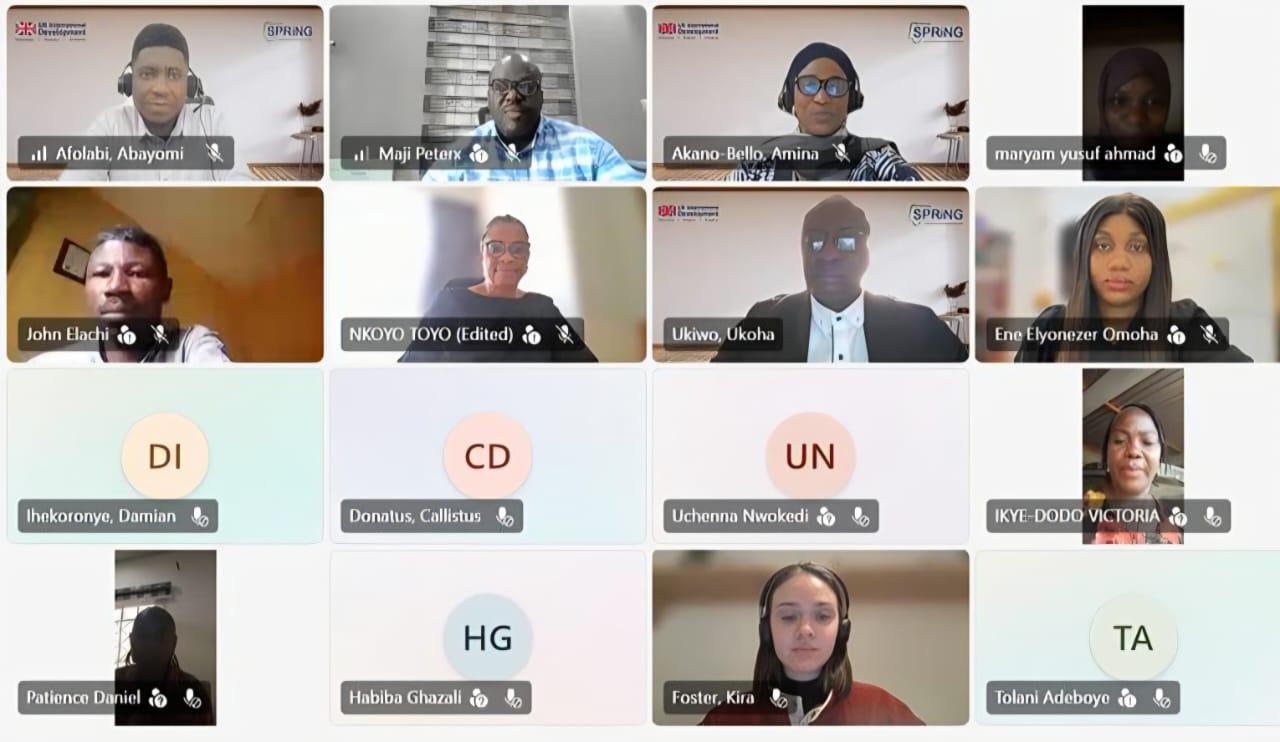
Stakeholders have underscored the imperative of embedding psychosocial support within Nigeria’s justice systems as a critical pathway to advancing women’s rights and improving access to justice.
The submission was made during a webinar hosted by the Strengthening Peace and Resilience in Nigeria (SPRiNG) Programme, funded by the United Kingdom Foreign, Commonwealth and Development Office.
The webinar, themed “Advancing Women’s Rights and Access to Justice through Psychosocial Support and Trauma-Informed Peacebuilding,” was convened to mark International Women’s Month.
Speaking, SPRiNG Director, Dr. Ukoha Ukiwo stated that “unaddressed trauma leads to a prolongation of conflict,” emphasising the need to interrogate “the impact of conflict on the psychosocial health of women.”
He expressed optimism that the deliberations would not only raise awareness but also stimulate concrete and actionable outcomes.
“The hope is that the conversations and interactions during this time will truly take us beyond resolutions, beyond decisions about how to advance women’s rights and improve women’s access to justice,” Ukiwo added.
In her remarks, SPRiNG Gender, Equality, Disability and Social Inclusion Lead, Amina Akano-Bello, said “women and girls continue to face violence, trauma, stigma, and barriers that make it difficult for them to seek justice and access support.”
She stressed that “peace, safety, trust, and dignity” are essential, noting that Justice is often discussed in terms of laws, institutions, and systems, which are factors that make it possible for women to speak out, seek help, and begin to rebuild their lives.

Panelists drawn from clinical, policy and peacebuilding fields emphasised the centrality of trauma care in justice delivery and peacebuilding processes.
Psychologist and GBV specialist, Victoria Estella Daaor, said that when a woman is traumatised, “there is fear, there is shame, there is confusion.”
She further explained that trauma can significantly hinder justice-seeking, as “trauma affects memory. They begin to forget some of the details of whatever has happened to them. Their story may be considered false, but it is trauma speaking.”
Public policy expert, Ambassador Nkoyo Toyo highlighted the pervasive nature of trauma, stating that “conflict must not be just seen as where the conflict itself is happening, but increasingly in terms of where the conflict itself is impacting upon.”
“We must go beyond just asking this question of psychosocial support, and begin to see this as a mainstream issue in the wider agenda of women’s contribution to peace and security in the country.We need to bring in more specialisation into the healing process in order not to create a system where the intersection of patriarchy and the attempt at dealing with the silence does not reinforce some of the values that already exist,” She added.
Also speaking, peacebuilding expert, Maji Peterx emphasised that trauma is deeply personal and can trigger post-traumatic stress disorder and re-traumatisation.
He advocated a trauma-informed approach, saying, “if we have a broad-based approach to peacebuilding engagement, if we have a more trauma-informed approach to peacebuilding, to countering violent extremism, to transforming violent extremism, we realise that we are having a process that every step we take leads to the achieving of the overall picture.”
Participants at the webinar recommended the institutionalisation of psychosocial support within justice frameworks through dedicated budgetary provisions.
They also called for the training of security and justice sector actors in trauma-informed care, the establishment of safe spaces and community-based support systems, as well as strengthened multi-stakeholder collaboration.
The recommendations, if effectively implemented, have the potential to significantly shift Nigeria’s justice landscape for women by not only strengthening accountability but also restores dignity and trust in institutions.
By integrating psychosocial support into formal and informal justice mechanisms, survivors of violence are more likely to be heard, believed and supported throughout the legal process.
This approach ultimately, embeds trauma-informed practices within justice delivery, moving the system beyond punitive measures to a more holistic, survivor-centred model, one that enhances access, promotes healing, and reinforces the role of women as active participants in peacebuilding and national development.