

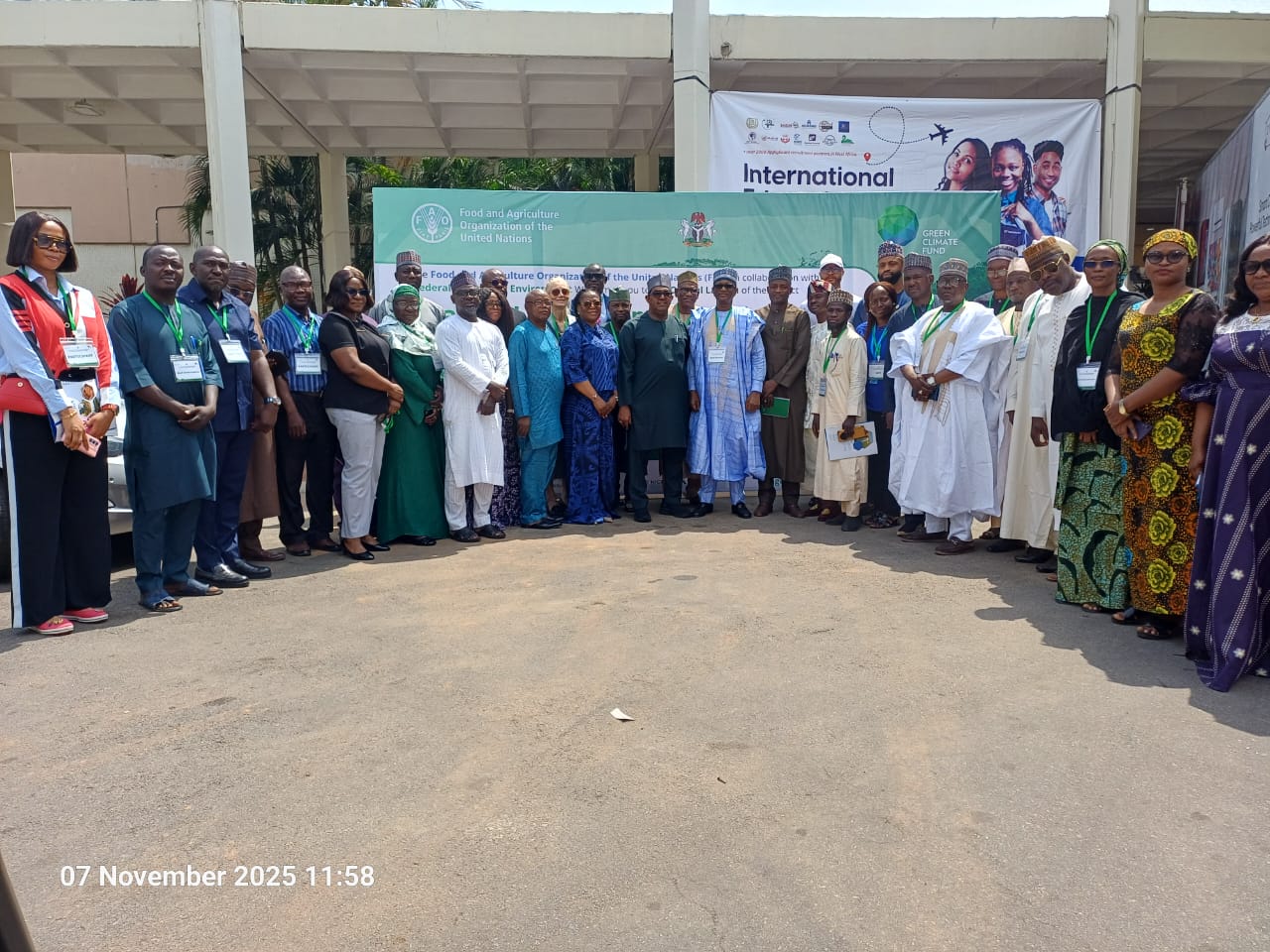
In a move to alleviate climate change, land degradation, food insecurity, and rural vulnerability in Nigeria, the Food and Agriculture Organisation of the United Nations (FAO) in partnership with National Agency for the Great Green Wall (NAGGW), the National Council on Climate Change (NCCC), and the Agro-Climatic Resilience in Semi-Arid Landscapes (ACReSAL) project, under the strategic oversight of the Federal Ministry of Environment have launched the National Project of the Scaling Up Resilience in Great Green Wall Areas, (SURAGGWA).
The project was launched during an inception workshop for stakeholders in Abuja, Nigeria’s capital city.
The SURAGGWA project is designed to tackle the most pressing climatic challenges facing the Sahel region and funded by the Green Climate Fund (GCF).
It is a strategic investment in building climate resilience, restoring degraded ecosystems, and enhancing livelihoods across the African Great Green Wall (GGW) region.
The SURAGGWA programme will be implemented across the Great Green Wall area of the Sahel, which spans 11 countries, with a focused implementation in eight priority countries of Burkina Faso, Chad, Djibouti, Mali, Mauritania, Niger, Nigeria, and Senegal.
The programme is expected to benefit approximately 8.7 million people, including over 3 million direct beneficiaries and over 5.6 indirect beneficiaries, while Nigeria stands as the largest beneficiary, with over 1.9 million people.
Read Also: Nigerian Government Inaugurates Committee on Green Climate Fund
Nigeria Commits to Driving Africa’s Climate Change Agenda
Speaking during the launch, the FAO representative to Nigeria and the ECOWAS Mr. Hussein Gadain, said the project will boost climate resilience and empower rural women and youth.
According to Mr. Gadain, the project will be implemented by the FAO in partnership with all relevant stakeholders in participating countries.
“The implementation approach will leverage a combination of modalities. Activities will be directly implemented by FAO, in collaboration with line ministries, technical agencies, service providers, and development partners.
Each country will establish a Country Implementation Unit (CIU) responsible for day-to-day coordination and delivery of project activities”
“As we embark on this ambitious journey, I wish to call on all partners federal and state governments, civil society, private sector actors, and community-based organizations to come on board and join efforts to ensure the successful delivery of this transformative programme” he said.
Timely Project
The Minister of Environment, who was represented by the Director General of the National Agency for the Great Green Wall (NAGGW), Mr. Saleh Abubakar said the project is timely and reflects government’s resolve to confront the challenges of land degradation, climate change, and declining livelihoods through coordinated, inclusive, and innovative action
“The SURAGGWA programme is both strategic and timely. It reinforces Nigeria’s leadership under the Pan-African Great Green Wall Initiative, aligns with the National Drought and Desertification Policy, the National Restoration Agenda, and advances the goals of the Paris Agreement and our Nationally Determined Contributions (NDCs)”
He commended the Food and Agriculture Organization of the United Nations (FAO) for its partnership, working hand in hand with the NAGGW and other national institutions, noting that FAO’s technical guidance will facilitate community-driven results.
According to him, the federal government is committed to the implementation of the SURAGGWA programme by providing policy direction, institutional coordination, political will, and enabling environment required to ensure its lasting success.
Victoria Ibanga