


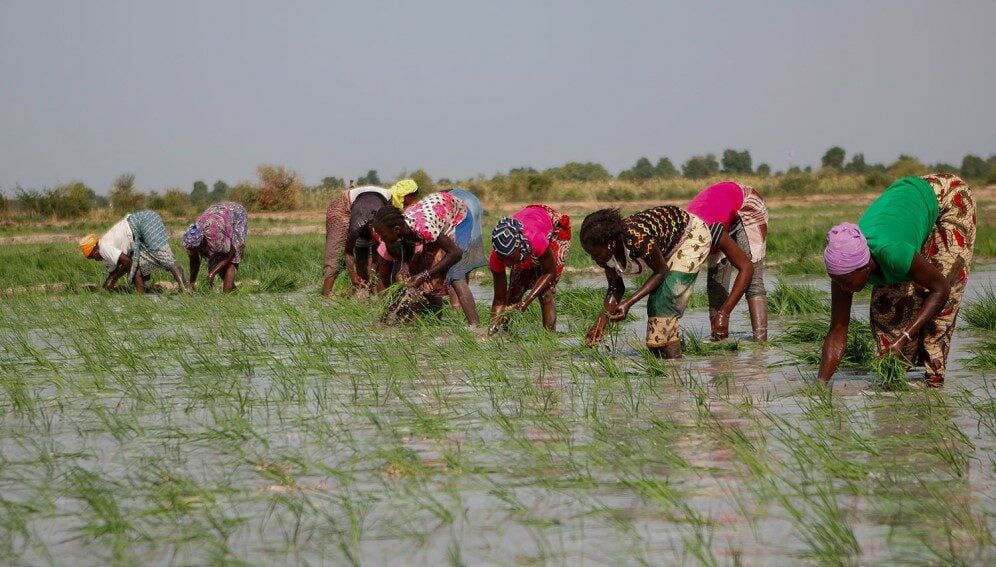
Stakeholders in Ebonyi have called on the government to increase support for women rice farmers to boost production and enhance food security in the state.
The stakeholders, who spoke with Newsmen in separate interviews on Wednesday in Abakaliki, said women constituted the bulk of the rice farming labour force in the state.
They noted that despite their crucial role in rice production, women farmers continued to face numerous challenges, including limited access to finance, poor input distribution and climate-related disruptions.
Ms Nancy Ifeyinwa, Lead Director of the Neighborhood Initiative for Women Advancement (NIWA), said the organisation had scaled up support for rural women through training and advocacy.
According to her, NIWA provides capacity-building programmes on agronomic practices, financial literacy, and climate-smart agriculture.
READ ALSO:Rice Farmers Lament Crippling Local Production
She said that it also advocated for fair pay and improved working conditions for women engaged in various stages of rice production, such as parboiling and processing.
“We are working to reduce poverty among rural women and improve their productivity through skills and awareness creation. There is urgent need to make agriculture more inclusive, productive and resilient for women, especially in the face of climate change,” she said.
Ifenyinwa said although NIWA had supported some women with limited financial grants, large-scale input distribution remained the responsibility of government.
She commended the Ebonyi State Government for distributing fertilisers, certified seeds and herbicides under its People’s Charter of Needs initiative and for facilitating farmer training through international partnerships, including with Thailand.
Mr Philips Ewa, an agricultural extension service provider, called for stronger collaboration among stakeholders to enhance women’s engagement in food production.
He applauded the Federal Government’s Renewed Hope Agriculture Support Programme (RHASP) coordinated by the Ministry of Agriculture and Food Security in partnership with the Better Health for Rural Women (BERWO) Foundation, for supporting women farmers.
“International organisations such as the Food and Agricultural Organisation (FAO)and Consultative Group for International Agricultural Research (CGIAR)’s Zero Hunger Project have also provided training and support to farmers in the state.
“UN Women had distributed agricultural inputs and promoted biogas energy for rural women, while private sector players like BATN Foundation and Nigerian Agricultural Projects Activity are supporting value chain development,” he said.
A rice farmer, Mrs Margaret Nkwuda, urged the state government to provide timely and affordable inputs, such as certified seeds, fertilisers and herbicides, and to prioritise the welfare of women farmers.
Another rice farmer from Izzi LGA, Mrs Ijeoma Okorie, called for increased access to credit and extension services, tailored specifically to the needs of rural women and marginalised groups.
She lamented that in spite of government support, many rural women still operated under severe constraints.
“I rely on personal savings to buy inputs and sometimes I skip planting because I cannot afford the costs,” she said.
Although official statistics are scarce, stakeholders estimate that women contribute up to 79 per cent of the labour force in rice production in Ebonyi.
They maintained that while government and development partners had made commendable efforts, more support was needed to unlock the full potential of women farmers.