

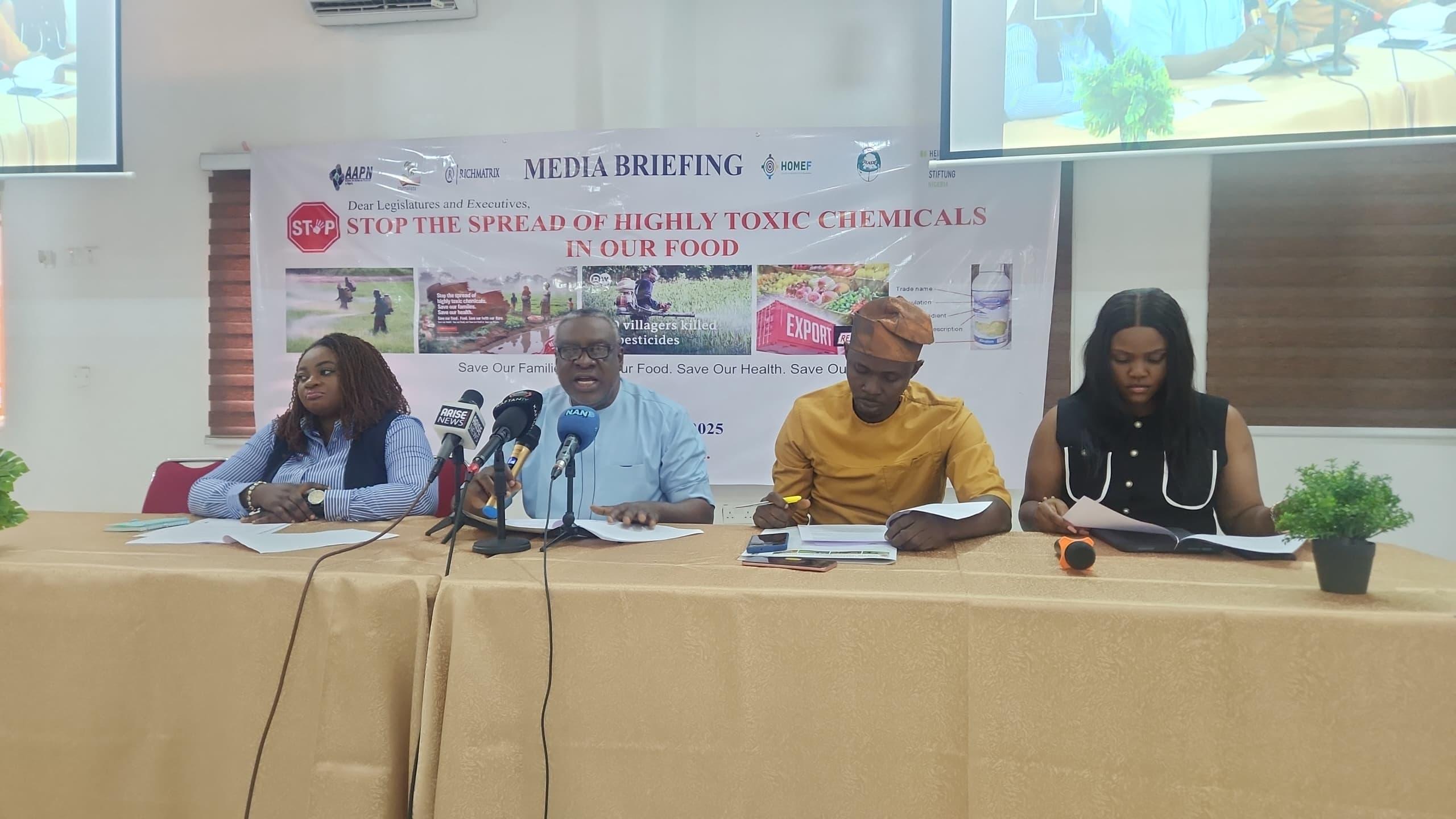
Stakeholders in Nigeria’s health, agriculture, and environmental sectors have raised an urgent alarm over the widespread use and distribution of Highly Hazardous Pesticides (HHPs) across the country.
They warned that the practice is endangering lives, degrading the environment, and undermining the nation’s trade reputation.
In a media briefing jointly signed by Prof. Simon Irtwange, Co-Founder of the African Agricultural Pesticide Network (AAPN), and Barrister Oreoluwa Adelakun, Legal Lead of AAPN in Abuja, the group disclosed that over 65% of the active ingredients in pesticides used in Nigeria are classified as highly hazardous, with many already banned or severely restricted in the European Union, the United States, and parts of Asia.
“Despite this, these chemicals are being routinely distributed to farmers through government programmes, constituency projects, philanthropic donations, and agricultural support schemes, often without adequate safety information or training.”
According to data cited by the Nigerian Stored Products Research Institute (NSPRI), the country uses about 23,400 metric tons of pesticides annually, with over 80% of those distributed to smallholder farmers already banned in the EU and US.

The health risks linked to these substances range from acute poisoning and respiratory problems to cancers, neurological disorders, and reproductive issues.
“A tragic example occurred in 2020 when over 270 people died in Benue State after pesticide contamination of a community river.”
The statement also highlighted severe economic consequences, including Nigeria’s loss of about $362.5 million annually due to the EU’s ban on its bean exports over excessive pesticide residues, with other agricultural products such as sesame seeds, palm oil, and dried fish also suffering repeated rejections.
The stakeholders condemned weak regulatory oversight by the National Agency for Food and Drug Administration and Control (NAFDAC) and the Federal Competition and Consumer Protection Commission (FCCPC), citing a lack of consistent enforcement, public awareness campaigns, and sanctions for violators.
They also expressed concern over the open sale of banned pesticides in markets and on online platforms, where they are accessible even to untrained buyers, including teenagers.
They called for immediate actions, including the introduction of a national pesticide control bill, gradual withdrawal and eventual ban of HHPs in line with FAO/WHO guidelines, mandatory hazard training for all distributors, and the promotion of safer alternatives such as bio-pesticides and organic fertilizers.
The group also urged public awareness campaigns, rigorous market surveillance, and transparent enforcement measures to protect farmers, consumers, and the environment.
“This is not merely a case of good intentions gone wrong; it is a matter of public safety,” the statement stressed.
“Support to farmers must be responsible, regulation must be proactive, and well-meaning interventions must never again serve as a cover for systemic harm.”