

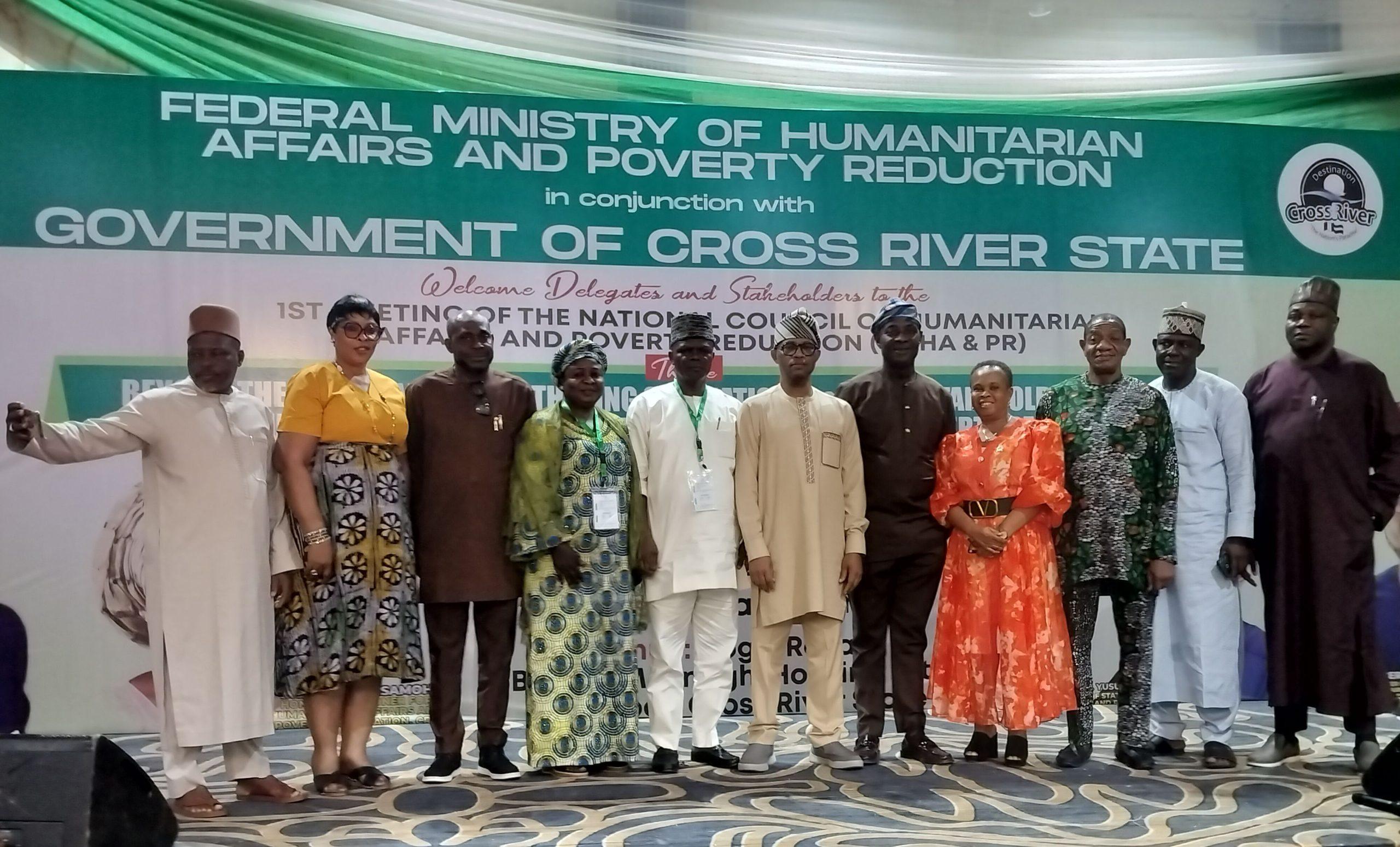
Stakeholders across Nigeria’s humanitarian landscape have endorsed a unified and coordinated framework for humanitarian response and poverty reduction.
The stakeholders including international actors, converged on Calabar, the capital of Cross River State, southern Nigeria, for the inaugural session of the National Council on Humanitarian Affairs and Poverty Reduction.
The meeting, convened by the Federal Ministry of Humanitarian Affairs and Poverty Reduction, brought together permanent secretaries, directors and officials from the 36 states and the Federal Capital Territory, alongside development partners and allied agencies.
Deliberations focused on aligning policies and interventions to reduce duplication and improve impact in line with the theme, “Beyond the National: Strengthening Subnational and Multi-stakeholder Synergy for a Unified Approach to Humanitarian Response and Poverty Reduction.”
At the technical session of permanent secretaries, more than 100 memoranda submitted by states and agencies were reviewed.
Timely
Speaking on the outcome of the technical session, the Permanent Secretary, Ministry of Humanitarian Affairs, Akwa Ibom State, Mrs. Eno Akpan, described the council as timely, noting that humanitarian interventions in Nigeria have largely been fragmented.
Akpan said, “humanitarian interventions have been fragmented in so many ways, and even now it is still relatively new in Nigeria because the Ministry of Humanitarian Affairs itself has not been there for a long time.
“Some states are even just coming up with their own ministries. So, this major council meeting is really apt because it brings us together to streamline humanitarian interventions, Nigerian aid and define the roles of various actors,” she further said.
Akpan explained that the discussions revealed common priorities across the 36 states, noting “from what we have just done, I have come to find out that almost all states are talking in the same direction — poverty reduction, care for the elderly, immigrants and other vulnerable groups. Poverty is endemic and Nigerians should look forward to better impact of humanitarian aid as this will streamline interventions across the federation.”
Collaborations
Also speaking, the Permanent Secretary, Ministry of Special Duties and Intergovernmental Affairs, Ogun State, Mrs. Funmi Baker, emphasised collaboration and domestication of programmes at the state level as key takeaways from the meeting.
Baker said, “since the beginning of this programme, we have identified two major impact points. One is the need for collaboration — all stakeholders must work together as a team. The second is that projects should be mainstreamed and domesticated at the state level.”
The Permanent Secretary, who explained that most of the memoranda reviewed were recommended for approval, while others were stepped down after scrutiny, noted gaps between federal and state institutional structures and stressed the need for states to align with national frameworks.
Outcomes
Similarly, the Permanent Secretary, Ministry of Humanitarian Affairs and Poverty Alleviation, Cross River State, Mr. Andy Akpotu-Andeshi, described the council as a high-level policy platform capable of shaping national development outcomes.
Akpotu-Andeshi stated, “council meetings are top-level policy meetings that influence the political, economic and social strata of a nation. From such meetings, policy thrusts and directions emerge that cascade from the federal level, in collaboration with the regions, down to the local levels.”
He also agreed that as a relatively new ministry, the meeting provided an opportunity to develop guiding policies for humanitarian action and poverty reduction.
“We needed to brainstorm like older ministries to have policies that will guide our work on humanitarian matters and poverty issues. These are issues that will ultimately reduce the burdens on Nigerians.
“By this meeting, there will be clear indicators and policy directions on how every state is expected to align with the federal government for harmonious and effective service delivery to citizens of Cross River State and Nigeria at large,” he said.
The three-day council meeting is expected to conclude with the issuance of a communiqué, which stakeholders say will provide a clear pathway for managing humanitarian affairs and poverty reduction architecture in Nigeria and set the country on a more coordinated and impactful path for humanitarian interventions.