

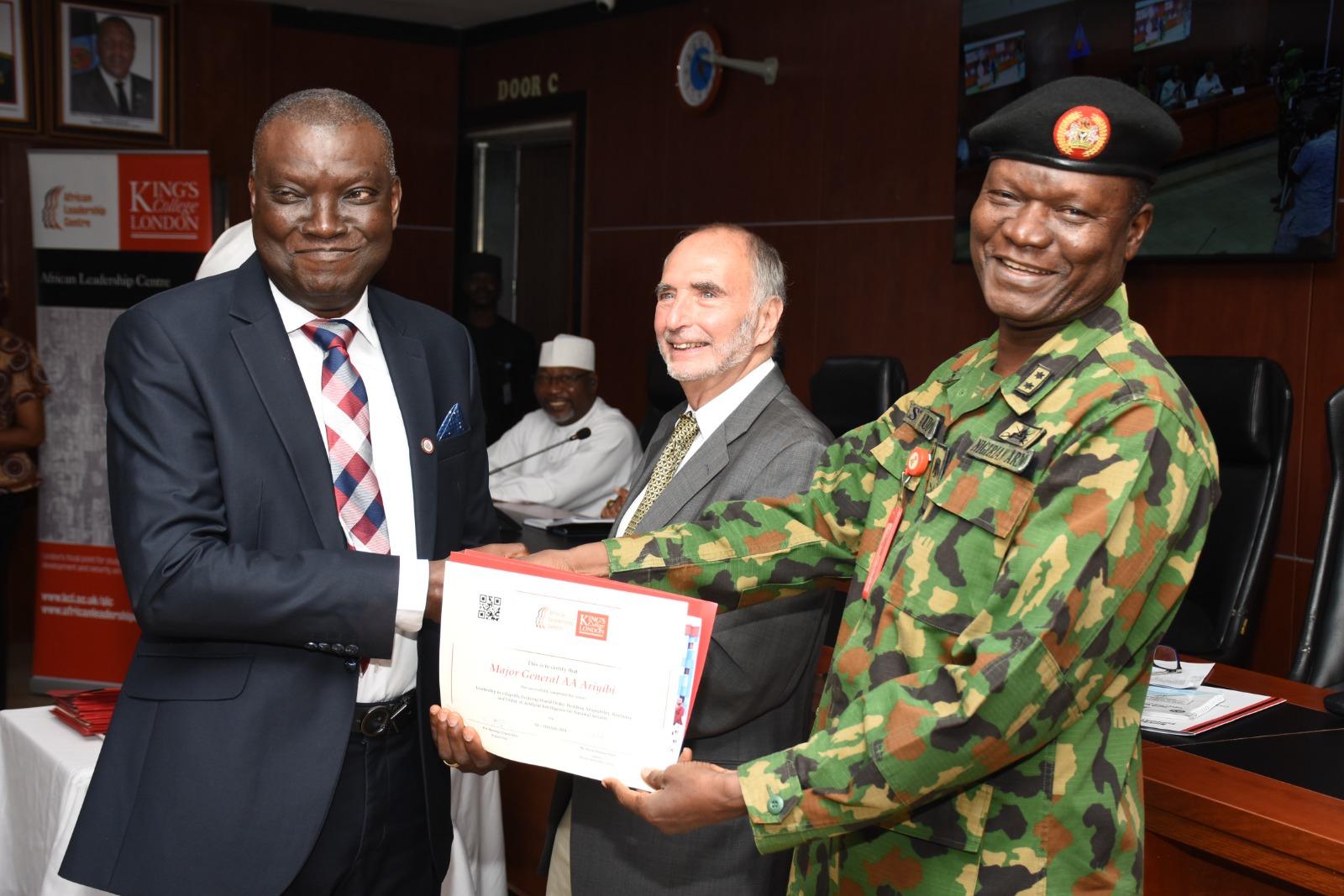
The Nigerian Military has reaffirmed its unwavering commitment to enhancing strategic leadership and operational effectiveness through a targeted training initiative designed to equip mid- and senior-level officers with global perspectives and policy insights.
Lieutenant General Olufemi Oluyede, the Chief of Army Staff, made this announcement in Abuja during the graduation ceremony for the strategic leadership course, Phase 1, which was conducted in collaboration with Queen’s College London.
Represented by Major General Sylvester Audu, the Coordinator of the Nigeria Army Training Support and Assistance Team at Army Headquarters, the Army Chief commended the vision underpinning the program, describing it as a significant milestone in the Army’s ongoing efforts to cultivate intellectually robust and strategically minded personnel.
He stated that the current security challenges confronting the nation necessitate not only physical courage and tactical brilliance but also profound strategic thinking and adaptive leadership. He urged participants to apply the knowledge acquired from the course—delivered through a combination of international expertise and local relevance—to enhance decision-making and leadership within the service.
The Chief emphasized, that the knowledge acquired must be translated into actionable leadership in the field, at headquarters, and wherever duty calls.
He reminded them that the hallmark of effective leadership is a sense of responsibility.
Further, Major General Garba Wahab, Retired Director General of the Nigerian Army Resource Centre, highlighted the critical importance of leadership, decision-making, and a comprehensive understanding of the operational environment in addressing security challenges, particularly in the context of unconventional warfare such as insurgency.
General Wahab referenced lessons learned from past military operations, especially in the Northeast during the early engagement against Boko Haram, where insufficient cultural sensitivity and environmental awareness resulted in strategic miscalculations and a decline in local support.
He underscored the necessity for resilience and adaptability, asserting that every crisis conceals opportunities if approached with clear and profound thinking.
He cautioned against the indiscriminate adoption of foreign strategies without contextual adaptation, advocating for the development of robust internal structures capable of withstanding repeated assaults.
Dr. Shuvai Nayoni, Executive Director of the African Leadership Centre at King’s College London, emphasised the importance of acknowledging the rapid technological advancements that are permeating even the most remote regions of Africa, including Nigeria.
She articulated that technology is no longer confined to elite developers but is increasingly accessible to the general populace.
Dr. Nayoni remarked that the democratization of technology presents both opportunities and challenges. For leaders in Nigeria, it is vital to recognize that these changes are irreversible.
She added that leadership must not only embrace these transformations but also adequately understand and address the societal vulnerabilities they may introduce.