


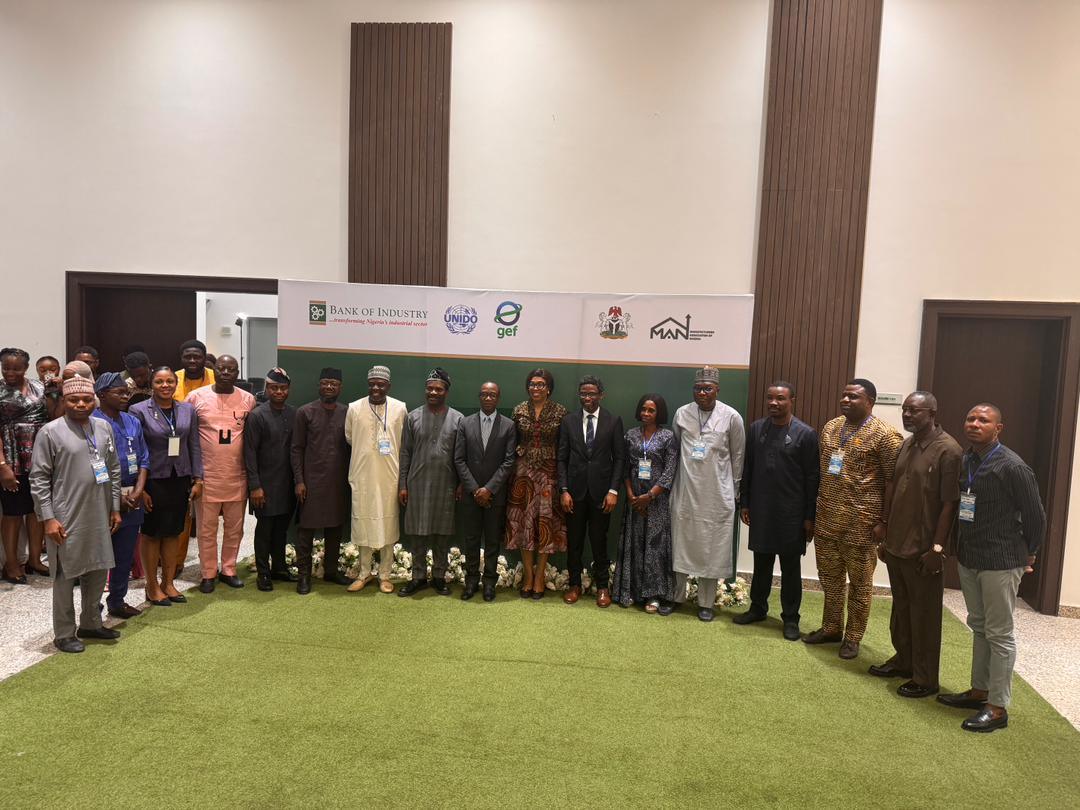
The United Nations Industrial Development Organization (UNIDO), in collaboration with the Global Environment Facility (GEF), the Manufacturers Association of Nigeria (MAN), and other key stakeholders from Nigeria’s industrial and financial sectors, convened in Abuja to present the outcomes of the financing component of the GEF–UNIDO Industrial Energy Efficiency (IEE) and Resource Efficient and Cleaner Production (RECP) Project.
In his opening remarks, the Director-General of MAN and Chairman of the Investment Committee, Segun Ajayi-Kadir, noted that the project commenced in 2022, with the Bank of Industry (BoI) serving as a key partner. He added that the collaboration has since deepened, with several industries already benefiting from the initiative.
Ruben Bamidele, the UNIDO National Programme Officer, explained the project’s design aimed at promoting industrial energy and resource efficiency. He observed that conventional financial institutions are often reluctant to fund high-risk investments, which points to the importance of the partnership with the Bank of Industry.
“Traditional bank lending typically does not support high-risk investments. This is why the GEF has provided support for implementing this scheme through the Bank of Industry to encourage investors to participate in this critical area of industrial development,” he said.
Dr. Bamidele further emphasised that the forum provided an opportunity to update stakeholders on the project’s progress, achievements, emerging opportunities, challenges encountered, and recommendations for the future.
Read this also: UNIDO Warns of Rising Energy Waste in Industrial Sector
The event featured presentations on key outcomes recorded during the implementation of the project, particularly in advancing Industrial Energy Efficiency (IEE) and Resource Efficient and Cleaner Production (RECP) among participating enterprises. It also served as a platform for engagement with national stakeholders and financial institutions, with discussions centred around lessons learned and the programme’s impact on promoting sustainable industrial practices in Nigeria.
Participants, drawn from government agencies, financial institutions, and the private sector, deliberated strategies to strengthen financing mechanisms, scale up the adoption of energy-efficient solutions across industries, and shape future interventions, while sustaining the gains achieved through the project.