

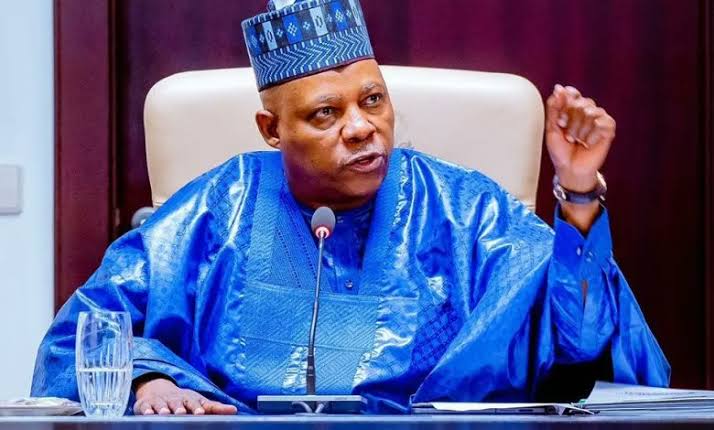
Nigeria’s Vice President Kashim Shettima has flagged off the Aliko Dangote Foundation Education Scholarship Initiative, calling on stakeholders to recommit to building a future where every Nigerian child can become the best version of themselves.
The programme, projected to cost ₦1 trillion over the next ten years, will support students across multiple levels through a range of targeted schemes.
Speaking on Thursday in Lagos during the launch of the education scholarship scheme, the Vice President extolled Dangote’s philanthropic efforts, saying education is a burden carried by those who understand its transformative power.
“Now is the time to recommit to building a future in which every Nigerian child has a fair shot at becoming the best version of themselves.
“Let us live our lives so that posterity will remember us not for the offices we held or the titles we bore. Posterity must remember us for the doors we opened and the lives we transformed,” he stated.
VP Shettima urged the private sector and corporate entities to invest in education, insisting that they must regard themselves as stakeholders in the survival of Nigeria’s education system.
He noted that there is no better time than now to confront the “consequences of demographic acceleration,” he said.
According to him “A youthful population is a global asset only when it is educated. Without education, it becomes a threat to itself and to the nation that houses it.
“We come from a difficult history. Formal education was once treated as an intrusion. It was seen as an affliction. It was seen as a scheme to estrange children from their heritage. The residue of that suspicion, the gap that misunderstanding created, still weighs heavily upon our national progress.”
He emphasised that, rather than expecting a miracle or mere rhetoric to close and erase the gap created by such misunderstanding, deliberate effort must be made “to end a needless cycle of failure that has persisted for far too long.”
This, he said, inspired President Bola Ahmed Tinubu to roll out bold and far-reaching reforms, including the introduction of the Nigerian Education Loan Fund (NELFUND) to create equitable access to education.
“We strengthened UBEC to deepen basic education infrastructure and accountability. We expanded TETFUND’s intervention footprint to revitalise tertiary institutions. We accelerated our Technical and Vocational Education and Training programmes to reflect the needs of a new economy. We also mainstreamed digital learning as a core national priority,” he added.
Human Capital Index
The Vice President decried what he described as the “reality of West Africa as the region that now carries the burden of having the lowest Human Capital Index in the world,” stating that Nigeria must invest in education to reverse the trend.
“We must treat education as a survival strategy. This is why our administration treats the National Human Capital Development Programme as a national emergency. We are bringing states, development partners, the private sector, and civil society together to reclaim our destiny,” he said.
VP Shettima described the Founder and President/CEO of the Dangote Group, Alhaji Aliko Dangote, as standing apart, saying: “In a nation that has produced giants, he remains a colossus.”
Applauding the ₦100 billion annual education support scheme introduced by Dangote, he said, “His (Dangote’s) philanthropy is not episodic. His philanthropy is structural. His philanthropy is generational. His philanthropy is visionary. He is not only the largest private employer of labour in Nigeria. He has also become the most consequential private investor in the rescue of our most critical sector, education.”
Strengthening Nigeria’s Education Sector
The President of the Foundation, Alhaji Aliko Dangote, said the Foundation’s ₦100 billion annual education support programme will strengthen Nigeria’s educational sector and expand access to quality learning for young people nationwide. He assured that all beneficiaries will be selected through a transparent, merit-based process.
He further announced partnerships with NELFUND, NECO, WAEC, and other government agencies to ensure accountability and fairness in programme delivery, revealing that he has dedicated 25 per cent of his personal wealth to the foundation, a commitment that will extend beyond his lifetime.
The Minister of Education, Dr Tunji Alausa, described the initiative as one of the most comprehensive human capital development programmes in Nigeria’s history, aligning with the Federal Government’s education reform agenda.
Dr Alausa also noted that 25 per cent of the scholarship slots will be reserved for persons living with disabilities, calling the gesture a “humane and inclusive approach.”
In her goodwill message, United Nations Deputy Secretary-General Amina Mohammed commended the foundation’s investment in education, saying the expanded scholarship opportunities, particularly in Technical and Vocational Education and Training (TVET) would create new pathways for Nigerian children. She described investment in girls’ education as one of the most powerful tools for societal progress.
Speaking on behalf of state governors, Lagos State Governor Babajide Sanwo-Olu applauded Dangote’s commitment to the future of Nigerian youth. He acknowledged that the Dangote Foundation has redefined philanthropy in Nigeria, adding that state governments will work to ensure the success of the initiative, beginning with Lagos State, which has allocated 10 per cent of its annual budget to education.
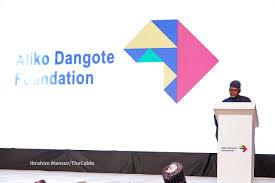
The high point of the event was the unveiling of the Vision 2030 ₦100 billion logo of the Dangote Foundation.