
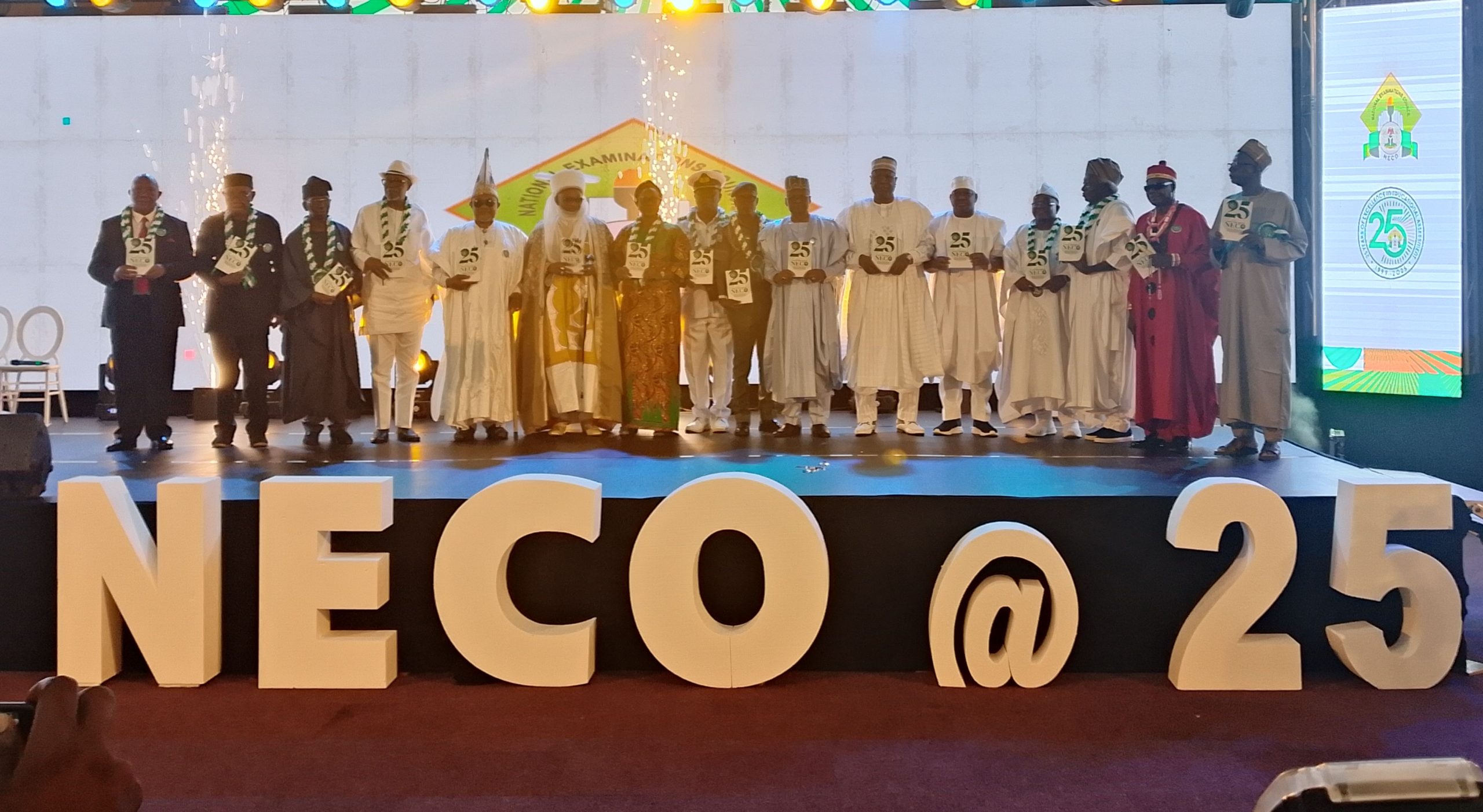
Nigerian Vice President Kashim Shettima has urged the National Examinations Council (NECO) to deepen its commitment to integrity in examination administration and strengthen security mechanisms to protect the sanctity of assessments.
Shettima made the call during NECO’s Silver Jubilee celebration held in Abuja, Nigeria.
The Vice President enjoined the council to also ensure the transparent and timely release of results to candidates and institutions.
According to him there was the need for the council to ensure that its services remain” accessible and affordable to every Nigerian child, regardless of background.”
He also stressed the need to expand professional development opportunities for educators and examiners, and to leverage technology and strategic partnerships to “improve access and innovation, particularly in the era of artificial intelligence.
The VP acknowledged NECO’s progress in the last 25 years, describing the milestone as “a profound testament to collective national resolve and our enduring faith in the Nigerian child.”
Shettima represented by his Senior Special Assistant on Legal and Compliance Matters, Bashir Maidugu, commended the council for embracing digital solutions.
Read Also: NECO Partners With NOUN on Result Verification, CBT Expansion
NECO Accredits Burkina Faso Schools For SSCE, BECE
NECO Releases 2025 SSCE External Results
NECO Establishes New Examination Center In London
The Minister of Education, Dr. Maruf Tunji Alausa, in his keynote address said that the council has performed exceptionally well and reduced examination malpractice by 90 percent.
“The achievement reflects years of deliberate reforms in examination administration and security” he said.
Alausa reiterated that NECO is set to commence Computer-Based Examinations (CBE) in some schools later this year to further strengthen integrity and provide real-time monitoring of candidates, while full migration by all schools would be in 2027.
“We are at the threshold of a very important reform which NECO is spearheading – and that is the Computer-Based Examination (CBE), which is to commence this year. This will go a long way in curbing the menace of Examination malpractice due to its ability to track and detect suspicious activity and also provide real-time monitoring of Candidates,” he said.
He said the council’s early focus on secure examination processes, reliable scoring and timely release of results had helped restore public confidence in national certification.
“Investments in examiner training, item development, psychometrics and quality assurance had laid the foundation for rigorous standards.
“Today, we pause to reflect on a remarkable journey—one that has shaped our educational landscape, strengthened accountability, and reinforced the promise of equal opportunity for all learners in our nation,” he said.
Alausa explained that NECO has also expanded its examination centre network to give students in diverse regions fair access, diversified its subject offerings to suit different learning stages, and adopted technology-driven processes such as secure data management and electronic results to improve efficiency and transparency.
The Minister expressed the Ministry of Education’s commitment to it’s oversight role in setting standards, safeguarding fairness and aligning NECO’s examinations with national curricula and development objectives.
Internationally Recognized Examination Body
The Registrar of NECO, Professor Dantani Ibrahim Wushishi in his remarks, said the council had evolved from its early challenges of limited public trust and infrastructure gaps to become an internationally recognized examination body now conducting examinations in eight countries.
He attributed the progress to transparent procedures, the introduction of online registration and internet-based release of results, and sustained collaboration with stakeholders both within and outside Nigeria.
Prof. Wushishi noted that NECO had undertaken the construction of offices in 10 states and a standard science laboratory at its headquarters, while also procuring 50 Mitsubishi single cabin trucks, 24 Toyota Hilux double cabin trucks, two Isuzu mini trucks and two 18-seater buses to improve logistics.
“The council has also developed the NECO e-verify application for result confirmation, an e-library, e-granary, a Statistics and Data Analysis studio, and created additional departments and six zonal directorates to enhance staff mobility and development,” he said.
The Registrar paid tribute to former Presidents General Ibrahim Badamasi Babangida and Olusegun Obasanjo for their roles in establishing and consolidating the council.
He also acknowledged the contributions of past Ministers of Education, Governing Board members and former Registrars for building the foundations on which NECO now stands.
Prof. Wushishi said NECO would continue to enhance security protocols, item banking and anti-cheating measures, expand e-services and data analytics, align with international best practices through partnerships with global examination bodies and broaden access for learners in underserved communities through targeted outreach and fee strategies.
As part of activities marking the jubilee celebration, a lecture titled ‘Educational Assessment in a Changing World: Innovations, Challenges and Opportunities for Africa’ was delivered by Emeritus Prof. Pius Augustine Ike (PAI) Obanya. A book titled ‘Twenty-Five Years of NECO: Evolution, Challenges and Contributions to Nigeria’s Educational Assessment System’ was also unveiled.
NECO was established in April 1999 in response to growing calls for a national examination body that could meet Nigeria’s needs.


 to deepen its commitment to integrity in examination administration and strengthen security mechanisms to protect the sanctity of assessments.)