


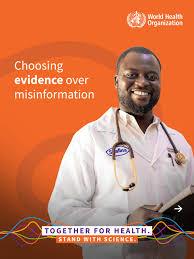
The World Health Organisation (WHO) has urged people worldwide to renew their commitment to collaboration and to support science as a driving force for improved global health.
The agency called on governments, institutions and individuals to strengthen cooperation and ensure evidence-based approaches guide health policies and everyday decisions.
WHO made the appeal in a statement marking the 2026 World Health Day, themed “Together for health. Stand with science.” The campaign commemorates the organisation’s founding on April 7, 1948, and launches a year-long public health initiative.
READ ALSO: WHO Advocates Health Policy Inclusion for Refugees, Migrants
Observed annually on April 7, World Health Day raises awareness of pressing global health issues and promotes healthier living. WHO noted that human health has been significantly transformed over the past century, largely due to scientific advances and international cooperation.
“The global maternal mortality rate has fallen by more than 40 per cent since 2000, and deaths among children under five have been reduced by over 50 per cent,” the agency said.
“Advances in technology, scientific knowledge and skills, and collaboration between different disciplines, sectors and countries continue to turn once-life-threatening health challenges such as elevated blood pressure, cancer diagnoses or HIV infection into manageable health issues, extending and improving lives worldwide.”
Yet, WHO warned that health threats continue to grow, fuelled by climate impacts, environmental degradation, geopolitical tensions and shifting demographics. These challenges include persistent diseases, strained health systems and emerging diseases with epidemic or pandemic potential.
Thousands of scientists, alongside organisations such as WHO, are accelerating research and developing policies, tools and innovations needed to protect communities today and safeguard the health of future generations.
“Science is one of humanity’s most powerful tools for protecting and improving health,” WHO Director-General Tedros Ghebreyesus said.
“People in every country live longer and healthier lives on average today than their ancestors did, thanks to the power of science. Vaccines, penicillin, germ theory, MRI machines and the mapping of the human genome are just some of the achievements that science has delivered that have saved lives and transformed health for billions of people.”
WHO stressed that scientific innovations are most powerful when widely adopted, and every success in improving human health reflects the collective work of scientific organisations, policymakers, health workers and the public.
Before modern anaesthesia, surgery meant unimaginable pain. Today, safer medicines, affordable technologies and trained specialists allow life-saving operations to be performed while patients sleep comfortably.
“Scientific progress has helped democratise these advances, making safe surgical care accessible across the world, including in many resource-limited communities,” WHO said.
Over the past 50 years, global immunisation efforts have saved over 154 million children from infectious diseases. Vaccines have contributed to a 40 per cent reduction in infant mortality, with just the measles vaccine saving over 90 million children.
Advances in early screening technologies are transforming health outcomes. From electronic blood pressure monitors to breast cancer screening through mammography, these tools have become life-saving interventions for millions.
Over its 78 years of convening global scientific organisations, WHO has remained at the forefront of scientific and health transformation.
In line with the World Health Day 2026 theme, WHO and the G7 Presidency of France are convening a One Health Summit in Lyon, France, from April 5 to 7, bringing together Heads of State, scientists and community leaders to strengthen coordinated action.
WHO will host the Global Forum of its Collaborating Centres network from April 7 to 9, with representatives from over 800 academic and research institutions across more than 80 countries. These centres support WHO’s research, technical assistance and capacity-building work worldwide.
“Science transforms uncertainty into understanding and reveals the pathways to protect and heal our communities,” WHO Chief Scientist Dr Sylvie Briand said.
“Without the clarity of rigorous scientific inquiry, we risk being led by bias and misconception and too often toward treatments that fail us or even place us in harm’s way. Today, we must stand together with science so that our collaboration is sustained, supported and enhanced for the better health of generations to come.”
WHO emphasised that science must continue to guide health decision-making at all levels. Its partners generate and translate evidence across a wide range of health priorities, from infectious diseases and chronic conditions to mental health, nutrition and environmental risks, supporting countries to deliver effective, equitable care.
Achievements in global health show that when countries unite behind science, they respond to crises more effectively and build stronger, more equitable health systems for the future.
NAN