
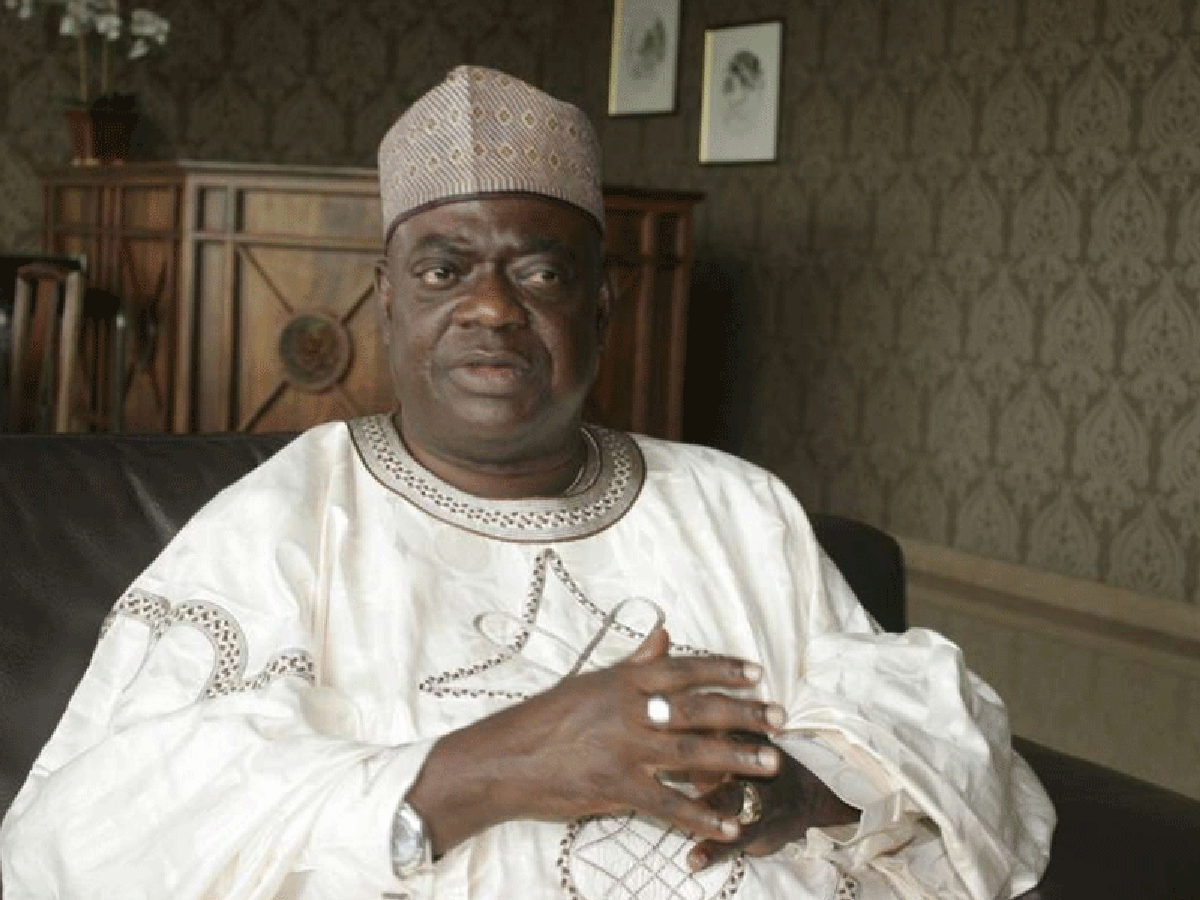
The Former Niger State Governor and Chairman, Board of Trustees of the Sir Ahmadu Bello Memorial Foundation, Mu’azu Babangida Aliyu, has called for stronger government-citizen engagement in Northern Nigeria
According to him, Northern Nigeria’s persistent challenges stem from elite complacency, institutional neglect, and decades of policy failures that long predate the current administration.
He stated this during the opening of a two-day interactive session on government-citizens’ engagement at Arewa House, being held in Kaduna state
Aliyu said while President Tinubu inherited many of the region’s problems, Northern political and intellectual elites must also accept responsibility.
“Our problems didn’t start today, and they weren’t caused solely by this government. Many of us who watched and did nothing must also bear the blame. We failed to act when it mattered most,” he said.
The engagement, convened by the Sir Ahmadu Bello Memorial Foundation, builds on its 2022 meeting with presidential candidates and aims to deepen inclusive governance through structured dialogue between policymakers and citizens across Northern Nigeria.
Aliyu listed insurgency, banditry, poverty, the growing number of out-of-school children, porous borders, and youth unemployment as urgent concerns. He warned that the growing disconnect between governments and citizens is fuelling mistrust, misinformation, and public frustration.
“There’s a communication vacuum between governments and the governed. That gap is breeding frustration and eroding public trust. This forum is a deliberate attempt to bridge that divide,” he stated.
He advocated institutionalised, town hall-style meetings nationwide, citing successful global examples where such civic engagement has shaped policy and strengthened democracy.
“Let’s be clear: there’s a big difference between governance and partisanship. Governments must listen to the people, and citizens must be bold enough to speak up—with respect and clarity,” he added.
Aliyu reaffirmed the foundation’s non-partisan stance, stressing its commitment to promoting leadership rooted in justice, equity, and good governance. He also commended platforms such as the Arewa Consultative Forum (ACF), Northern Elders Forum (NEF), Jam’iyyar Matan Arewa (JMA), and Arewa House for consistently demanding accountability.
“Together, we must remind our leaders that if they escape accounting here, they won’t escape it in the hereafter,” he warned.
Aliyu further condemned long-standing delays surrounding the Mambilla Hydroelectric Power Project and the Baro Inland Port, describing both as unfulfilled federal promises.
“The Mambilla project is a 40-year-old scam. Kill it or come clean. As for Baro Port, government must complete it and dredge the River Niger,” he said.
In his remarks, the Chairman of the Board of Trustees of the Arewa Consultative Forum, Alhaji Bashir Dalhatu, urged President Tinubu to renew his commitment to Northern development, citing the region’s overwhelming support in the 2023 presidential election.
“Of the 8.8 million votes that brought this government to power, the North alone delivered 5.6 million. We believe the region has earned the right to benefit from the promises made during the campaign,” he said.
Dalhatu disclosed that Northern leaders had formally presented key expectations to the President during a meeting on 30 May 2024. Top among their demands were enhanced security, revived agriculture, improved education, and investment in energy and infrastructure.
He acknowledged that such interventions take time but stressed the need for the Federal Government to begin reflecting Northern concerns more clearly in its policies and programmes.
“Our advocacy has been peaceful, respectful, and well-intentioned. We aim to support the President in delivering on his promises—especially to Northern communities still plagued by insecurity and poverty,” Dalhatu added.
He praised the foundation for sustaining dialogue and encouraged continuous citizen-government engagement to strengthen democracy.
“We must keep these conversations going—to promote understanding, unity, and accountability,” he said.
Chairman of the Northern Elders Forum, Prof. Ango Abdullahi, called for a sharper federal focus on education and infrastructure in the North, warning that current neglect undermines national development.
He decried the region’s disproportionate share of the country’s estimated 20 million out-of-school children.
“If even half of the N15 trillion federal budget were channelled into education, we could build schools, train teachers, and drastically cut down the out-of-school population,” he said.
Abdullahi criticised the state of road infrastructure in the North-East, describing it as among the worst in the country.
“Good roads are not a luxury; they are a necessity for economic growth,” he said.
He also urged fair representation in federal appointments and expressed concern over recent developments at the Central Bank of Nigeria, including the relocation of departments to Lagos and what he described as lopsided leadership appointments.
Abdullahi called for the strategic location of agro-allied industries in Northern Nigeria to reflect the region’s agricultural potential.
“If we truly want Nigeria to develop, then the North must be industrialised along its natural endowments. We must continue to engage constructively. These conversations are necessary for progress and we hope to see greater inclusion and responsiveness going forward,” he concluded.
NAN/PIAK

