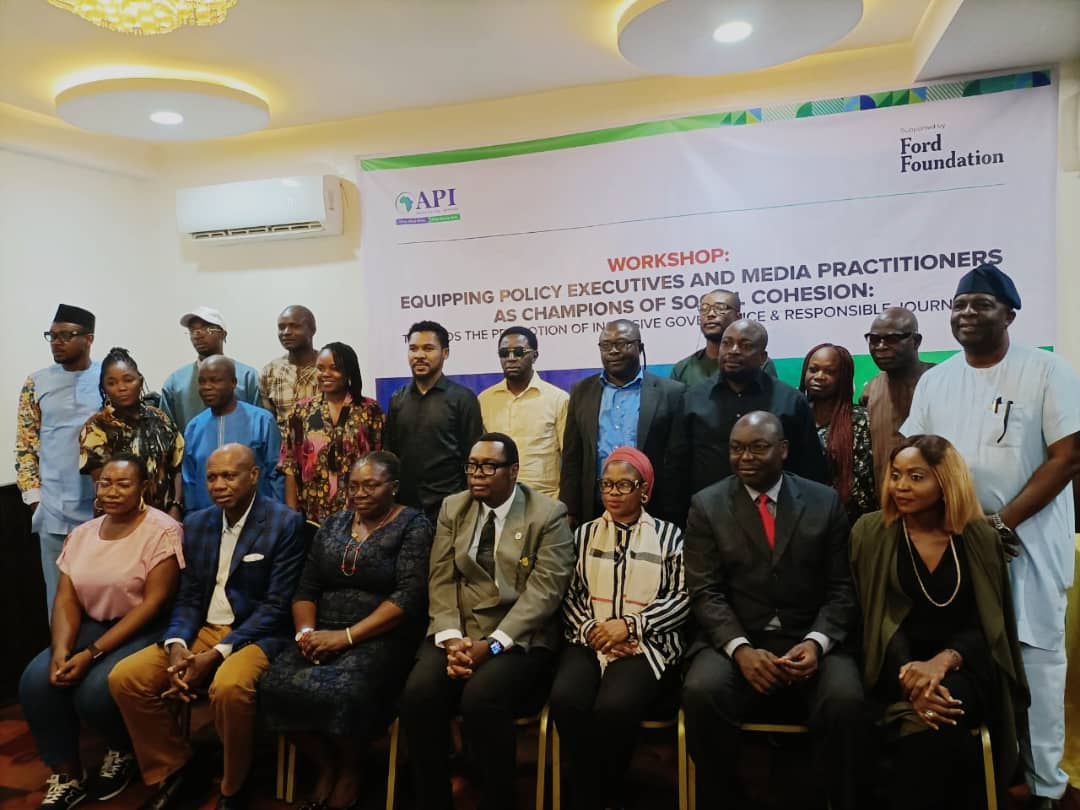
An Advocacy group, the Africa Polling Unit (API), with support from the Ford Foundation, has stressed the need to integrate social cohesion principles into policy design, implementation, and review governance processes.
The Executive Director of the Africa Polling Unit, Professor. Bell Ihua made the disclosure at a workshop held in Abuja for journalists, communication professionals, researchers, policy experts and academics, in Abuja.
The capacity-building workshop was aimed at equipping media practitioners and policy actors with the tools needed to promote social cohesion and strengthen public trust.
It was also to explore the role of the media in addressing growing social divisions, misinformation, and the decline in public confidence in governance.
According to Prof. Ihua, the approach would not only improve governance outcomes but also encourage constructive and solution-oriented storytelling within the media landscapes.
Professor Ihua also noted that many citizens increasingly feel that the social contract between the government and the people is weakening, resulting in declining trust in public institutions.
He emphasised that promoting socially cohesive reporting can help rebuild confidence among citizens while fostering greater understanding between governments and the governed.
Also speaking at the training, a Development Communication Practitioner, Mr. Diego Kenyodo, urged journalists to place humanity at the centre of their reporting.
He encouraged media professionals to go beyond official statements and government briefings by telling stories that reflect the lived experiences of ordinary people.
Mr Kenyodo further highlighted editorial independence as a critical pillar of responsible journalism, stressing the importance of maintaining professional autonomy while serving the public interest.
Similarly, a Professor of Journalism and Media Studies at Veritas University, Dr. Obiora Chukwumba, delivered a presentation on “Required Newsroom Responses to Social Cohesion Gaps in Nigeria.”
During his session, he shared what he described as uncomfortable truths about the current state of the nation and the media’s role within it.
Dr. Chukwumba argued that Nigeria may not be as resilient as many assume and warned that the media’s surveillance and accountability functions are increasingly under pressure.
He also expressed concern about narratives advocating the fragmentation of African states, suggesting that such issues are not receiving sufficient attention in media discourse.
The media scholar further pointed to what he described as a growing disconnect between storytelling and audience realities, urging journalists to ensure that their reporting reflects the genuine concerns and experiences of citizens.
“We must make scapegoats of the enemies of the country,” he said.
In her presentation, Dr Helen Emore, Researcher and Founder of Scientia Partners Innovation Hub, who spoke on navigating journalism, diversity, and pluralism in increasingly complex information environments.
Dr. Emore emphasised that responsible journalism must remain anchored in professional ethics and standards. She noted that quality reportage requires accuracy, concise storytelling, verification of facts, accountability, and a commitment to correcting errors when they occur.
According to her, journalism plays a critical role in informing citizens, fostering public debate, building communities, and holding power to account.
The workshop concluded with Dr Olusoji Adeniyi, a certified trainer and assessment specialist, calling on media practitioners to intensify efforts to combat misinformation, disinformation, stereotypes, and negative narratives that undermine social cohesion.
Participants agreed that fact-checking and verification processes do not weaken journalism but instead enhance credibility, professionalism, and public trust.
The training forms part of ongoing efforts by the Africa Polling Unit and its partners to strengthen the media’s contribution to building a more inclusive, informed, and cohesive Nigerian society.
The workshop focused on addressing challenges such as stereotypes, discrimination, misinformation, disinformation, mistrust and social exclusion.
Participants were encouraged to adopt reporting practises that strengthen national unity and amplify shared values across diverse communities.