
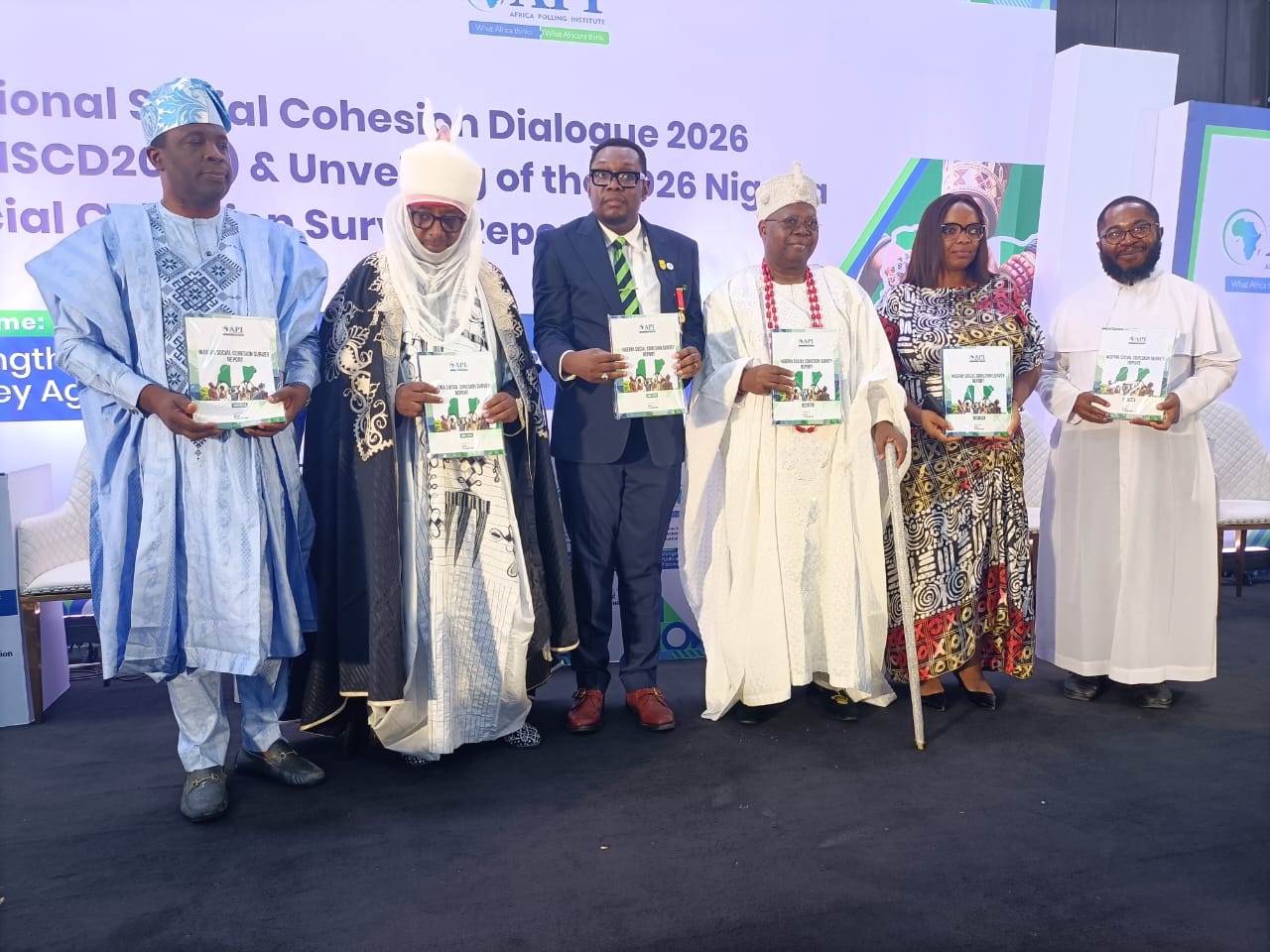
Stakeholders from government, traditional institutions, religious bodies, development organisations and academia have called for stronger collaboration in promoting national unity, peaceful coexistence and public trust.
The call was made in Abuja as the African Polling Institute (API) unveiled the 2026 Nigeria Social Cohesion Survey Report.
The event, held under the theme “Strengthening the Role of Religious and Traditional Institutions as Key Agents of Social Cohesion,” brought together traditional rulers, religious leaders, policymakers, diplomats and civil society organisations to examine the state of social cohesion in Nigeria and chart a path towards a more united nation.
The Executive Director of the African Polling Institute, Professor Bell Ihua, announced that Nigeria’s Social Cohesion Index had risen to 48.8 per cent, the highest recorded since the survey began.
READ ALSO: NITP Urges Traditional Leaders to Champion Urban Planning Reforms
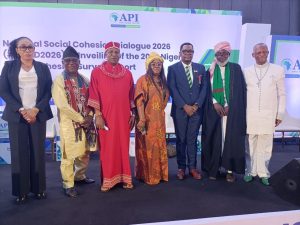
According to him, one of the most significant findings was that, for the first time, a majority of respondents identified themselves primarily as Nigerians rather than by their ethnic, religious or regional identities.
“The 2026 Nigeria Social Cohesion Index has been computed at 48.8 per cent. More importantly, for the first time since the survey began, the majority of respondents identified primarily as Nigerians before identifying with their ethnic, religious or regional groups,” Ihua noted.
Gradual Progress
He however stated that while the report reflects gradual progress in strengthening national identity, public trust in government institutions remains low, reinforcing the need to engage institutions that continue to command citizen’s confidence.
Speaking on behalf of the Regional Director of the Ford Foundation, Dr. Catherine Aniagolu-Okoye, the Grant Officer Onyinye Onyemobi described Nigeria’s diversity as one of its greatest strengths but stressed that it requires deliberate leadership and collaboration to preserve.
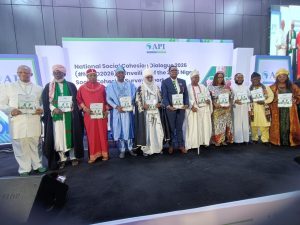
“The Ford Foundation acknowledges that Nigeria’s inherent diversity represents one of its most profound national strengths. However, strategic leadership is required to cultivate trust, mutual understanding and harmonious coexistence,” she highlighted.
Onyemobi noted that traditional and religious leaders occupy influential positions beyond their cultural and spiritual responsibilities.
“Traditional rulers and religious leaders possess the unique capacity to guide communities beyond ethnic and religious divisions by emphasising our shared humanity and collective obligation towards Nigeria’s future and prosperity,” she stated.
She also explained that the Foundation has consistently worked with faith and traditional institutions, citing its conference on gender-based violence earlier in the year as evidence of its commitment to community-based solutions.
The Ogoga of Ikere-Ekiti, and Chairman of the Ekiti State Council of Traditional Rulers, Oba Samuel Adejimi Adu Alagbado, as the royal father of the day, called for renewed recognition of traditional institutions, arguing that they remain indispensable in maintaining peace and resolving conflicts at the grassroots.
Constitutional Relevance
Reflecting on Nigeria’s political evolution, the monarch lamented that traditional rulers had gradually lost the constitutional relevance they once enjoyed.
“Traditional rulers have been emasculated and seriously relegated. Yet today, in the current situation of insecurity, where do people run to? It is the palace,” he said.
The Monarch maintained that traditional rulers continue to serve as trusted mediators within their communities.
“The people trust their traditional rulers just like a baby runs to its mother. Palaces remain centres for alternative dispute resolution, community peace and social stability,” the monarch stated.
He urged researchers and policymakers to examine the historical decline of traditional institutions and consider assigning them clearer constitutional responsibilities in governance and community development.
Delivering the keynote address on behalf of the Archbishop of the Catholic Archdiocese of Abuja, Most Reverend Dr. Ignatius Ayau Kaigama, Reverend Father Dr. Emmanuel Unamba, said the declining public trust in government presents an opportunity for religious and traditional institutions to strengthen national unity, given the confidence Nigerians continue to place in them.
Speaking on the topic “We All Bleed Red,” Unamba stressed that Nigerians share a common humanity and should place national interest above ethnic or religious identities.
“It is a danger when you prioritise your private identity over the national identity. This does not mean you should delete your tribal or ethnic identity, but do not place it above national cohesion,” he emphasised.
Greater Recognition
The Clergy urged government to accord greater recognition to religious and traditional institutions.
He addedthat these institutions remain vital partners in promoting peace, security and social cohesion because of their strong presence at the grassroots.
The Emir of Kano, His Highness, Muhammadu Sanusi II (Sanusi Lamido Sanusi), re-presented by the Falakin Kano, Alhaji Mukhtar Ibrahim Bello, described the dialogue as timely, especially as Nigeria grapples with security, economic and social challenges.
He commended the African Polling Institute for producing evidence-based research capable of informing national policy.
“The findings consistently show that religious and traditional institutions continue to enjoy a high level of public trust across communities. This confidence reposed in us is both an honour and a responsibility,” he explained.
According to him, traditional and religious institutions must continue to serve as “beacons of hope, justice, wisdom and reconciliation.
“As leaders entrusted with the confidence of our people, we must champion tolerance, inclusiveness, compassion, justice and respect for human dignity while discouraging every form of division, extremism, hate speech and discrimination,” Sanusi noted.
The event also featured a thought-provoking presentation by renowned poet and public intellectual, Dike Chukwumerije, who challenged Nigerians to rethink the historical narratives that continue to deepen ethnic divisions.
Using history, geography and poetry, Chukwumerije argued that openness and integration, rather than exclusion, have always defined the Nigerian space.
“Our division is our weakness. It is the unlatched back door through which the colonial interloper walked in,” he said.
He argued that many of the rigid ethnic identities embraced today were products of colonial narratives designed to divide Nigerians.
According to the Poet, “If Boko Haram was developing in Maiduguri and people elsewhere said it was not their business, or kidnapping was developing in Port Harcourt and others looked away, history has shown that crises do not respect artificial boundaries.”
He stated that Nigeria’s shared history should inspire greater unity rather than deepen division.
“Our ancestors were far more open and accepting than we are today. Historically and geographically, this is open country. Our future depends on rediscovering that shared identity,” he concluded.
Participants at the dialogue agreed that while the latest survey indicates encouraging improvements in social cohesion, sustaining the gains would require stronger partnerships between government, traditional rulers, religious leaders, civil society organisations and citizens.
They expressed optimism that the recommendations from the dialogue would contribute to policies and initiatives aimed at strengthening national unity, rebuilding public trust and fostering lasting peace across Nigeria.

