


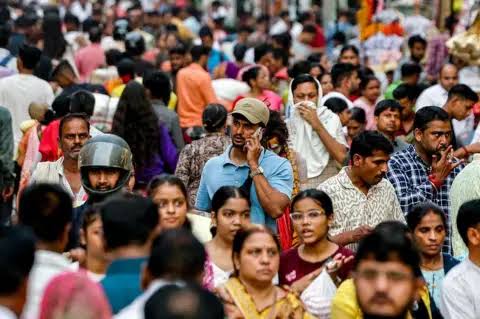
India on Wednesday began the 2026 National Population and Housing Census with three million officials to count over one billion people across the country, making it the first population headcount in more than 15 years.
The 2026 National Population and Housing Census is a two-phase exercise, billed as the world’s most ambitious of its kind, with more than three million officials to spend a year counting every person in India.
In these areas, self-enumeration will run from 1 to 15 April, followed by a house listing and housing survey between 16 April and 15 May.
According to the United Nations Population Fund, UNFPA, India is expected to overtake China in 2023 in terms of population, with more than 1.4 billion people.
The exercise has been described as “Billion-plus people” Census with 33 questions will span 36 states and federally-administered territories, more than 7,000 sub-districts, over 9,700 towns and nearly 640,000 villages, with fieldwork carried out by enumerators and supervisors – typically schoolteachers, government staff and local officials.
For the first time, the census will be conducted digitally, with enumerators using mobile apps to collect and upload data.
Authorities have introduced self-enumeration, letting residents submit details online via a 16-language portal that generates a unique ID for verification by census workers.
There will be two phases of physical door-to-door surveys.
The first phase, known as the House Listing and Housing Census, will gather information on housing conditions, amenities and household assets.
The second phase – population enumeration – is scheduled for February 2027 and will collect detailed data on demographics, education, migration and fertility.
It will also include caste enumeration, a politically sensitive issue that has long been debated.
India’s 16th census – the eighth since independence in 1947 – will also include caste data and is seen as crucial for policy, welfare delivery and political representation in the world’s most populous country.
With more than 1.4 billion people, India overtook China in 2023, according to the United Nations Population Fund.
Yet, falling fertility and a median age of 28 mean it remains one of the world’s youngest countries, with nearly 70% of its population of working age.
The last census was held in 2011, with the 2021 round delayed by the pandemic and later pushed back further due to administrative and electoral scheduling – the first time the decennial exercise missed its schedule.
From its origins as a rudimentary headcount under colonial rule, India’s census questionnaire has steadily expanded in scope, mirroring the state’s changing priorities.
The first attempt in 1872 contained 17 questions and was essentially a house register – recording who lived where, along with basic markers such as age, religion, caste and occupation.
By 1881, when the first synchronous nationwide census was conducted, the template had stabilised around identity (name, gender, marital status), social markers (caste, religion, language) and rudimentary education and disability categories.
Over the next decades, questions on language, literacy and occupation were refined, adding secondary work and dependency details.
English proficiency – a colonial preoccupation – was one of 16 questions in the 1901 census.
A shift began with the 1941 census, when its 22-question schedule moved from “who you are” to also “how you live”.
Fertility, employment status, economic dependency, migration and job search entered the frame, signalling a growing administrative focus on economic behaviour.
After independence, this widened further: the 1951 and 1961 rounds incorporated nationality, displacement (in the shadow of Partition), land ownership and more work categories.
From the 1970s onwards, the census took on a distinctly socio-economic lens.