

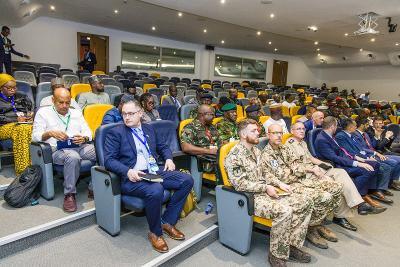
International partners have reaffirmed their support for Nigeria’s efforts to strengthen its national response to the threat posed by improvised explosive devices (IEDs), as security stakeholders gathered in Abuja for the Counter-IED Baseline Assessment Workshop.
The commitment was highlighted during remarks delivered by representatives of the United Nations Mine Action Service (UNMAS) and the British High Commission at the National Counter Terrorism Centre (NCTC), where participants from Nigeria’s military, law enforcement, and security agencies are undertaking a multi-agency assessment of the country’s counter-IED capabilities.
Speaking at the workshop, the UNMAS representative, Edwin Faigmane, explained that “the United Nations continues to support member states in mitigating the threat posed by improvised explosive devices to civilians, security personnel and critical infrastructure.”
Also Read: UK, Germany Pledge Support for Nigeria’s Counter-Terrorism Drive
According to him, “UNMAS, as the global focal point for mine action within the United Nations system, works with national authorities to develop IED threat mitigation strategies and build sustainable national counter-IED capacities aligned with international standards.”
Faigmane disclosed that “the current workshop forms part of a broader international support programme that began in 2024 with an operational assessment of the explosive ordnance disposal capabilities of the Nigeria Police Force.”
He added that the initiative subsequently led to specialised training programmes for officers of the Nigeria Police Force and the Nigeria Security and Civil Defence Corps, enabling them “to deliver explosive hazard risk education in vulnerable communities.”
He further noted that additional training supported by the governments of the United Kingdom and Japan in 2025 “expanded Nigeria’s pool of trained personnel in explosive hazard awareness, search operations, conventional munitions disposal and improvised explosive device disposal.” As a result, he said, “Nigeria now has 15 qualified IED and conventional munitions disposal officers as well as 25 trained search specialists within its security architecture.”
Faigmane added that “with the arrival of new operational equipment expected in 2026, Nigerian authorities will be able to establish dedicated search teams and specialised IED disposal units within the Nigeria Police Force and the Nigeria Security and Civil Defence Corps.”
He emphasised the importance of deploying trained personnel effectively and encouraged “closer operational coordination among security institutions, including potential joint operations with the military where appropriate.”
He also revealed that “ongoing collaboration with Nigerian authorities will include a review of operational standard operating procedures, mentoring of newly established teams and support for improvements to the Nigeria Police Force explosive ordnance disposal training curriculum.”
The representative of the British High Commission, Mr Annup Vyas, stated that “the United Kingdom remains committed to supporting Nigeria’s counter-IED efforts under the UK–Nigeria Security and Defence Partnership.”
He noted that “improvised explosive devices continue to pose a serious threat to lives, communities and national stability, affecting both civilians and security forces while undermining critical infrastructure and economic recovery in affected areas.”
According to him, “addressing the challenge requires more than resources and determination,” stressing that “a successful response must be based on a clear understanding of existing capabilities, institutional gaps and priority areas for improvement.”
Pvious explained that “the Counter-IED capability maturity self-assessment framework being used during the workshop provides Nigeria with a structured methodology for evaluating its preparedness across key areas including prevention, detection, mitigation, investigation and consequence management.”
He emphasised that “the exercise is not intended as a procedural formality but rather as an opportunity for security institutions to undertake an honest assessment of their systems and coordination mechanisms in order to strengthen the country’s overall counter-IED architecture.”
The British High Commission representative also acknowledged the technical contributions of UNMAS and other international partners, noting that “the findings from the workshop are expected to guide future investments in training, coordination frameworks and operational capacity across Nigeria’s counter-IED ecosystem.”
Participants at the workshop were encouraged to provide candid inputs and share operational insights that “will help shape practical recommendations for strengthening Nigeria’s ability to prevent, detect and respond to improvised explosive device threats.”
The engagement forms part of broader national and international efforts aimed at “enhancing Nigeria’s multi-agency counter-terrorism framework while protecting communities and strengthening institutional capacity to confront evolving security threats.”