

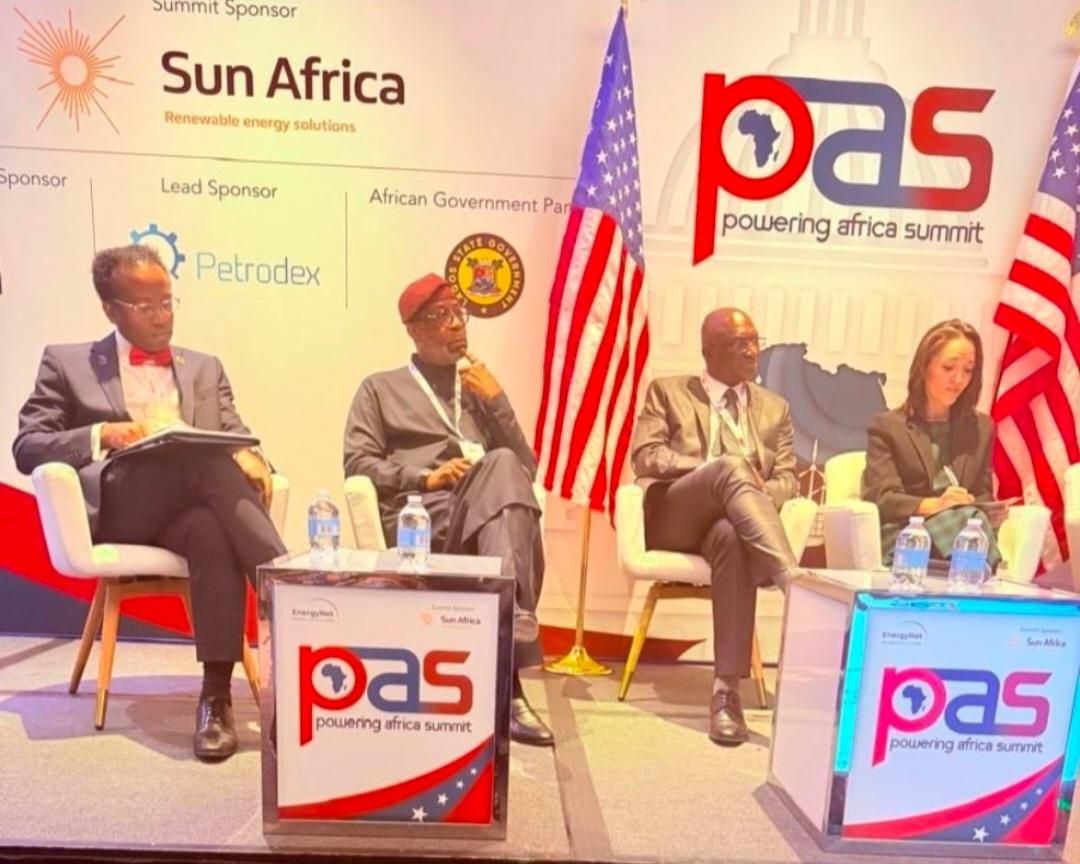
The Minister of Solid Minerals Development, Dele Alake, has called on the United States and African countries to prioritise the creation of regional energy hubs as a key strategy to boost cross-border mining industrialisation and strengthen supply chains for critical minerals.
Alake made the call while speaking at a high-level panel titled “Critical Minerals in Africa: Meeting Global Demand” at the ongoing Powering Africa Summit in Washington, D.C., United States.
He stressed that sustainable partnerships with Africa remain the fastest route to meeting growing global demand for critical minerals.
The minister advocated the development of regional industrial corridors similar to the Lobito Corridor, citing the Lagos–Abidjan corridor—linking Nigeria, Benin, Togo, Ghana, and Côte d’Ivoire and the Walvis Bay Corridor as viable models to unlock Africa’s vast mineral resources.
According to him, such corridors would act as economic catalysts by driving infrastructure development, improving energy access, and promoting regional integration across the continent.
“The development of nuclear power in one West African country, for instance, can service an entire corridor. With that in place, local beneficiation, technology transfer, manufacturing, and cross-border industrialization will naturally follow,” Alake said, noting that establishing three to five such corridors could significantly accelerate Africa’s industrialisation.
Highlighting reforms under the administration of President Bola Tinubu, the minister said improved governance, regulatory frameworks, and digitiaed licensing processes have repositioned Nigeria’s mining sector as a viable driver of economic diversification.
He added that recent reforms now guarantee secure tenure for mineral title holders, providing long-term stability for investors. The government is also expanding the generation of certified geological data to support informed investment decisions.
On security, Alake acknowledged existing challenges but pointed to progress made through the establishment of Mining Marshals. He disclosed that over 350 suspected illegal miners, including foreign nationals, have been arrested within the past year, with more than 150 currently facing prosecution.
Reaffirming Nigeria’s openness to investors, the minister emphasised strict adherence to local laws while outlining incentives such as tax waivers on imported mining equipment and full repatriation of profits after due payments.
“We have successfully de-risked and sanitised the mining environment, making it conducive to Foreign Direct Investment. Within the last two and a half years, we have attracted over $2.6 billion in FDI into the sector,” he said.
Also speaking, the Senior Vice President and Global Head of Origination at the Export-Import Bank of the United States, Sarah Whitten noted the importance of sustained collaboration and policy continuity in unlocking financing for critical minerals projects.
She said that while American banks are ready to support projects, their role is largely to catalyse private sector capital and facilitate long-term investment in the sector.