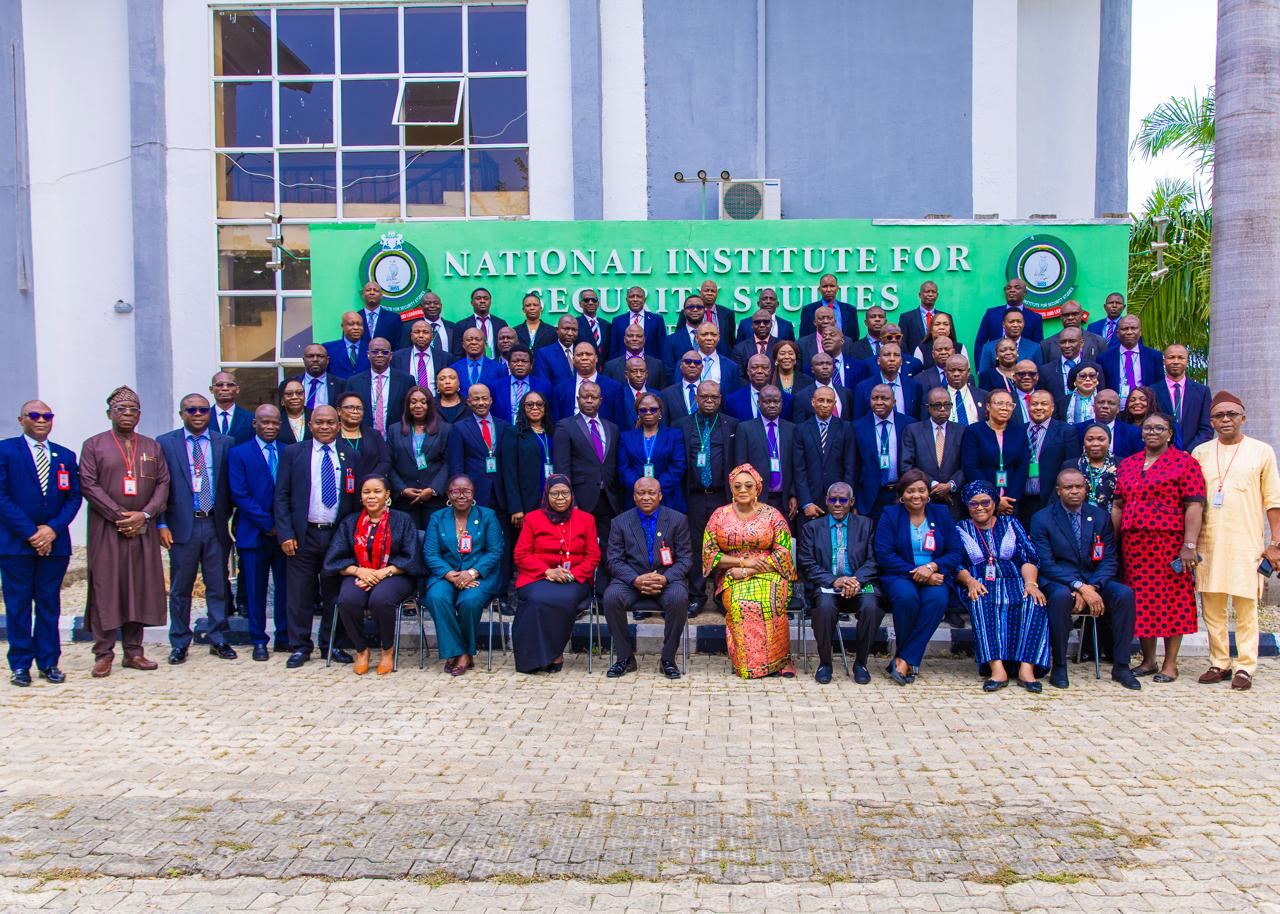
The Minister of Women Affairs and Social Development, Hajiya Imaan Sulaiman-Ibrahim, has called for intelligence-driven and gender-responsive security strategies across Africa, warning that responses excluding women and girls would continue to undermine regional stability.
Delivering a lecture at the Executive Intelligence Management Course 19 at the National Institute for Security Studies in Abuja, the Minister described ethnic militias, resource competition and gender inequality as “structurally interconnected components of a single system of insecurity.
“Understanding that interconnection is not an academic exercise. It is a prerequisite for designing security responses that actually work.” she said.
READ ALSO: Women Affairs Minister Makes Digital Library Endowment To NSUK
The Minister, also a fellow of the Institute noted that violent conflicts across Africa were increasingly driven by economic and ecological stress, weak institutions and competition over shrinking resources.
“The violence in the Sahel is not primarily about ethnicity. It is about ecological collapse, institutional failure, and the absence of legitimate mechanisms for managing competing claims over resources. Ethnicity is the vocabulary of the conflict, not its cause,” she stated.
Intelligence Operations
Addressing intelligence and security professionals, Sulaiman-Ibrahim urged agencies to strengthen inter-agency data coordination, cohesion, female participation within intelligence operations and integrate gender analysis into all-source intelligence assessments.
“Investing in the recruitment, training, and operational integration of female intelligence collectors is not a diversity exercise. It is a capability investment,” she said.
Transboundry Gender Intelligence Networks
The Minister also called for the establishment of transboundary gender intelligence networks to tackle trafficking, sexual violence and the cross-border logistics systems sustaining armed groups.
According to the Minister, “the gender dimensions of militia and resource conflict are transboundary phenomena that require transboundary intelligence cooperation.”
She also stressed that women should no longer be viewed solely as victims in conflict environments.
“Women are not only the victims of militia violence. They are, in multiple and complex ways, participants in it,” she said, noting that women serve as combatants, recruiters, intelligence gatherers and logisticians within armed group ecosystems.
The Minister cited data from the Armed Conflict Location and Event Data Project indicating that Africa recorded over 21,000 violent incidents involving non-state actors in 2022, while Nigeria recorded more than 6,700 conflict-related deaths within the same period.
On displacement, she said women and children account for about 60 to 65 per cent of Africa’s internally displaced population, warning that insecurity continues to expose them to gender-based violence, exploitation and economic exclusion.
The Minister further urged security institutions to review disarmament, demobilisation and reintegration programmes to ensure women associated with armed groups were not excluded from rehabilitation and reintegration opportunities.
On Nigeria’s regional obligations, she said the country must champion governance frameworks capable of reducing the structural drivers of militia formation across Africa.
“Nigeria should be the leading voice in regional fora for the integration of gender into peace and security architecture, not as a concession to international pressure, but because the evidence shows it produces better security outcomes,” she said.
Conflict Prevention
Minister Sulaiman-Ibrahim maintained that women remained disproportionately affected by insecurity while also constituting an under-utilised resource in conflict prevention and peacebuilding.
“The evidence I have presented today is not ambiguous. Women are disproportionately harmed by militia violence and resource conflict. Women are also structurally excluded from the governance mechanisms that could prevent and resolve it,” she stated.
Sueiman-Ibrahim warned that security responses lacking gender inclusion would remain ineffective.
“Responses that are gender-blind are not sophisticated. They are incomplete. And incomplete security responses do not produce security,” the Minister said.
The lecture titled “Ethnic Militias, Resource Competition And Gender In Africa: Implications For Regional Security” was attended by management, faculty and participants of Executive Intelligence Management Course 19.