


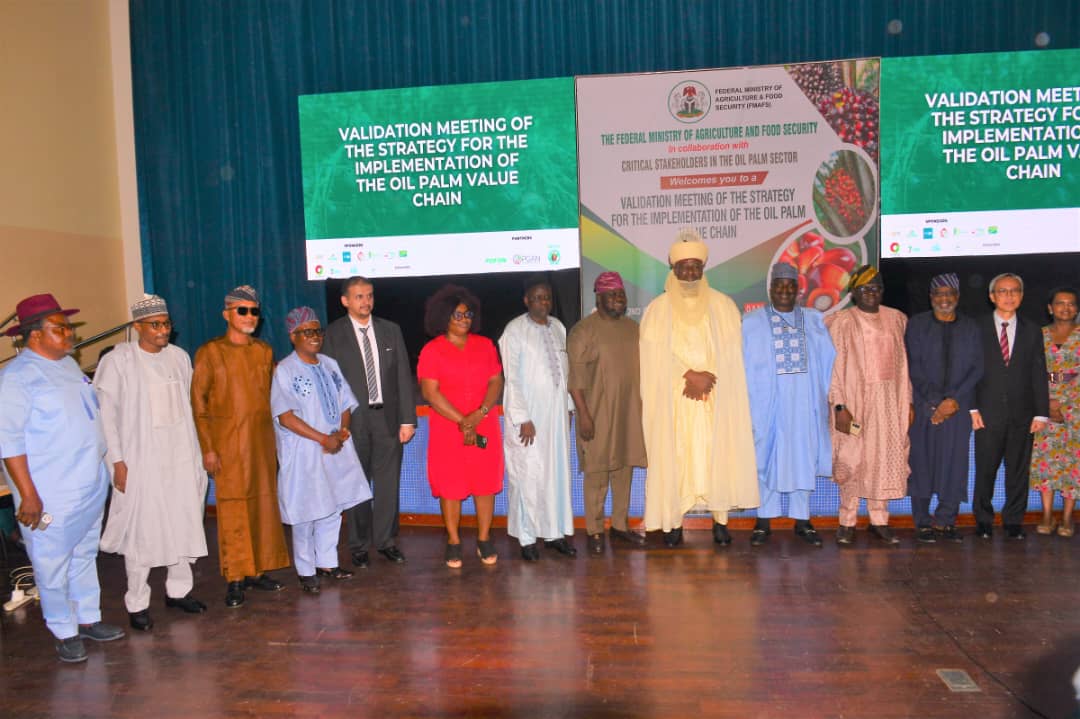
The Federal Ministry of Agriculture and Food Security (FMAFS), in collaboration with relevant stakeholders in the oil palm subsector, has convened a validation meeting aimed at repositioning the Nigerian oil palm industry for food security, rural transformation, industrial growth, job creation, and export diversification.
Speaking during the Nigerian Oil Palm Development Strategy Validation Meeting held in Abuja, Nigeria, the Minister of State for Agriculture and Food Security, Sen. Dr. Aliyu Sabi Abdullahi, said revitalising the oil palm subsector will not only lift about two million Nigerians out of poverty in the next six years but also enable the country to capture at least 10% of the global oil palm market.
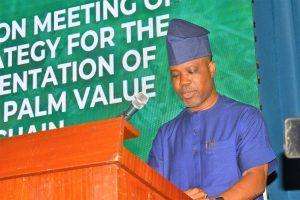
Sen. Abdullahi said that “the oil palm is an industrial raw material that connects agriculture to manufacturing, supports food systems and value addition. It supplies inputs for edible oil, soap, cosmetics, pharmaceuticals, animal feed, and many other industrial uses.”
He pointed out that “revitalising the oil palm sector is not only an agricultural priority, it is also an economic and industrial priority. If we get it right, oil palm can help Nigeria reduce import dependence, improve domestic edible oil supply, create jobs, support smallholder incomes, strengthen agro-industrial development, and increase export earnings.”
The Minister added that “the objective is to restore productivity and competitiveness in a way that’s inclusive, environmentally responsible, and economically transformative, moving from aspiration to action.”
He lamented Nigeria’s lost glory as one of the leading producers of palm oil in the world, noting that before the rise of petroleum, oil palm sustained livelihoods, drove commerce, supported local industries, and contributed to national revenue.
Senator Aliyu expressed confidence that with Nigeria’s vast land, good climate, market demand, industrial need, and opportunities, the country can reclaim its position in the sector.
According to him, “What is required now is vision, discipline, and action. President Bola Ahmed Tinubu’s prioritisation of Agriculture under the Renewed Hope Agenda is not merely an agricultural ambition, but it is a national economic development agenda.”
The Minister disclosed that “today is not just about validating a document. It is about shaping the future of one of Nigeria’s most strategic agricultural commodities. It is about agreeing on a clear path forward. It is about ensuring that the Oil Palm Sector once again takes its rightful place in our national development story.”
He therefore called for a coordinated national approach to unlock the oil palm industry’s full potential, citing needs like improved productivity, modernised processing, and enhanced sustainability.
The Minister further stressed the need to empower smallholder farmers with technical training, improved seedlings, climate-resilient planting materials, extension services, and access to finance, calling for investment in modern processing technologies and quality assurance systems to improve value addition and reduce losses.
He underscored the importance of international cooperation, announcing Nigeria’s participation as an observer country in the Council of Palm Oil Producing Countries (CPOPC), and emphasised commitment to responsibly grown and sustainably processed palm oil.

In his welcome address, the Permanent Secretary, FMAFS, Dr. Marcus Olaniyi Ogunbiyi stated that the process of setting up a Technical Working Group (TWG) to develop a strategy for Nigeria’s Oil Palm growth was initiated following directives of the Hon. Minister of State in 2024.
He added that the ministry ensured broad-based participation, involving relevant departments, the Nigerian Institute for Oil Palm Research (NIFOR), commodity associations, government organisations, and private sector actors to identify gaps and recommend policy actions.
He revealed that “this multi-stakeholder approach reflects our recognition that the transformation of the Oil Palm sector requires collective ownership, technical depth, and strong institutional collaboration.”
Ogunbiyi commended stakeholders for their contributions and called on participants to brainstorm, ensuring the final document serves as a roadmap for the transformation of the Oil Palm Industry in Nigeria
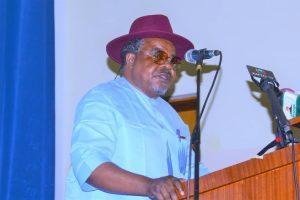
In his Goodwill Message, the Chairman of the Oil Palm Growers Association of Nigeria, (OPGAN), Chief Onyuike said that ‘Nigeria’s decline from about 40 percent global dominance to roughly two percent reflects structural failures, particularly weak coordination and inconsistent policy execution.’ ’.
He emphasised that smallholders, who represent about 80 percent of the sector, must be central to implementation, warning that excluding primary producers from decision-making would stall progress.

During his vote of thanks, Director, Department of Planning and Policy Coordination, Ibrahim Tanimu lauded stakeholders’ commitment to the strategy’s development, emphasising that the task ahead lies in translating every key recommendation, policy direction, investment priority, and implementation framework into action.