
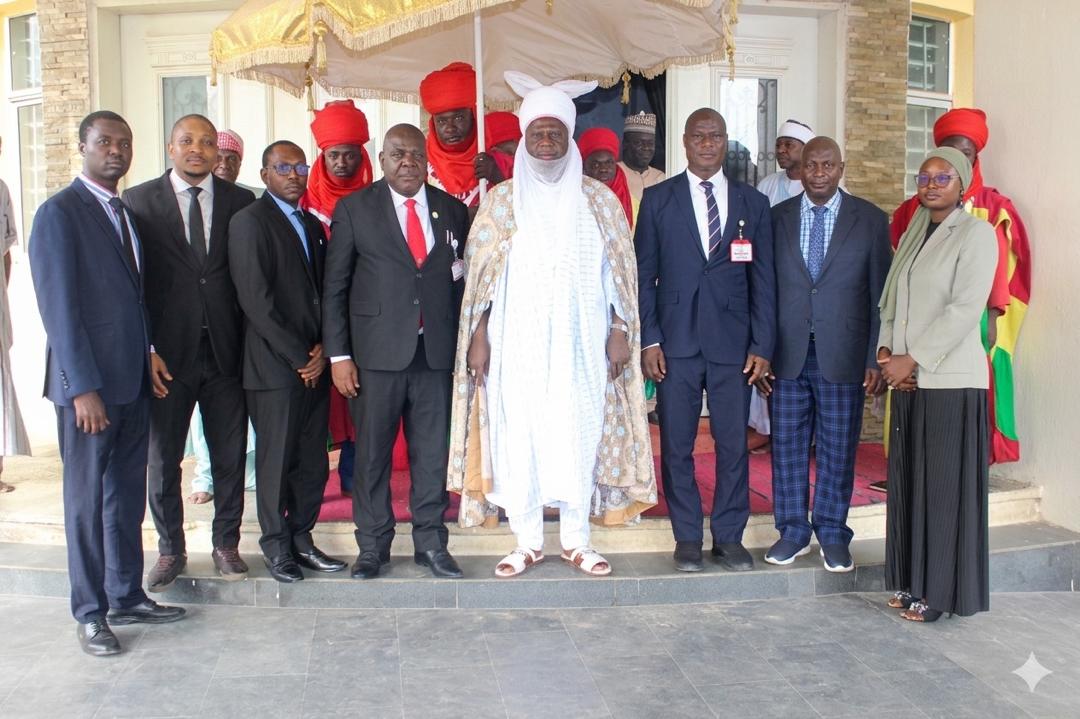
The National Centre for the Control of Small Arms and Light Weapons (NCCSALW) has strengthened collaboration with the Minna Emirate to tackle the growing threat of illicit small arms and light weapons in Niger State, North Central Nigeria.
This formed the focus of a sensitisation and courtesy visit by the North Central Zonal Director of the Centre, Abdul Adamu Eneche, who led his management team to the palace of the Emir of Minna, Umar Faruq Bahago.
The visit aimed to deepen cooperation and raise awareness about the dangers posed by the proliferation of illegal weapons across Niger State and the North Central region.
Speaking during the meeting, Eneche conveyed goodwill from the Centre’s Director General, Johnson Babatunde Kokumo.
He explained that the Centre was established through a Presidential Executive Order in 2021 and later backed by law in 2024 to regulate and control small arms and light weapons in Nigeria.
Eneche said that the Centre operates under the Office of the National Security Adviser.
READ ALSO: Niger State Boosts Security Through Intelligence, Technology
The Zonal Director identified key security challenges facing the country, including terrorism, insurgency, banditry, kidnapping, farmer-herder clashes, and communal conflicts. He stressed that the widespread availability of illegal weapons continues to fuel these threats.
According to Eneche, earlier efforts to address the problem were weakened by poor coordination, which led to the establishment of the Centre as a more structured and unified body to handle the challenge effectively.
He also highlighted the critical role of traditional institutions in intelligence gathering.
Eneche urged the Emir and other traditional leaders to use their closeness to the people to report suspicious activities and the presence of illegal arms.
He said that “the Centre collaborates with security agencies, conducts public sensitisation, and maintains a national database on small arms.”
Eneche further noted that “illegal weapons enter the country through porous borders and are also produced locally by illicit blacksmiths, whose activities are becoming more advanced.”
In his response, the Emir of Minna described the partnership as timely and necessary.
He emphasised that addressing the spread of illegal arms requires strong collaboration with traditional rulers, who are deeply connected to their communities.
The Emir expressed concern over the increasing presence of illegal weapons in his domain and commended the Centre for its efforts.
He pledged full support to NCCSALW through public awareness campaigns, reporting of suspicious activities, and discouraging the local production and misuse of arms.


 has strengthened collaboration with the Minna Emirate to)