The Minister of Women Affairs and Social Development, Hajiya Imaan Sulaiman-Ibrahim has reaffirmed Nigeria’s commitment to strengthening access to justice for vulnerable groups, stating that justice must be evaluated by its impact on those most at risk.
Speaking at the 2026 High-Level IHL Dialogue, organised by the Federal Ministry of Justice and the National Committee for the Implementation of International Humanitarian Law Treaties in Nigeria, themed “Complementarity: Threshold and Outcomes,” in Abuja she declared that “justice is not abstract; it is measured by reach,” emphasising that it must be accessible “swiftly, safely, and without fear.”
Addressing the theme, the Minister stressed that justice must go beyond theory, noting that “our discourse transcends legal theory; it becomes a moral and national imperative.”
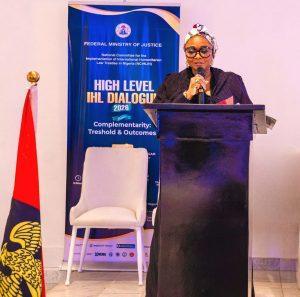
Sulaiman-Ibrahim commended the Attorney-General of the Federation for convening the forum, describing it as a strategic platform to “bridge the gap between legal frameworks and lived realities.”
Highlighting legislative milestones, the Minister said all 36 states have domesticated the Child Rights Act, while 35 states have adopted the Violence Against Persons Prohibition Act.
Despite this progress, she cautioned that “domestication represents only the first threshold; implementation remains the true test of justice.”
The Minister linked ongoing reforms to the Renewed Hope Agenda, aimed at ensuring laws are “responsive, enforceable, and impactful at the grassroots level.”
She also referenced the designation of 2026 as the Year of Family and Social Development, noting that “the family is the primary unit of protection, resilience, and social stability.”
On access gaps, the Minister disclosed that Nigeria has about 50 Sexual Assault Referral Centres nationwide, stressing that “the gap is significant, and the response must be deliberate and urgent,” as expanding such centres “is not optional; it is essential.”
She further noted that outcomes from the 70th Session of the Commission on the Status of Women reaffirm that “justice must move beyond normative commitments to measurable outcomes.”
Emphasising coordination, she stated that “complementarity must ensure that national legislation… function in seamless coordination,” adding that “no survivor should be lost between systems.”
The Minister concluded that Nigeria remains committed to building a justice system that is “accessible, trusted, and effective,” however, “if justice does not protect the weakest, it has failed its purpose.”
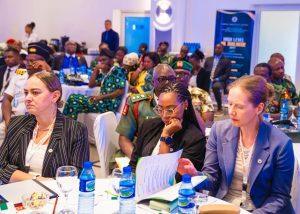
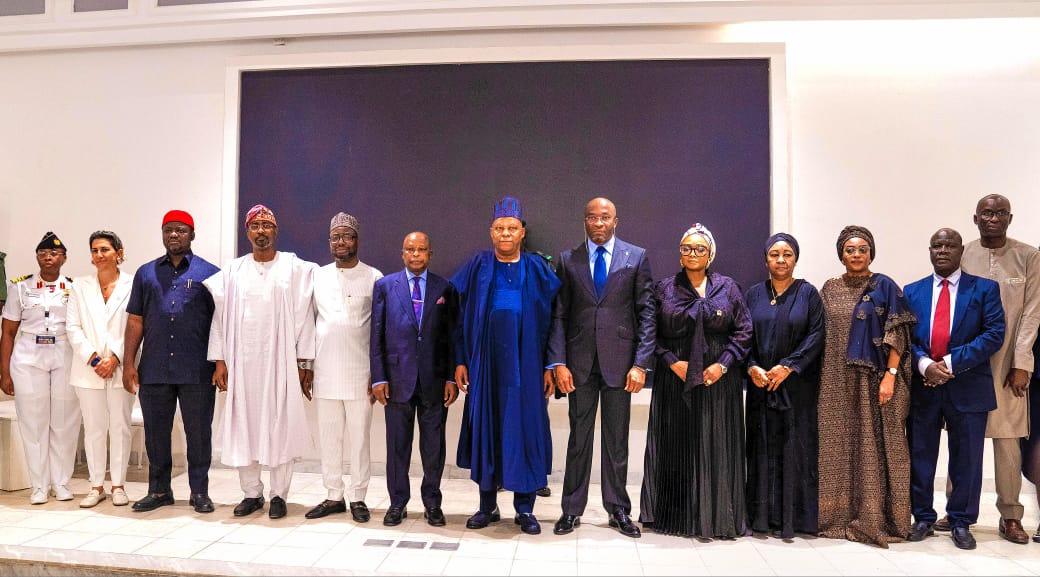
Dignitaries at the dialogue included the Vice President Kashim Shettima, Deputy Speaker House of Representatives, Benjamin Kalu, Minister of Justice, Lateef Fagbemi, Security Agencies, Development partners amongst others.