

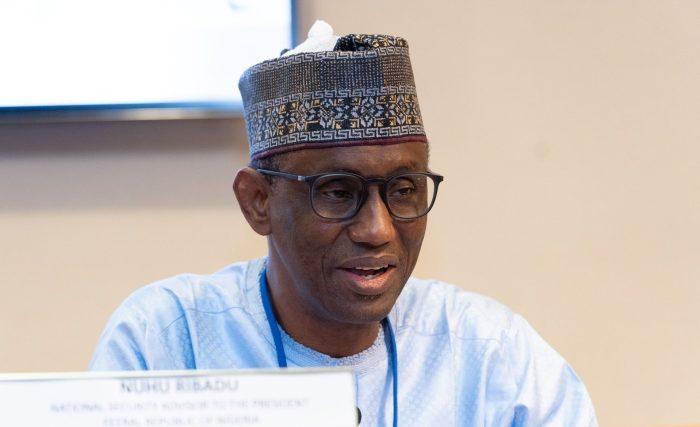
Nigeria’s National Security Adviser, Mallam Nuhu Ribadu, has declared that the nation’s security partnership with the United States has moved decisively beyond dialogue into measurable operational impact, with counter-terrorism cooperation now delivering tangible results across multiple theatres of operation.
He made the assertion on Thursday while delivering opening remarks at a Nigeria–United States Working Group engagement in Abuja.
Ribadu described the meeting as the third high-level engagement with senior U.S. government officials since November 2025, noting that the engagements reflect a maturing strategic relationship grounded in trust, candour, and shared responsibility.
He stressed that Nigeria views the Working Group as a practical problem-solving platform rather than a compliance mechanism, aimed at aligning priorities, addressing concerns, and consolidating gains already recorded.
According to Mallam Ribadu, intensified cooperation since November has translated into enhanced intelligence sharing, closer coordination between U.S. AFRICOM and Nigeria’s Defence Headquarters, and improved operational effectiveness across the North East under Operation HADIN KAI, as well as the North West and North Central under Operation FANSAN YAMMA.
“These engagements have moved decisively beyond dialogue to action,” he said.
He added that the collaboration has strengthened target identification, joint planning, and operational fidelity, resulting in the neutralisation of hundreds of terrorists, the destruction of logistics hubs, and the interception of key facilitators and logisticians.
Ribadu also acknowledged U.S. commitments towards the delivery of outstanding military platforms, including drones, helicopters, spare parts, and support systems, as well as the provision of surplus defence equipment, noting that all cooperation has respected Nigeria’s sovereignty and prioritised civilian protection.
At the national level, the NSA said President Bola Ahmed Tinubu has taken deliberate steps to confront insecurity, including declaring security emergencies in vulnerable areas, authorising intensified joint operations, and directing sustained deployments to communities facing recurrent attacks on civilians and religious groups.
Also Read: AU Pledges Collaboration with Nigeria on Peace, Counter-Terrorism
He disclosed that Nigeria is expanding early-warning and rapid-response mechanisms and developing a national database to serve as a single authoritative source of verifiable data on deaths and casualties arising from violence, to strengthen accountability and evidence-based decision-making.
Mallam Ribadu emphasised that Nigeria’s plural identity makes the protection of Christians, Muslims, and citizens of all beliefs non-negotiable, adding that violence framed along religious lines is treated as an attack on the Nigerian state itself.
“Violence framed along religious lines is treated as an attack on the Nigerian state itself,” he said.
He urged that Nigeria’s security efforts be assessed based on institutional capacity, direction of travel, and decisions taken at the highest level, rather than isolated incidents within a complex operating environment.
Beyond security, Ribadu noted that Nigeria–U.S. relations also encompass democratic resilience, the rule of law, and regional stability, warning against extremist and malign actors exploiting governance gaps.
The NSA welcomed frank dialogue at the Working Group and reaffirmed Nigeria’s commitment to delivering credible security, justice, and lasting protection for all communities, while expressing appreciation to U.S. leadership, congressional delegations, and the U.S. Mission in Nigeria for sustained engagement.
The United States Under Secretary for Political Affairs, Allison Hooker, while delivering her address during the U.S.–Nigeria Working Group, urged Nigeria to take stronger and sustained action to protect communities, as both countries deepen security cooperation against terrorism and insecurity.
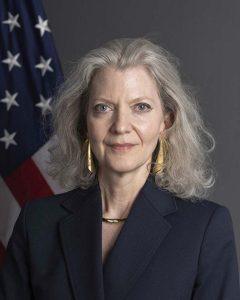
The Under Secretary said advancing religious freedom and security would strengthen broader bilateral cooperation, including economic partnerships, counter-terrorism efforts, and public health collaboration.
Hooker recalled that on 31 October 2025, the United States designated Nigeria as a Country of Particular Concern, noting that the decision had since led to closer cooperation aimed at protecting vulnerable communities across the country.
She said the U.S.–Nigeria partnership remains grounded in shared interests spanning trade, investment, energy, security, and regional stability, stressing that religious freedom is now a central pillar of that engagement.
“Today, we are here to discuss how we can work together to deter violence against Christian communities; prioritising countering terrorism and insecurity; investigating attacks and holding perpetrators accountable,” she said.
Hooker acknowledged Nigeria’s cooperation in degrading terrorist capabilities, including coordinated airstrikes carried out on 25 December, which she said were closely planned with Nigerian authorities.
She pointed to recent developments as evidence of progress, including the recruitment of 20,000 additional police officers for deployment to vulnerable areas, the arraignment of suspects linked to a June massacre in Benue State, and the arrest of individuals allegedly fleeing Sokoto State following December operations.
“This real progress is a direct result of our engagement with the Nigerian government,” she said.
She urged local government authorities to work closely with non-governmental organisations to support victims’ families and communities affected by attacks.
Hooker added that discussions would also focus on returning internally displaced persons to their communities in North Central states, disrupting terrorist financing and arms flows, and ensuring accountability through expanded investigations and prosecutions.
“I look forward to seeing Nigeria take active, sustained steps to promote and protect freedom of religion or belief for all and to turn the tide on insecurity and terrorism,” she said.