


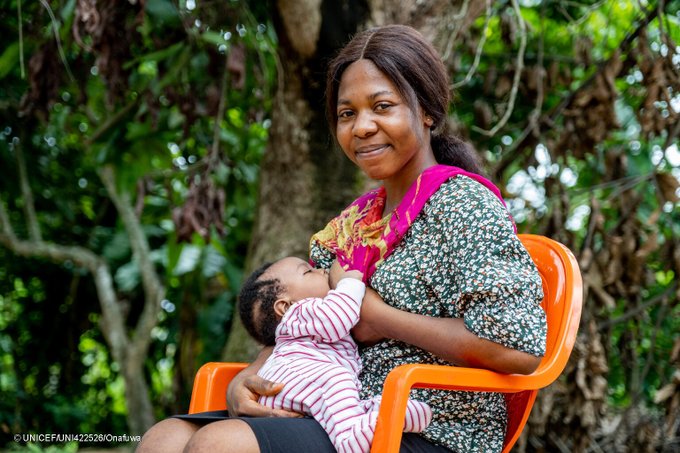
The Nigerian government, in collaboration with UNICEF, has called for urgent action to prioritise breastfeeding by establishing sustainable support systems for mothers nationwide.
The appeal was made to mark World Breastfeeding Week, observed globally from 1 to 7 August 2025, under the theme “Prioritise Breastfeeding: Create Sustainable Support Systems,” which underscores the critical role of breast milk in child survival, growth, and healthy development.
In a statement issued by Suzan Akila, UNICEF highlighted that breast milk is the most complete source of nutrition for infants.
“For women, breastfeeding significantly reduces the risk of certain types of cancers as well as type II diabetes. Breastfeeding is also a climate-smart solution.
“It’s sustainable, cost-effective, and zero-waste,” the statement noted.
Breast milk contains antibodies that protect children from diseases, enhance cognitive performance, and reduce the risk of obesity later in life.
It’s #WorldBreastfeedingWeek!
Breastmilk is safe, nutritious and packed with antibodies that protect children from disease.
For every child to benefit, governments and partners must invest in strong policies, programmes and funding to support breastfeedinghttps://t.co/RTVWfC3sRk pic.twitter.com/h6e7HU1amm— UNICEF Nigeria (@UNICEF_Nigeria) August 1, 2025
Despite these benefits, UNICEF expressed concern over stagnating breastfeeding practices in Nigeria. Data from the 2023–2024 National Demographic and Health Survey (NDHS) reveals that early breastfeeding initiation has declined from 42% in 2018 to 36% in 2023, while exclusive breastfeeding rates remain at 29%.
“Only 23% of babies are breastfed up to the recommended two years of age. Only 12 of the 36+1 states have paid maternity leave up to six months,” the statement added.
To reverse these trends, UNICEF stressed the importance of supporting mothers at home, in healthcare settings, and in workplaces to initiate breastfeeding within the first hour of birth, breastfeed exclusively for six months, and continue with complementary foods for at least 24 months.
UNICEF Nigeria Country Representative Wafaa Saeed Abdelatef emphasised, “Breast milk is central to child survival and development; as such, all have a role to play in supporting mothers to breastfeed effectively.
“This World Breastfeeding Week, we urge every level of government, every workplace, and every community to build lasting support systems so that no mother lacks the encouragement or resources she needs. Let us mark this week not just with words, but with action.”
Call to Action
Through the Nutrition 774 Initiative, the Nigerian government and UNICEF urged policymakers, employers, health professionals, civil society, and communities to create sustainable breastfeeding support systems.
“Let us provide health workers with the tools they need to promote and support breastfeeding, let us extend paid maternity leave up to six months across all states in Nigeria, and champion breastfeeding as a smart national investment that protects the right of every Nigerian child to adequate nutrition,” the statement concluded.