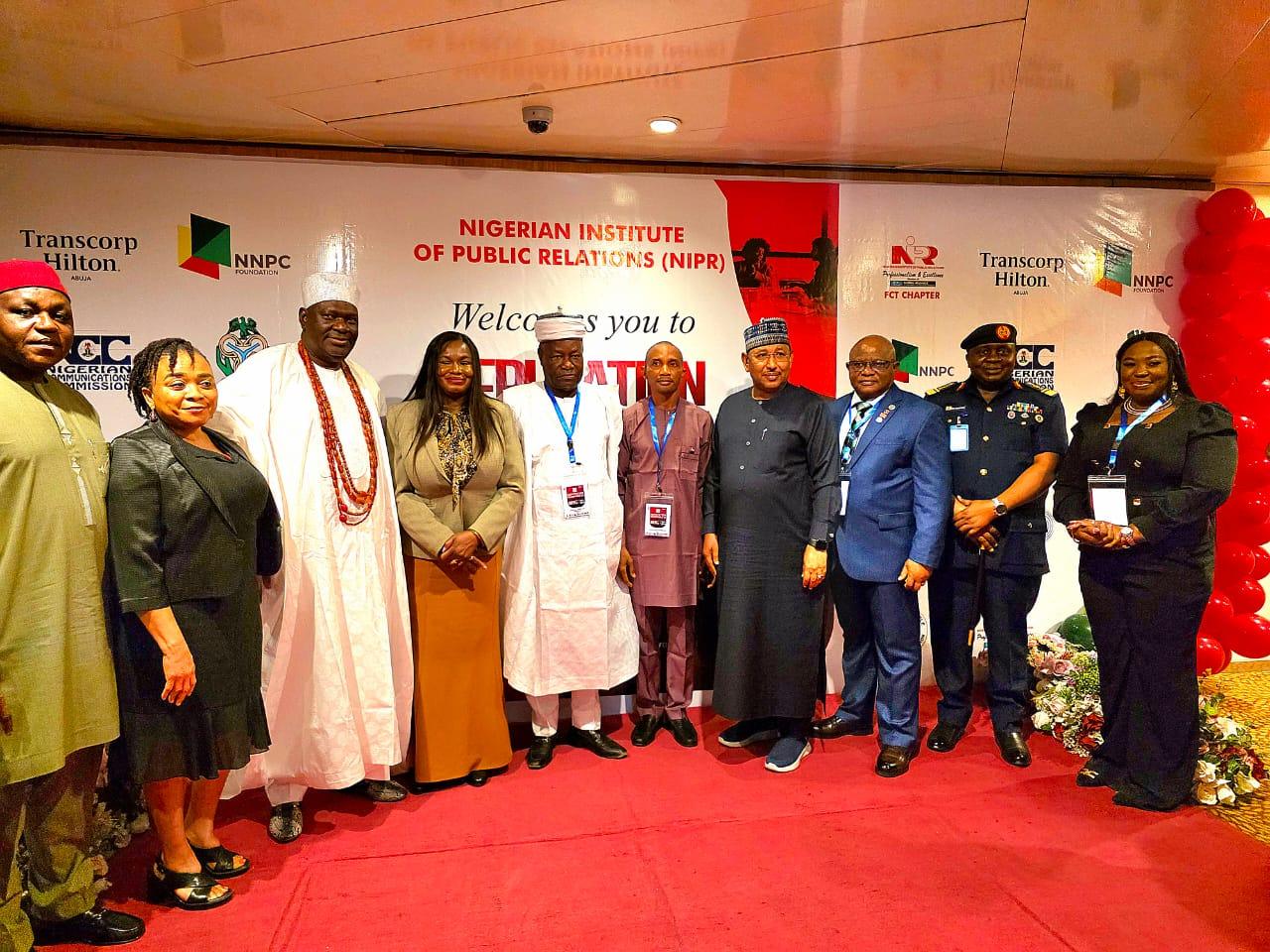
Stakeholders drawn from government, corporate institutions and the military converging on Abuja for the Nigerian Institute of Public Relations (NIPR) Abuja Chapter Reputation Roundtable 2.0 have underscored that integrity remains the bedrock of national development.
In various submissions, they declared that reputation must be shaped “in real time” through transparency, accountability and purposeful leadership.
Speaking at the forum, the Managing Director of the News Agency of Nigeria, Ali M. Ali, acknowledged concerns about Nigeria’s global image despite significant reforms and described integrity as “a high-value commodity in our country.”

He noted that institutions such as the Economic and Financial Crimes Commission and the Independent Corrupt Practices Commission were established to strengthen accountability and promote good governance.
“The task before us now is not just about shaping perceptions through press releases. It is about shaping it in real time,” he said, urging participants to embrace the responsibility with purpose.
In a keynote address, Managing Director of the NNPC Foundation, Dr. Emanuella Arukwe, stressed that integrity sits at the core of power, perception and purpose.
“Corporate integrity is a foundation for building trust, reputation and sustainable business,” she stated.

Dr. Arukwe explained that integrity goes beyond regulatory compliance to ethical commitment, governance, transparency and measurable impact. “Everything we do is based on data… measurable, trackable, verifiable and auditable,” she affirmed, highlighting interventions in education, health, financial literacy, STEM support and cataract surgeries across all states of the federation and the Federal Capital Territory.
She cautioned that in a fast-paced digital age, perception forms in real time. “We must move away from defensive communication and rather adopt proactiveness… embed transparency as an ancestral culture,” she said, adding that reputation is credit that must never be allowed to go bankrupt.
In his address, Major General James Gwom Kataps Myam (Rtd), Director, Nigerian Army Resource Centre, described corporate integrity as “not a moral luxury” but “institutional strategy.”

He warned that institutions fail not because of incompetence but because of broken trust and blurred accountability.
Myam, proposed three pillars for integrity anchored on “clearly structured power, transparency in managing perception, and purpose vested in public interest.”
In his presentation, Professor Okey Ikechukwu, Executive Director of Development Specs Academy, described the executive brand as “a critical asset requiring strategic cultivation and protection.”
He noted that “a leader’s character must align with their title,” because “building and sustaining a C-suite brand is a strategic project,” not a routine obligation. Leaders, he said, must deliberately define their narrative around efficiency, fairness, integrity and measurable results.
He urged strategic visibility and disciplined media engagement, warning that reputation risk now travels faster than operational risk in a 24/7 cycle. Advising on toxic narratives, he recommended clear guardrails and measured responses, including the firm declarative: “This report is incorrect.”
Summing up the practitioner’s mandate, he outlined three core duties: “Reinforce, Manage & Change, and Create” reputation as circumstances demand.
The event also featured the unveiling of former Director General of the National Broadcasting Commission, Mallam Danladi Bako, as “The Reputation Roundtable Ambassador” by Chapter Chairman Stanley Ogadigo.

In an emotional acceptance speech, Bako declared: “Integrity is something that must come from every one of us… All the opportunities we get to steal, let us nicely reject them.” He added pointedly, “Integrity starts from us, individually.”
Day one of the roundtable ended with a resounding consensus that the future of institutions and Nigeria rests squarely on structured power, transparent perception management and purpose-driven integrity.