Surveyors in Southeastern Nigeria are intensifying collaboration with government institutions and the public to curb widespread quackery undermining land administration.
They have called for stronger regulation, improved security, and investment in digital infrastructure to support sustainable development.
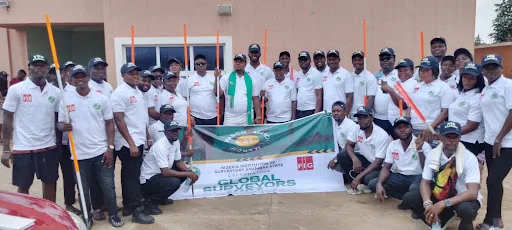
This message formed the core of activities marking the 2026 Global Surveyors Day by the Anambra State chapter of the Nigeria Institution of Surveyors (NIS), where professionals stressed that only coordinated efforts between regulators, practitioners and policymakers can restore integrity to the sector.
The event, held in Awka, the state capital, featured a large-scale public awareness walk that drew over a hundred participants. Marching from key city landmarks to the association’s headquarters in Amawbia, surveyors used the outreach to highlight their role in “measuring, mapping and shaping the world with precision,” and to educate citizens on the risks of engaging unqualified practitioners.
Speaking at the event, the state chairman of NIS, Surveyor Gabriel Okeke, described surveying as the bedrock of physical and infrastructural development, noting that the profession is undergoing rapid digital transformation in Nigeria.
He pointed to operational digital call stations in Awka and Onitsha that enhance pprecision mapping and monitoring across parts of Anambra and neighbouring Delta State.
However, he stressed that expanding coverage to underserved zones such as Ekwulobia and Ihiala requires significant investment.
Additional Stations
Okeke urged the Anambra State Government to support the installation of additional stations, noting that such infrastructure would not only benefit surveyors but also improve land management, urban planning, erosion monitoring and agricultural mapping.
Despite technological progress, practitioners say their work is increasingly challenged by insecurity and public misunderstanding. Field surveyors often face hostility from communities unfamiliar with their role, sometimes leading to confrontations on project sites.
Secretary of the Association of Private Practising Surveyors of Nigeria (APPSN) Vincent Ojiakuin the state, said the profession remains essential at every stage of construction and development, yet poorly understood by the public. He called for legislation to protect surveyors while on duty.
A major concern raised across the board was the growing impact of unqualified individuals posing as professionals. Sir Chukwubueze Onwuzuligbo, National Auditor of NIS and an academic in surveying and geoinformatics, described quackery as the “bane of the profession,” linking it to a significant proportion of land disputes in the state.
“Many people patronise individuals who lack the technical knowledge required for surveying, and the result is disputes, litigation and failed developments,” he said, adding that more than half of land-related conflicts can be traced to such practices.
He revealed that professionals are also exploring collaboration with government agencies on infrastructure monitoring, including proposals to deploy surveying expertise in tracking structural integrity of major bridges in Awka through early warning systems.
Other practitioners echoed the urgency of reform. Surveyor Raphael Blessing of the State Ministry of Lands described the scale of quackery as alarming, urging closer coordination between the Surveyor-General’s office and professional bodies to tighten registration processes and enforce standards.
Similarly, Awka-based surveyor Somtochukwu Onwuzuligbo emphasized that surveying extends far beyond basic measurements, involving complex scientific calculations and geospatial analysis. He warned that reliance on untrained individuals often leads to costly legal battles and unclear land ownership.
“Without a proper survey, there is no clearly defined location of land, and any agreement becomes fundamentally flawed,” he said.
Public Sensitisation
Participants agreed that sustained public sensitisation remains key to addressing the problem, alongside regulatory enforcement and government backing.
Beyond advocacy, the celebration also featured community-building activities, including a football competition, underscoring the profession’s effort to strengthen internal cohesion while engaging the wider public.
For Anambra’s surveyors, the message was unequivocal: development without accurate surveying is blind, and without eliminating quackery through collaboration and regulation, long-term progress will remain at risk.