

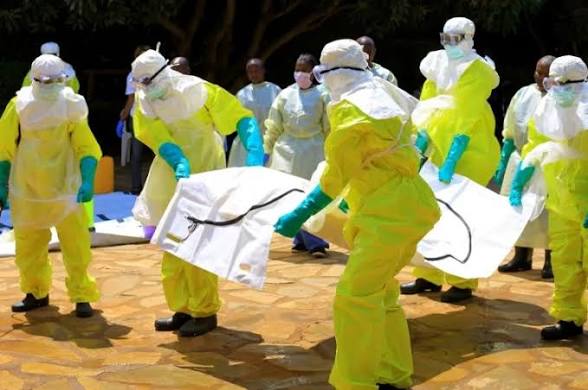
The World Health Organisation (WHO), says more than 500 suspected Ebola cases, including about 130 suspected deaths, have been reported in the Democratic Republic of Congo (DRC), although only 30 cases have so far been confirmed.
WHO representative in DRC, Dr. Anne Ancia, told reporters in Geneva on Tuesday that health officials were working with authorities and deploying more testing kits to eastern DRC to detect the Bundibugyo strain of Ebola, for which no vaccine or treatment currently exists.
“We have significant uncertainty about the number of infections and how far the virus has spread,” Ancia said.
Speaking from Bunia in Ituri province, she said the outbreak had spread to North Kivu, with confirmed cases in Butembo and Goma, while Uganda had also recorded two imported cases.
Ancia explained that investigators had yet to identify the source of the outbreak.
“I don’t think that we have the ‘patient zero’ for now,” Ancia said.
“What we know for now is that on May 5, there was…a person who died in Bunia. The body was brought back [to] Mongbwalu…and put in a coffin. And then the family decided that the coffin was not worth the person.
“And therefore…they changed the coffin. And then there was the funeral, and it’s from where it started.”
She noted that early detection was delayed because local tests initially returned negative for the more common Zaire strain of Ebola, while symptoms such as fever, diarrhoea, fatigue and vomiting complicated diagnosis.
According to WHO, the Bundibugyo virus was eventually confirmed through tests conducted in Kinshasa.
Ancia said WHO experts were considering possible vaccine options, including the Ervebo vaccine, although she noted it could take up to two months before it becomes available.
READ ALSO: World Health Organisation Urges Calm Amid Ebola Outbreak
WHO Experts Meet Over Ebola Vaccine Options
Uganda Begins Ebola Screening At Border Points
She stressed that community engagement remained critical in containing the outbreak through awareness campaigns, combating misinformation and ensuring safe burial practices.
“If we use coercive measures and the population does not agree, we will see bodies disappear. We will see suspected cases refusing to come to the hospitals and health facilities,” Ancia warned.
The WHO official added that more than 40 health workers had been deployed to support the government response despite insecurity, displacement and humanitarian challenges in the affected regions.
Meanwhile, the UN refugee agency (UNHCR) said the provinces of Ituri and North Kivu host more than two million displaced persons and returnees, while healthcare services remain weakened by ongoing conflict.
Ancia stressed that while vaccines may take time to arrive, efforts to contain the outbreak were already underway.
NAN

, a United Nations agency says more than 500 suspected Ebola cases, including about 130 suspected ...)