

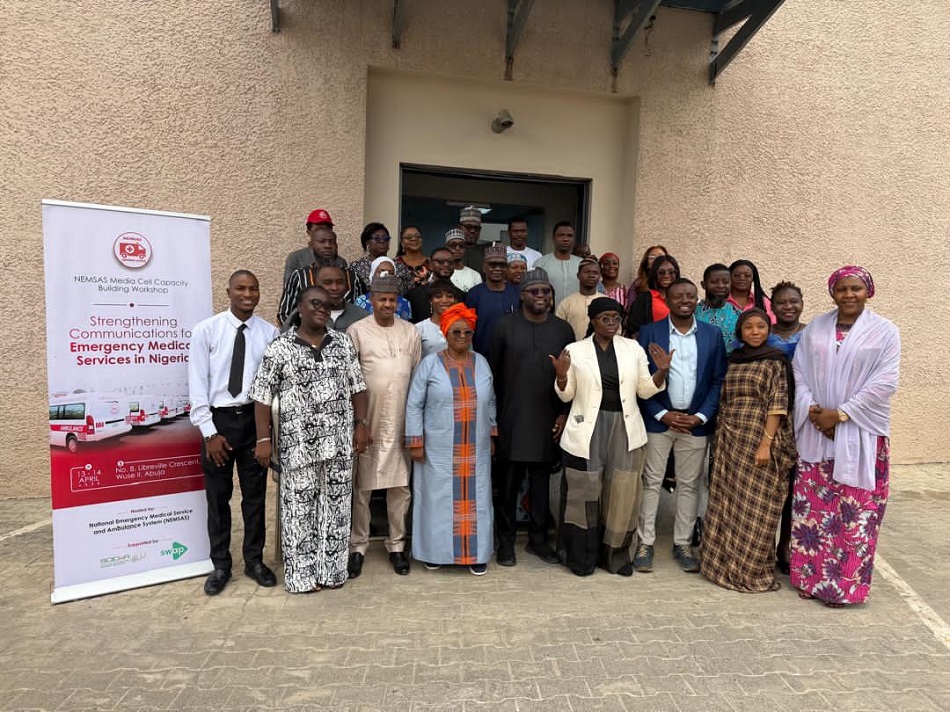
The National Emergency Medical Service and Ambulance System (NEMSAS) has called on state governments and the Nigerian Communications Commission (NCC) to strengthen emergency response systems, citing persistent gaps in coordination and communication across the country.
The call was made at the NEMSAS Media Cell Workshop in Abuja, where stakeholders reviewed the performance of emergency medical services and identified critical areas requiring urgent intervention to improve response time and save lives.
Speaking at the event, the National Programme Manager of NEMSAS, Dr Doubra Emuren, said the success of emergency services in Nigeria depends largely on the commitment of states to take ownership and operationalise structures established under the programme.
“The challenge is not only at the national level; states must be nudged to do what they need to do. It is a shared responsibility,” he said.
Emuren also raised concerns over the inefficiency of the national emergency number, 112, noting that poor connectivity and weak management of Emergency Communication Centres (ECCs) were hindering effective response.
“In every country, you must have an easily recollectable emergency number with responsive agents, but when that number doesn’t work, it affects the entire system,” he said.
The programme Manager of NEMSAS further disclosed that some distress calls were being diverted to private operators who demand payment, undermining public trust and defeating the purpose of free emergency services.
“When you call for help, and you are asked how much you will pay, it discourages people and puts lives at risk,” he stated.
Emuren, therefore, called for stronger collaboration between the NCC, ECC operators and state governments, urging the media to hold stakeholders accountable to ensure the system works effectively for all Nigerians.
Community Awareness
The Chairperson of Community Awareness and Engagement for the National Emergency Medical Treatment Committee (NEMTC), Moji Makanjuola, emphasised the urgent need for improved community awareness and faster emergency response systems in Nigeria.
She noted that preventable deaths persist due to delays and systemic inefficiencies.
According to her, “Every day in Nigeria, lives are lost, not always because help is unavailable, but because help does not arrive on time or systems fail when they are needed most, the response time, coordination, and system efficiency often determine survival in emergencies”.
Media Role
Makanjuola underscored the pivotal role of the media in bridging the gap between health policies and the public, describing it as a powerful tool for driving awareness and accountability.
“The media is not just a channel for information; it is a bridge between policy and the people,” she said, statng that clear and accurate communication empowers citizens to understand emergency services, act responsibly, and build trust in the health system.
She further noted that low public awareness remains a major challenge to effective emergency care delivery, stressing that many Nigerians are unaware of available services.
“People are not aware, so they don’t even know that these systems are there,” she said.
Makanjuola explained that the ongoing training was designed to strengthen the capacity of media practitioners to tell compelling stories, counter misinformation, and promote public engagement in Nigeria’s health sector reforms.
Efdective Health Reforms
The Head of Communication and Innovation Lead at SWAP, Dr Lawal Bakare, emphasised that effective health reforms in Nigeria depend on strong, visible institutions, noting that leaders alone cannot deliver services.
“There is no reform where the institutions are not visible; institutions must take responsibility and engage the media professionally to achieve real impact,” he said.
Bakare urged journalists to play a more active role beyond reporting by shaping programmes and promoting accountability.
“We want you to also be co-designers of programmes, helping governments to hold governments accountable before they fail,” he stated.
Dr Bakare highlighted the need to address the trust deficit through transparent and balanced communication.
He also identified maternal and neonatal mortality as a top priority in ongoing reforms, noting its impact on the country’s health outcomes.
According to him, “if you say the health sector of Nigeria is suffering, it is because of maternal and neonatal death,” stressing that tackling it would significantly reduce the overall health burden.

