
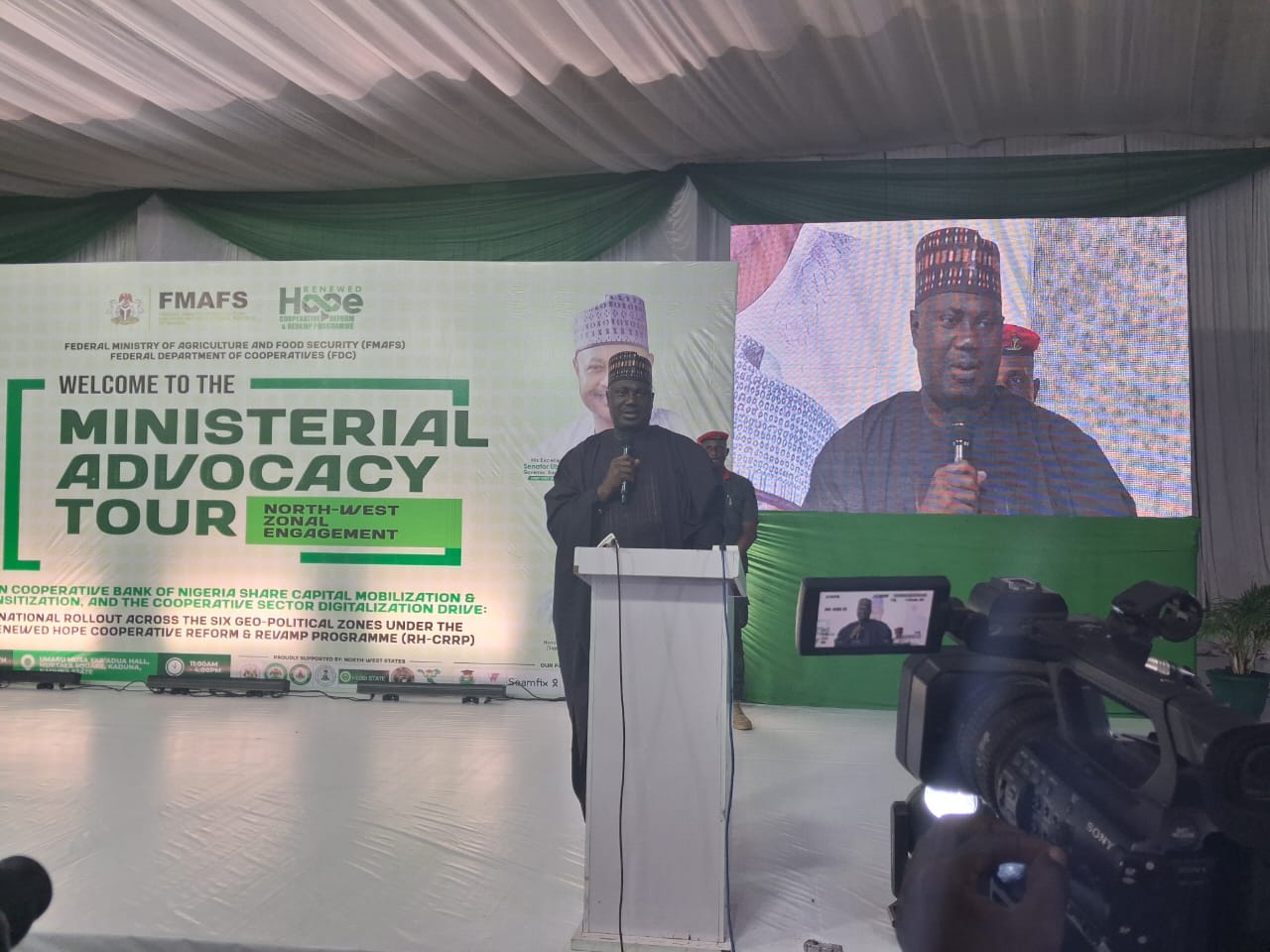
The Nigerian Government has launched a ₦200 billion share capital mobilisation campaign for the proposed Cooperative Bank of Nigeria, under the Renewed Hope Cooperative Reform and Revamp Programme (RH-CRRP), as approved at the 8th regular meeting of the National Council on Cooperative Affairs.
The Minister of State for Agriculture and Food Security and Supervising Minister of Cooperative Affairs, Dr. Aliyu Sabi Abdullahi made this disclosure during the North-West zonal engagement of the Ministerial advocacy tour held in Kaduna State, Northern Nigeria.
Dr Aliyu Abdullahi revealed that the “Ministry is targeting 10,000 cooperative societies across the 36 states and FCT through a tiered mobilisation plan: 1,000 societies at ₦21M – ₦50M, 3,000 at ₦16M – ₦20M, and 6,000 at ₦1M – ₦15M.”
The Minister stated that “through this collective effort, we aim to mobilise approximately ₦200 billion and establish a strong, sustainable, and nationally owned cooperative financial institution capable of supporting agricultural development, enterprise growth, financial inclusion, housing, transportation, value-chain development, and wealth creation for millions of Nigerians.”
He emphasized that the programme is not a government project, but a movement-driven reform agenda that seeks to give life to aspirations that cooperative stakeholders have expressed for decades.
“To ensure continuity beyond the current administration, the Ministry has established an Inter-Ministerial Technical Committee for policy coordination and a National Steering Committee with MDAs, apex cooperative organisations, and development partners. The Federal Department of Cooperatives has also assigned dedicated desk officers to each of the seven strategic pillars of RH-CRRP,” he said.

According to him, the proposed Cooperative Bank of Nigeria will preserve cooperative control and identity while attracting strategic investment.
“65% of equity will be owned by cooperative societies through the Cooperative Trust & Investment Society of Nigeria (CoopTrust).
“30% will be open to institutional investors, development finance institutions, impact investors, and individual cooperators.
“5% is reserved for an Employee Share Ownership Scheme.”
He further revealed that the Ministry is rolling out the National Cooperative Digital Architecture Platform (NCDAP) to address data gaps with key components to include the National Cooperative Smart Registry (NCSR), Cooperative Verification Number (CVN) and CoopID, CoopCHECK Credit Bureau powered by CreditRegistry.
“We cannot build a modern, globally competitive cooperative economy using outdated analog systems,” Dr. Abdullahi said.
The Minister recalled that cooperatives drove Nigeria’s biggest agricultural successes in the past.
In the North-West, marketing societies organised farmers to power the groundnut pyramids, cotton industry, and hides and skins trade. Similar models delivered results in the old Western Region through cocoa cooperatives and in the Eastern Region through palm produce cooperatives.
He called on the Cooperative Federation of Nigeria, state federations, unions, societies, development partners, traditional institutions, and financial institutions to mobilise members and commit fully to the program.
In his remarks, the Executive Governor of Kaduna State, Uba Sani, represented by the Commissioner of Agriculture, Murtala Dabo said that the cooperative movement has historically played a vital role in Nigeria’s socio-economic development.
“Across our communities, cooperatives have served as platforms for collective action, savings mobilisation, access to credit, enterprise development, agricultural production, and community empowerment. They have enabled ordinary citizens to pool resources, reduce risk, improve productivity, and create sustainable livelihoods,” he said.
During her goodwill message, the President, Cooperative Federation of Nigeria, CFN, Mrs. Hannatu Mershak, said that a digitised cooperative sector would lead to veritable records, easier access to markets and finance as well as greater trust from government and development partners.

