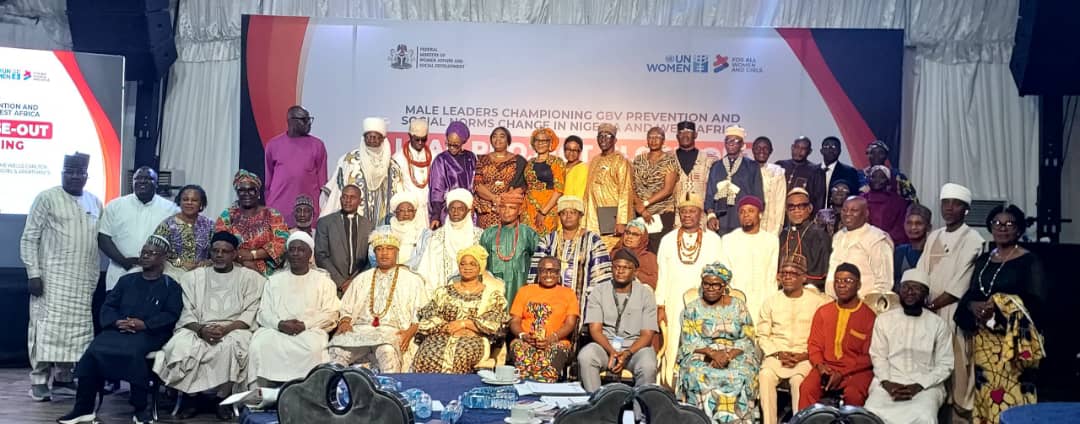
UN Women has launched a new regional initiative to strengthen community-led efforts to end gender-based violence (GBV) and combat the growing threat of technology-facilitated violence against women and girls in West Africa.
This followed the successful completion of a three-year programme that engaged traditional and religious leaders in changing harmful social norms across Nigeria.
The initiative, titled “Community-Led Advocacy and Digital Spaces for the Safety of Women and Girls in West Africa,” will be implemented in Nigeria, Ghana and Senegal with support from the Ford Foundation.
This was made known in Abuja, at the close-out of the three-year Traditional and Cultural Leaders for Ending Gender-Based Violence by Advancing Advocacy, Policy and Social Norms Change (LEAP) Project, implemented by UN Women in partnership with the Ford Foundation.
Speaking on behalf of the UN Women Representative to Nigeria and ECOWAS, Ms. Beatrice Eyong, the UN Women Deputy Representative, Ms. Patience Ekeoba, said the new regional programme, would build on the gains of the LEAP Project while addressing emerging threats posed by digital technology.
“As technology increasingly shapes how people interact, communicate and participate in society, it also presents new risks, including online harassment, cyberstalking, image-based abuse and other forms of digital violence that disproportionately affect women and girls,” she said.
Inclusive Digital Spaces
She noted that the project would equip traditional and religious leaders to promote safe, respectful and inclusive digital spaces while continuing advocacy to prevent violence within communities.
The UN Women Representative to Nigeria and ECOWAS, described the LEAP Project as a transformative initiative that demonstrated the power of engaging traditional and religious leaders in preventing violence against women and girls.
She said the project helped shift gender-based violence prevention from policy discussions to grassroots communities.
“Gender-based violence is preventable. Violence is not inevitable. When we challenge those narratives, when we transform harmful attitudes, when we promote positive cultural values, and when respected traditional and religious leaders become advocates for social justice, communities change. And when communities change, violence reduces, “she said.
Ms. Eyong said that the new initiative coincided with encouraging national trends, citing findings from the 2024 Nigeria Demographic and Health Survey, which showed reductions in physical, sexual and intimate partner violence, as well as a decline in female genital mutilation from 20 per cent in 2018 to 14 per cent in 2024.
Also speaking, the Programme Officer at the Ford Foundation, Dr. Izeduwa Derex-Briggs, said the Foundation would continue supporting initiatives that promote gender justice and community ownership in preventing violence.
Sustainable Social Change
While acknowledging progress made under the LEAP Project, he maintained that any form of violence against women and girls remained unacceptable.Derex-Briggs stressed that sustainable social change requires more than legislation.
“While there’s a decline, one girl or woman violated is more than enough. Laws are necessary, policies are important and institutions are critical. However, social norms are sustained in homes, communities, places of worship and traditional institutions. Because they are sustained collectively, they must be transformed collectively,” he noted.
He further reiterated the Ford Foundation’s renewed commitment to supporting the Council of Traditional Leaders of Africa (COTLA), describing the body as a strategic platform for advancing gender equality across the continent.
Representing the Minister of Women Affairs, Iman Suleiman, Mrs. Blessing Anunuike commended President Bola Ahmed Tinubu for prioritising the protection of women, children and vulnerable groups under the Renewed Hope Agenda.
She described traditional and religious leaders as key partners in reshaping harmful cultural norms and mentoring young men.
“This is precisely why your role as traditional and cultural leaders is completely indispensable as the primary mentors of positive masculinity. By actively redefining what it means to be a man, shifting the narrative from dominance to protection and from aggression to emotional intelligence, you provide a vital roadmap for young men to become champions of peace rather than perpetrators of harm,” she said.
Community Leadership
The Minister also urged traditional rulers and traditional institutions to deliberately include women in community leadership and decision-making processes.
“My fundamental appeal to you is that you lead this change by actively involving women in your traditional councils and decision-making processes, as communities where women’s voices are genuinely heard and valued are inherently more stable, peaceful and resilient,” she said.
Speaking on behalf of the Council of Traditional Leaders of Africa (COTLA), the Emir of Shonga, Dr. Haliru Yahaya, said traditional institutions must continue to champion the protection of women and girls.
“Leadership is not only about authority; it is about responsibility. As traditional leaders, we have a responsibility to protect the vulnerable, uphold dignity and guide our communities away from harmful practices.”
He urged traditional rulers across Africa to sustain the momentum generated by the LEAP Project.
“Let this convening mark not only the close-out of the project, but the beginning of a stronger movement led by traditional and religious leaders for the safety, dignity and rights of women and girls.”
Stakeholders at the event reaffirmed their commitment to strengthening community-led advocacy, institutionalising accountability mechanisms and ensuring that cultural and religious institutions remain active partners in ending gender-based violence across West Africa.