
The Chairman of the Nigerian Exchange Group (NGX), Umaru Kwairanga has called for proactive measures to tackle Nigeria’s unemployment crisis through entrepreneurship.
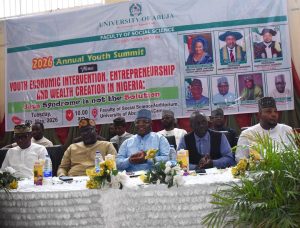
Kwairanga made the call while delivering a goodwill message at the University of Abuja Faculty of Social Sciences 2026 Youth Week, themed: “Youth Economic Intervention, Entrepreneurship and Wealth Creation in Nigeria: ‘Japa Syndrome is Not the Solution.”
He lamented the growing number of unemployed and underemployed youths competing for limited or non-existent white-collar jobs, while many others are seeking opportunities abroad.
According to the NGX chairman, a close study of the world’s fastest-growing economies shows that their success is largely driven by the ingenuity of their populations, innovative technology, and access to capital.
These factors, he noted, “have led to a boom in small and medium-scale enterprises (SMEs) that employ millions and export goods and services globally.”
He stressed that Nigeria must focus on instilling an entrepreneurial mindset in young people from an early age so they graduate not as job seekers, but as job creators.

He said; “Nigeria remains a land of immense potential-rich in human capital, natural resources, and entrepreneurial spirit. What is required is not an exodus of talent, but a deliberate and strategic harnessing of that talent to build sustainable economic value within our borders.”
Kwairanga, however, pointed to structural challenges that continue to shape the choices available to young people, particularly in employment, enterprise development, and wealth creation.
Calling for action, Kwairanga said; “universities must bridge the gap between academic knowledge and practical economic participation.”
He said that the private sector must deepen its role in mentorship, financing, and market access, while young people must take responsibility for building the capacity to compete in a global, technology-driven economy.
Admonishing the students, he said unlocking entrepreneurial potential requires a mindset shift, noting that every business begins with an idea—often rooted in solving existing problems through products or services.
“After coming up with a business idea, you will need some capital and that initial capital will have to come from your savings and family and friends. So to be an entrepreneur, you should first have a culture of savings and some knowledge of money management.
“More elaborate capital raising such as from private equity funds, government agencies dedicated to assisting SMEs or even issuing shares or debt can come later when you have grown the business. As a potential entrepreneur, you also need to have a plan and a structure.
“That means preparing a basic business plan to serve as a guide and treating the business as distinct from you as a person right from an early stage,” Kwairanga said.
He said NGX Group Plc believes the capital market is a powerful engine for wealth creation, enterprise development, and economic inclusion, noting that its platforms provide young entrepreneurs with access to funding, scalability, and opportunities to turn innovation into lasting value.
Kwairanga, however, cautioned that entrepreneurs will face challenges, particularly in Nigeria, where access to finance, electricity, and trust issues remain significant constraints.
“For today’s generation, I should also mention distractions such as social media and the lure of get rich quick schemes, for example pyramid schemes and yahoo. How you confront and overcome such challenges will determine the success or failure of your business. I can assure you that if you, as a young budding entrepreneur, work hard, stay focused and disciplined, you will succeed in business in Nigeria,” Kwairanga explained.
He emphasised that wealth creation is not accidental, but structured, intentional, and often intergenerational.
“Nigeria’s demographic advantage will only translate into economic strength if we are able to convert youthful energy into productive capacity and that responsibility lies with all of us. To our youths, I say this: entrepreneurship is not merely an alternative-it is a necessity and the bridge between aspiration and achievement and it demands resilience, discipline, and vision,” Kwairanga said.
He urged students to see themselves not just as beneficiaries of the system, but as active participants in shaping it, stressing that the future Nigeria seeks will be built by its youth, not imported.