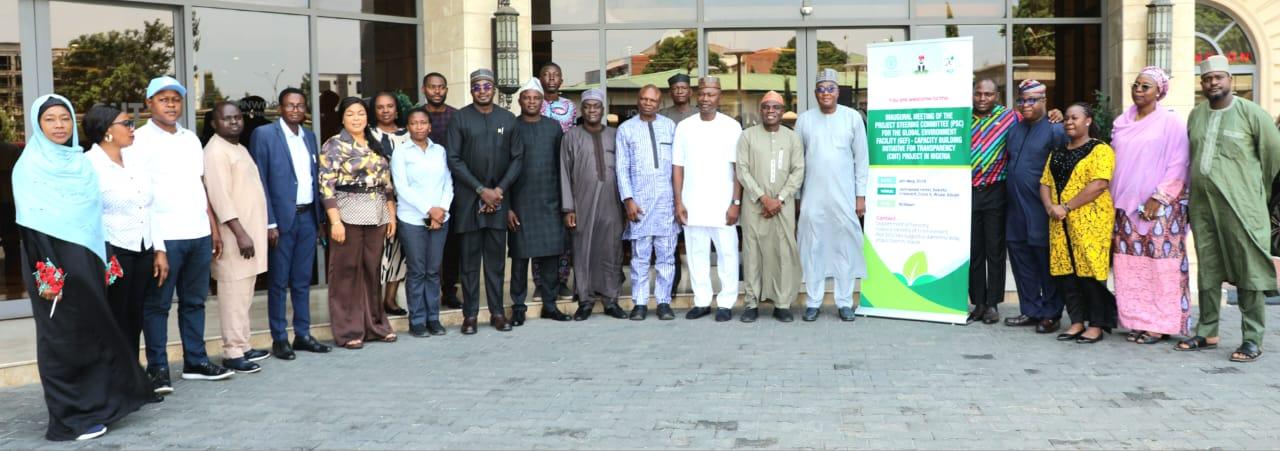
The Nigerian Government, through the Federal Ministry of Environment, has inaugurated the Project Steering Committee (PSC) for the Global Environment Facility (GEF) Capacity Building Initiative for Transparency (CBIT) project in Nigeria.
The initiative is aimed at strengthening the country’s capacity to effectively track, report, and verify its environmental and climate actions.
The Capacity Building Initiative for Transparency (CBIT) is a programme under the GEF designed to help countries improve how they track and report climate actions.
READ ALSO: Stakeholders Launch Initiative to Strengthen Access to Climate Data
Speaking at the inauguration ceremony in Abuja, the Director of Forestry in the Ministry, Halima Bawa-Bwari, described the establishment of the Project Steering Committee as both timely and strategic.
Represented by the Deputy Director, Department of Forestry, Ministry of Environment, Aiwuyo Christopher, she said the PSC is expected to provide overall policy guidance, ensure effective oversight, and facilitate inter-agency coordination to achieve the project’s objectives.
“As you are aware, the CBIT project was established under the Global Environment Facility in response to decisions reached at COP21 in Paris, with the aim of supporting countries to meet the enhanced transparency requirements of the Paris Agreement. For Nigeria, this project represents a critical step towards improving our capacity to generate, manage and report credible greenhouse gas (GHG) data across key sectors,” Bwari said.
She explained that the project will strengthen institutional frameworks for GHG data management, enhance technical capacity of stakeholders, and support the development of a robust web-based platform for transparent data sharing.
“Ultimately, it will position Nigeria to meet its reporting obligations under the Paris Agreement with greater accuracy, consistency and credibility. Your role is therefore pivotal in ensuring that the project delivers on its mandate and contributes meaningfully to Nigeria’s climate commitments.” The Director emphasised.
Bwari noted that the Department of Forestry remains committed to providing coordination, technical guidance, and institutional support for successful project implementation.
“We recognise the importance of collaboration, particularly given that the effectiveness of this project depends largely on the quality of data and cooperation from multiple sectors, including AFOLU, Energy, Transport, IPPU, and Waste. I encourage all members to actively engage, provide strategic direction, and foster the collaboration required to achieve our shared goals. Let us approach this task with a sense of purpose, responsibility and commitment to national development.” She stated.
The Director of Planning, Research and Statistics and GEF Operational Focal Point Officer in Nigeria, Babagana Bukar, said the Steering Committee will provide strategic direction, resolve bottlenecks, and ensure alignment with national priorities such as the Energy Transition Plan, NDC, and sectoral policies.
He noted that transparency is not merely paperwork but the backbone of credible climate action.
The FAO Representative in Nigeria and ECOWAS, Hussein Gadain, said FAO remains committed to supporting the Paris Agreement by fostering data-driven decision-making and strengthening partnerships for sustainable development.
Represented by Adesoji Adeyemi, he said the goal of CBIT is to assist countries in meeting ETF requirements and strengthening capacities for monitoring emissions across key greenhouse gas-emitting sectors.
The Director-General of the Nigeria Conservation Foundation (NCF), Joseph Onoja, said the organisation is committed to delivering impact in the country, stressing that the partnership reflects a shared commitment to ensuring meaningful initiatives are effectively implemented.
“Our focus remains on building sustainable systems that allow us to reflect on progress with pride. By strengthening collaboration and embracing synergy across sectors, we can avoid duplication of efforts and instead create unified and effective approaches. This includes ensuring that initiatives such as these are supported by coordinated action and a shared vision,” Onoja said.
The Representative of the National Council on Climate Change (NCCC), Ann Umas, said the goal is to build a strong data-driven foundation that supports informed decision-making, enhances climate initiatives, and ensures long-term sustainability.
The event was organised by the Department of Forestry, Federal Ministry of Environment, in collaboration with the Food and Agriculture Organisation of the United Nations (FAO) and the Nigeria Conservation Foundation (NCF).