

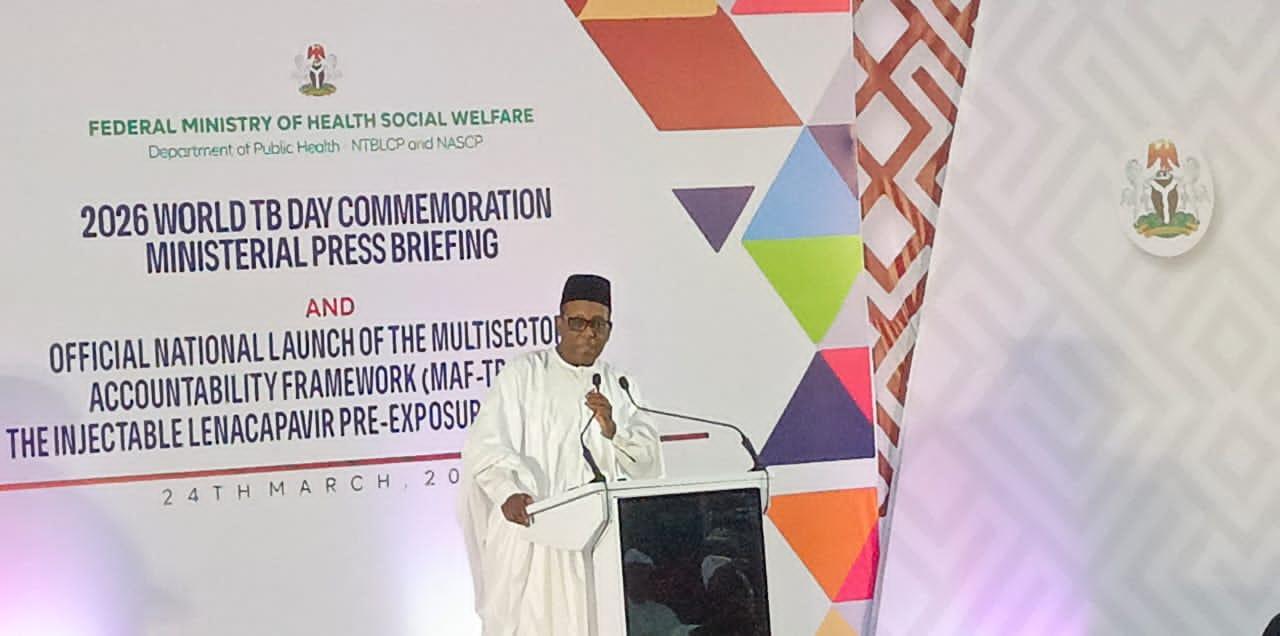
Nigeria has reaffirmed its commitment to ending tuberculosis (TB) and HIV as it intensifies fight, launches HIV Lenacapavir and calls for stronger domestic financing and a more coordinated health system.
The Coordinating Minister of Health and Social Welfare, Dr Ali Pate, made the call during the 2026 World TB Day ministerial press briefing and the official launch of the Multisectoral Accountability Framework (MAF-TB) and injectable Lenacapavir Pre-Exposure Prophylaxis (PrEP), organised by the Federal Ministry of Health and Social Welfare through the Department of Public Health.

He noted that the global health landscape was evolving, with declining external funding and increasing pressure on countries to take ownership of their health programmes.
“We’re dealing with multiple crises, and financing has become constrained globally and locally, in such times, it’s innovation that will allow us to get ahead of the challenges,” he said.
The Coordinating Minister emphasised the need to move away from fragmented interventions. “As long as we avoid working in silos, we can stretch limited resources to achieve better results,” he stated, adding that Nigeria is adopting a sector-wide approach to improve efficiency and impact.
Dr Pate disclosed that the Federal Government plans to inject an additional $346 million into TB, HIV and malaria programmes in the 2026 budget.
“By 2030, Nigeria should be able to put its own domestic resources towards priority diseases, so that it is not consistently looking for external grants,” he said.
Renewed Commitment
Earlier, the Minister of State for Health and Social Welfare, Dr Iziaq Adekunle Salako, said the event reflects Nigeria’s renewed commitment to tackling TB and HIV through innovation, integration and accountability.
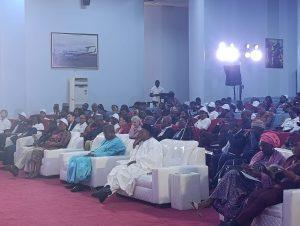
“This convergence reflects an intentional shift towards a health system that is innovative, integrated, and accountable,” Salako said.
He noted that the presence of top health officials underscores the importance of the fight against both diseases.
He highlighted progress in TB control, with case notifications rising from 138,591 in 2020 to about 440,000 in 2025.
“This is the highest ever recorded in Nigeria, driven by expanded diagnostic networks and improved access to care,” he said, and that treatment success remains at 94 per cent.
On HIV, Salako noted that Nigeria was nearing the UNAIDS 95-95-95 targets.
“We have achieved 93 per cent of people knowing their status, 99 per cent of those on treatment, and 95 per cent viral suppression,” he noted.
He described the introduction of long-acting injectable PrEP, including Lenacapavir, as a breakthrough.
“It offers high efficacy, discretion, and convenience, especially for individuals who face stigma or difficulty adhering to daily medications.
“If you have a cough that lasts for two weeks or more, do not wait. Visit a health facility and get treated, together, we can end TB and HIV,” Solako added.
Representing the Global Fund, Jean-Thomas Nouboussi, pride in Nigeria’s dual commemoration of TB Day and the launch of injectable Lenacapavir, describing it as a strong signal of commitment to integrated health responses.
He said “Lenacapavir is not just a “game changer”but a breakthrough in HIV prevention, particularly in addressing adherence challenges associated with daily medication, the innovation offers new hope for reaching populations previously underserved”, adding that for the first time, such a tool is being rolled out simultaneously in developing and Western countries.
Nouboussi disclosed that the Global Fund aims to reach two million people with Lenacapavir by 2028, with Nigeria among nine early adopter countries.
“Nigeria is expected to receive about 179,700 doses by 2028, with initial rollout planned across eight states, while urging the government to scale up deployment nationwide.”
On Tuberculosis, Nouboussi stressed that sustaining these gains depends on strong domestic commitment, urging continued government investment to avoid funding gaps.
He warned that interruptions could reverse progress, while expressing confidence that, with sustained efforts, Nigeria can achieve the goal of ending TB.
Representing the Network of People Living with HIV/AIDS in Nigeria (NEPWAN), Abdulkadir Ibrahim called for stronger government commitment to ending HIV and tuberculosis (TB), noting that both diseases remain critical public health challenges.