


Nigeria’s Chief of the Air Staff (CAS), Air Marshal Hasan Abubakar has reaffirmed that strict adherence to international humanitarian law enhances Nigerian Air Force (NAF) operational effectiveness.
Speaking at the closing ceremony of the NAF Civilian Harm Mitigation training in Abuja, the CAS said that protecting civilians in conflict environments builds trust, improves intelligence gathering, and contributes to long-term stability.

“Protecting civilian lives fosters trust and cooperation from local communities, facilitates intelligence gathering, and contributes to long-term stability. It also strengthens Nigeria’s standing as a professional and responsible actor in the global security space,” he said.
Air Marshal Abubakar stressed that compliance with humanitarian law is never an obstacle but a “force multiplier” for military operations.
As part of its commitments, the NAF launched a Civilian Harm Mitigation Action Plan earlier this year, with a dedicated Department of Civilian Harm Mitigation established at the Air Warfare and Doctrine Centre.
The department will serve as a hub for training, analysis, and doctrine, institutionalising best practices for harm mitigation during air operations.
“The department will function as the hub for NAF-wide training, analysis, and doctrine on civilian protection, thereby institutionalising best practices for harm mitigation and response during air operations,” the CAS said.
Air Marshal Abubakar urged officers to uphold professionalism, discipline, and accountability.
“While technology, platforms, and tactics provide the means to fight, it is our values, respect for human dignity, and compliance with international law that truly define us as a force for good,” he added.
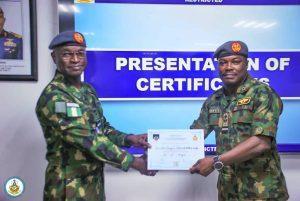
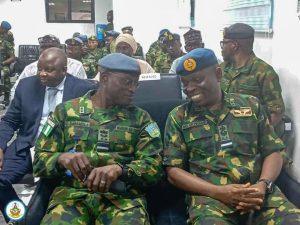
Air Marshal Abubakar was represented by the Chief of Civil-Military Relations, Air Vice Marshal Ibikunle Daramola at the event.
The Civilian Harm Mitigation training, conducted between August 11 and 30 in three batches for 69 officers, reflected Nigeria’s commitment to international obligations under the Geneva Conventions of 1949, their Additional Protocols, the Hague Regulations, and the African Charter on Human and Peoples’ Rights.
The programme covered international humanitarian law in the context of Nigerian air operations, precision selection of ordnance to minimise collateral damage, application of Rules of Engagement, positive target identification, targeting categorisation, the No-Strike List (NSL), and the Sensitive Target Approval and Review (STAR) process.
Commandant of the Air Warfare and Doctrine Centre, Air Vice Marshal Michael Ekwueme, thanked the CAS for entrusting the Centre with the training and commended the officers’ dedication.
He noted that the rigorous curriculum, including practical modules on sensitive target engagement, has further prepared NAF personnel to meet international standards in protecting civilians during conflict.
The NAF emphasised that the training reflects Nigeria’s global responsibility to uphold humanitarian values while enhancing operational effectiveness.
PIAK