

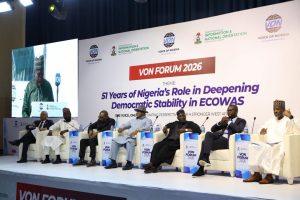
Voice of Nigeria convened its 2026 Forum at the Shehu Musa Yar’Adua Centre in Abuja under the theme “51 Years of Nigeria’s Role in Deepening Democratic Stability in ECOWAS”. The forum brought together stakeholders from governance, security, traditional leadership and the media to examine Nigeria’s role in regional stability.
The forum, organised under the leadership of Director-General Mallam Jibrin Baba Ndace, provided a platform for discussions on Nigeria’s long-standing engagement in West African peacebuilding and democratic support.
Over the past five decades, Nigeria has played a central role in regional security and diplomacy. In March 2026, the Nigerian Army completed pre-deployment training for 197 troops for a peacekeeping mission in The Gambia under the ECOWAS Mission in The Gambia framework. This continues a tradition of military engagement in peace support operations across Liberia, Sierra Leone, Mali, and Guinea-Bissau.
Nigeria’s diplomatic influence within the sub-region was also highlighted at the forum. The Gambia’s High Commissioner and Permanent Representative to ECOWAS, Mohamadou Musa Njie, described Nigeria’s contribution as “of fundamental significance”, noting its consistent role in promoting democracy, rule of law, and governance within ECOWAS.
The discussions took place against a shifting regional context, following the withdrawal of Mali, Burkina Faso, and Niger from ECOWAS after military takeovers. The development has raised concerns about regional integration and the future of collective security and democratic governance in West Africa.
The ECOWAS Protocol on Democracy and Good Governance, adopted in 2001, also featured prominently in the discussions as stakeholders examined its relevance amid emerging political transitions and governance challenges in the region.
Participants noted that young people, who constitute an estimated 66 per cent of the ECOWAS population, remain under-represented in governance processes, raising questions about inclusion and participation in decision-making structures.
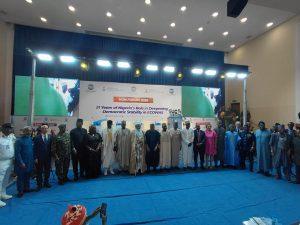
The forum featured a range of participants, including traditional rulers, security experts, and communication professionals. Among them were the Etsu Nupe, Dr Abubakar Yahaya; former Chief of Army Staff and diplomat General Tukur Buratai; and President of the Nigerian Institute of Public Relations, Dr Ike Neliaku.
Discussions at the event focused on the intersection of communication, security cooperation, traditional governance systems, and institutional trust in addressing regional challenges.
Key issues raised included the growing impact of misinformation and disinformation across digital platforms in West Africa. Speakers referenced concerns about the spread of manipulated content, including AI-generated material and cloned audio messages, which have increasingly circulated through social media and messaging platforms such as WhatsApp and Telegram.
The forum also noted concerns about narratives affecting perceptions of political and economic stability in the region, emphasising the importance of coordinated communication among ECOWAS member states in addressing information-related challenges.
At the conclusion of the forum, participants recommended the strengthening of media capacity to support fact-based reporting and the institutionalisation of platforms such as the VON Forum to sustain dialogue on governance and regional cooperation.
Stakeholders observed that sustained engagement through structured dialogue platforms could support policy discussions and enhance collaboration among key actors in governance, security, and communication.
Nigeria’s role in ECOWAS over the past 51 years has included peacekeeping deployments, mediation efforts, and support for institutional frameworks aimed at strengthening democratic governance in the sub-region.
The Voice of Nigeria Forum 2026 provided an avenue for reflecting on these engagements while highlighting ongoing discussions around regional stability, communication strategy, and institutional cooperation.
Sa’id is a Communications Strategist and Reputation Manager. He writes from Kaduna.
The views expressed in this article are those of the author and do not necessarily reflect the editorial position of Voice of Nigeria.