

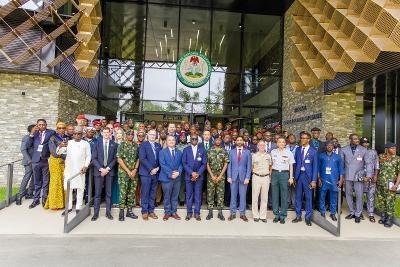
Nigeria has commenced a national baseline assessment of its counter-Improvised Explosive Devices (C-IED) capabilities as part of efforts to strengthen the country’s response to the evolving threat posed by terrorist use of explosive devices.
The initiative was highlighted on Wednesday, 11 March 2026, at the National Counter Terrorism Centre (NCTC) in Abuja during the opening of the Counter-IED Baseline Assessment Workshop held at the Centre, Office of the National Security Adviser.
The National Coordinator of the NCTC, Major General Adamu Laka, explained that the workshop “represents a follow-up to the Counter-IED Symposium held in March 2025 and is jointly organised with the United Nations Mine Action Service and the British High Commission to support Nigeria’s efforts in strengthening its national counter-terrorism architecture.”
He noted that improvised explosive devices remain among the most dangerous threats confronting personnel engaged in counter-terrorism operations, particularly in Nigeria’s North-East theatre.
“Beyond casualties among security forces and civilians, IED attacks have disrupted agricultural and economic activities, restricted humanitarian access, displaced communities, and undermined investor confidence in affected regions,” he said.
Also Read: Nigeria Begins Final Validation of National DDR Framework
The National Coordinator stated that the National Counter Terrorism Strategy has identified the development of a National Counter-IED Strategy as a key priority, stressing that the Centre “has been working with international partners to develop a coordinated framework capable of addressing the evolving tactics of terrorist groups.”
Guided by the Lomé Recommendations of the Global Counter-Terrorism Forum, he explained that “the objective is to harmonise efforts across government institutions while strengthening the policy, operational and technical mechanisms required to counter the threat effectively.”
The workshop brings together a wide range of participants, including members of the Armed Forces, security and intelligence agencies, representatives of Ministries, Departments and Agencies, as well as international partners, reflecting what officials described as “a Whole-of-Government and Whole-of-Society approach to addressing the IED threat.”
The National Coordinator also noted that the engagement holds additional significance following the designation of the NCTC as “a Regional Centre of Excellence for Counterterrorism in West Africa and the Sahel,” a role that requires Nigeria “to strengthen national capabilities while contributing to regional knowledge sharing and capacity building.”
Speaking at the workshop, the Commander Corps of Engineers of the Nigerian Army, Major General Shafaru Shamsudeen, described the engagement as “both strategic and necessary,” noting that “improvised explosive devices remain one of the most adaptive weapons used by hostile elements across multiple operational theatres.”
The Corps Commander emphasised that “countering the threat requires a unified and intelligence-driven approach involving all relevant stakeholders,” stressing that “no single institution can effectively address the challenge alone.”
He explained that “the baseline assessment will evaluate existing capabilities, operational procedures, training frameworks, equipment and coordination mechanisms across agencies involved in counter-IED operations, with the aim of identifying critical gaps and strengthening operational synergy.”
According to him, “the Nigerian Army Corps of Engineers remains fully committed to supporting national counter-IED efforts through professional combat engineering support, technical expertise and operational innovation aimed at enhancing force protection and securing critical infrastructure.”
Both speakers expressed confidence that “the deliberations would contribute to the development of a practical and sustainable National Counter-IED Strategy capable of adapting to emerging threats while strengthening cooperation among military, security, intelligence and civilian institutions.”
The workshop is also expected to utilise tools such as the United Nations Institute for Disarmament Research Counter-IED Self-Assessment Framework “to generate empirical data and guide future investments in human capacity, technical systems, legislative frameworks and institutional coordination required to strengthen Nigeria’s national counter-IED architecture.”