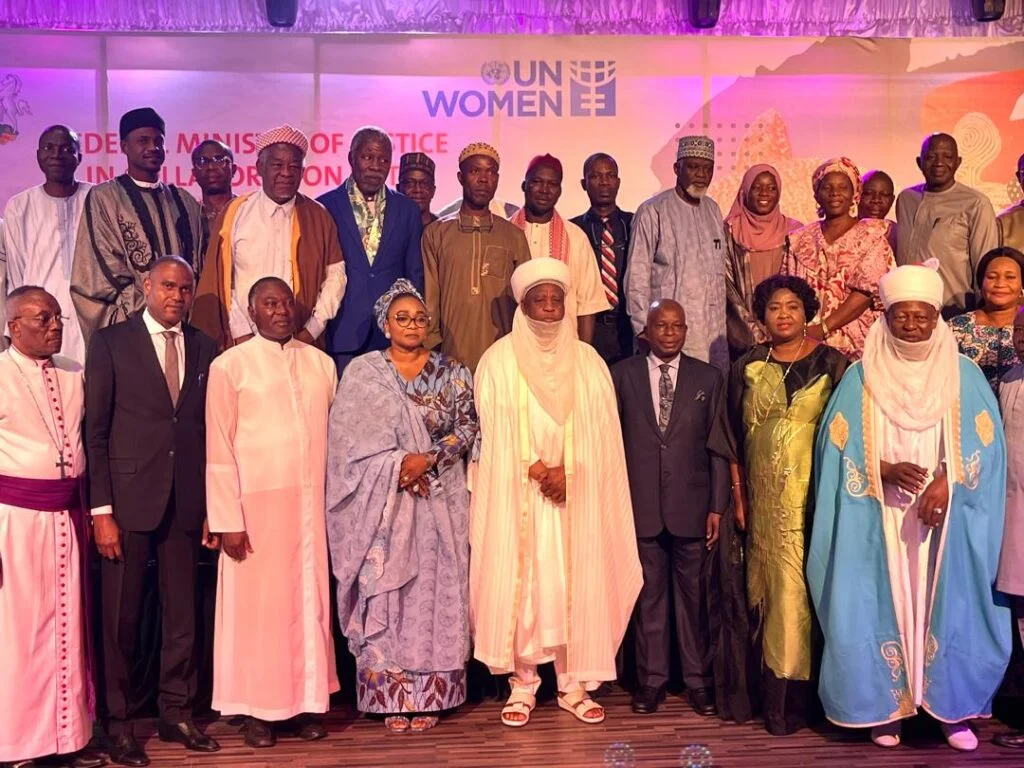
The Sultan of Sokoto and President-General of the Nigeria Supreme Council for Islamic Affairs (NSCIA), Alhaji Sa’ad Abubakar, and the Christian Association of Nigeria (CAN) have reaffirmed their collective commitment to eradicating gender-based violence (GBV) in Nigeria.
Their commitment was reiterated at a capacity-building session for faith-based organisations on GBV, held on Friday in Abuja.
The session was organised by the Federal Ministry of Justice in collaboration with UN Women, with support from the Ford Foundation.
A Call to Confront the Scourge
The Sultan declared, “Our personal presence here shows that we are very much aware of this, we are very committed, and we are deeply concerned about this violence being meted out to our people.
“It is high time we come out fully to tackle this monster, this scourge that has been inflicted on us by us, because human beings are the ones doing this.”
He emphasised the importance of promoting girl-child education and strengthening family values, calling it both a religious and national obligation.
“Educating the girl-child will give them the strength and knowledge to defend themselves, avoid dangers, and take action against intruders,” he said.
The Sultan also acknowledged that GBV affects men and stressed the need for unity across faiths, urging collaboration between religious communities and government institutions in the fight against GBV.
Read Also: Zamfara Begins 2025 Malaria Drug Distribution Campaign
CAN Stands Against Abuse
Rev. Fr. Anselm Olorunfemi-Ologunwa, Chairman of CAN in Ondo State, described GBV as a gross violation of human rights, dignity, and human worth.
He called on religious leaders to play a proactive role in both preventing GBV and ensuring justice for survivors.
“We must work together to address the root causes of GBV, including harmful traditional practices, gender inequality, and lack of access to education and economic opportunities,” he stated.
He further urged faith leaders to support survivors, promote a culture of respect and dignity, and advocate for policies that safeguard the rights of women and girls.
Government Urges Action from Faith Leaders
Attorney General of the Federation, Mr Lateef Fagbemi, SAN, called on religious leaders to encourage survivors to speak up, refer cases to law enforcement, and contribute to building community-led prevention and rehabilitation structures.
He proposed the establishment of safe spaces within churches and mosques.
“The formal justice system cannot succeed without your partnership. The law cannot walk alone; it needs feet in the community. Those feet are yours,” he said.
Religious Institutions as Agents of Protection
Minister of Women Affairs Hajiya Imaan Sulaiman-Ibrahim emphasised the critical role of religious institutions in protecting the vulnerable and upholding moral standards.
“Let this session ignite conviction, and let our places of worship and religious platforms become citadels of protection and moral clarity.
“No faith condones abuse, no scripture justifies violence, and no tradition must override human dignity,” she declared.
UN Women Urges Collective Responsibility
Mrs Beatrice Eyong, UN Women Representative to Nigeria and ECOWAS, represented by Deputy Country Representative Mrs Patience Ekeoba, said the event symbolised a unified commitment to change.
“We are here to support, to learn, and to act together. Ending GBV is not only a moral imperative but also a shared responsibility and a pathway to peace and prosperity,” she said.