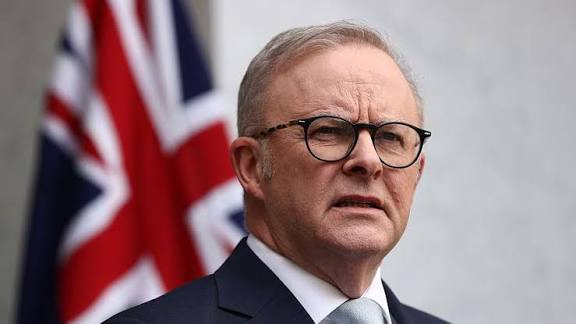
Australia, one of the world’s biggest polluters per capita, will aim to cut its carbon emissions by at least 62% compared to 2005 levels over the next decade.
The nation – which has faced global criticism for its continued reliance on fossil fuels – had previously pledged to reduce greenhouse gases by 43% by 2030.
“This is a responsible target supported by science and a practical plan to get there, built on proven technology,” Prime Minister Anthony Albanese said when unveiling the new target on Thursday.
A landmark risk assessment commissioned by the government this week warned Australia faced a future of increasingly extreme weather conditions as a result of man-made climate change.
Setting a target to reduce emissions from 2005 levels is part of Australia’s obligation under the Paris Climate Agreement.
The new target is in line with an emission reduction benchmark – of between 62% and 70% – that was recommended by the Climate Change Authority, a government body which provides climate policy advice, Albanese said.
The prime minister will confirm the commitment at a meeting of the UN General Assembly in New York later this month.
The 2015 Paris Climate Agreement saw world leaders agree to keep global temperatures from rising 1.5C above those of the late 19th Century, which is seen as crucial to preventing the most damaging impacts of climate change.
On Monday, a report into the impact of climate change – the first of its kind in the country – found Australia had already reached warming of above 1.5C and that no community would be immune from “cascading, compounding and concurrent” climate risks.
It warned that if the government failed to take stronger action there would be more heatwave-related deaths, poorer water quality due to severe flooding and bushfires, and sea level rises that would threaten 1.5 million people.
It also warned of a $406bn drop in property values as a result of such threats.
Opposition leader Sussan Ley on Thursday said the coalition was “dead against” the new target, saying that it failed on both “cost and credibility”.
Shortly after Albanese’s Labor government was elected in 2022 it set higher climate targets, up from the conservative coalition’s previous target of between 26% and 28%.
It has sought to make Australia a “renewable energy superpower”, but has also continued to approve fossil fuel projects.
BBC/Jide Johnson.