First Power Electricity Distribution Company Limited (FirstPower) has announced plans to reduce its dependence on Nigeria’s national grid by developing embedded power generation in Anambra State, part of a broader strategy to stabilise electricity supply and improve service delivery.
The initiative, to be executed in partnership with private sector investors, is expected to provide alternative energy sources to complement grid supply and address persistent challenges such as generation shortfalls, transmission constraints and funding gaps across Nigeria’s power sector.
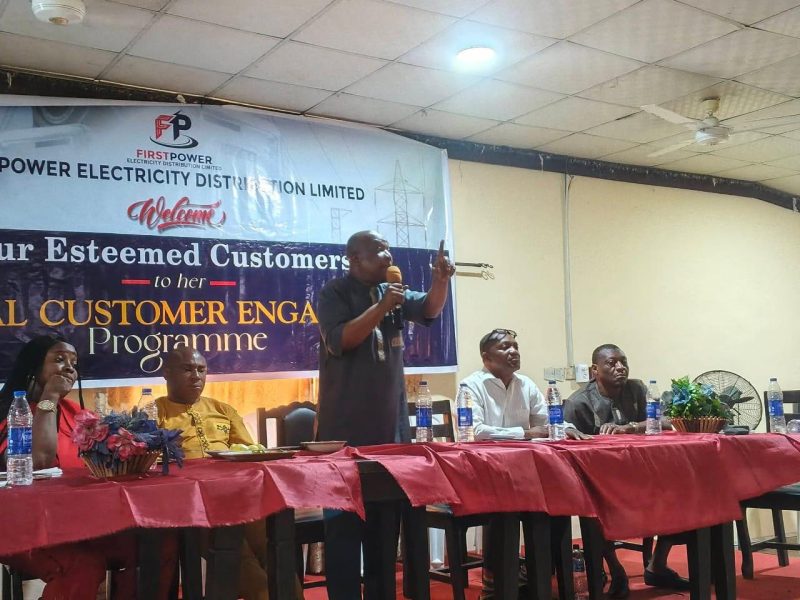
The Managing Director and Chief Executive Officer of FirstPower, formerly the Enugu Electricity Distribution Company (EEDC), Engr. Okechukwu Okafor disclosed this at the company’s 2026 Customer Engagement Programme themed “Stakeholder Engagement for Customers in Awka/Abagana,” held in Awka, the state capital.
Okafor acknowledged growing customer frustration over erratic electricity supply, noting that Anambra State experienced a significant drop in energy allocation in late 2025, receiving only about 45 per cent of its usual supply between November and December due to reduced generation capacity, largely linked to gas supply constraints. Although there has been a slight improvement in recent months, he said supply remains unstable.
He explained that electricity distribution companies operate at the end of the value chain and depend entirely on power generated and transmitted by upstream operators.
Revenue collected from customers, he added, is used to sustain the entire system, including generation, transmission and gas supply.
“Any disruption along the value chain ultimately affects supply to consumers. Without adequate funding across the system, electricity delivery cannot be sustained,” Okafor said.
He stressed the need for stronger collaboration between the company and consumers, pointing to vandalism, energy theft and non-payment of bills as key local challenges affecting service delivery.
Okafor urged communities to take responsibility for safeguarding electricity infrastructure, including transformers and distribution lines, and recommended the installation of solar-powered lighting and surveillance systems around critical facilities to deter vandalism.
During technical presentations, the Head of Technical Services, Engr. Okwudili Udechukwu warned that vandalism, illegal connections and unauthorised interference with installations remain major threats to efficient electricity distribution. He called on residents to remain vigilant and report suspicious activities.
The Chief Technical Officer, Dr Emeka Egbujor, provided further clarity on the electricity value chain, emphasising that distribution companies are responsible only for delivering power received from generation and transmission companies. He noted that disruptions at any stage inevitably affect end users.
On safety, the Head of Health, Safety and Environment, Dr Tosin Fadairo, cautioned against building or operating businesses within power line right-of-way corridors, citing risks such as electrocution and fire hazards.
He added that the company would enforce compliance, including the disconnection of structures that violate safety regulations.
Addressing customer relations, the Head of Customer Service, Mrs Obianuju Okafor, encouraged consumers to use official complaint and payment channels and to always request receipts for transactions to ensure transparency and accountability.
FirstPower also reiterated that customers are not required to pay for the repair or replacement of damaged infrastructure such as transformers, cables or meters, stressing that such responsibilities rest solely with the company. Customers were advised to report any unauthorised requests for payments by field staff.
On metering, the company disclosed that more than 13,000 prepaid meters are being deployed in Anambra as part of efforts to close the metering gap, with additional units expected under a federal government-backed programme. However, officials acknowledged that demand still far exceeds supply.
To accelerate deployment, FirstPower announced the establishment of a meter production facility in Onitsha, with a daily capacity of about 2,500 units, aimed at reducing reliance on estimated billing.
Technical experts at the forum also outlined ongoing interventions to improve network stability, including load balancing, feeder reconfiguration, transformer maintenance and system expansion to meet growing demand.
Customers at the event called for more transparent billing practices and faster response to service complaints, while company representatives assured them of improved communication channels and quicker resolution mechanisms.
The engagement programme concluded with a renewed call for cooperation, with FirstPower urging consumers to see themselves as active partners in building a more reliable electricity system.
Despite ongoing challenges in Nigeria’s power sector, Okafor expressed optimism that sustained collaboration, investment and improved understanding among stakeholders would gradually lead to a more stable electricity supply.