

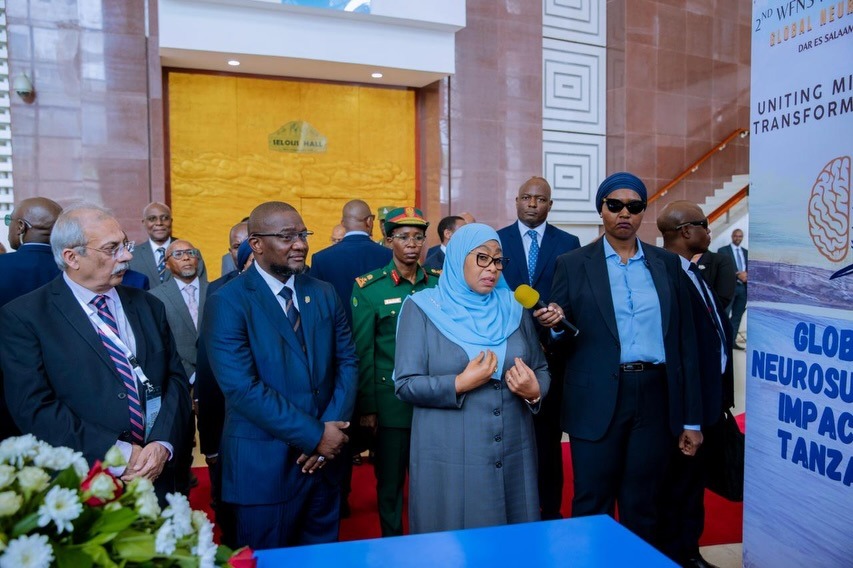
Tanzania’s President, Samia Suluhu Hassan, has reiterated her administration’s commitment to elevating the country’s healthcare system to global standards, as she officiated the opening of the World Federation of Neurosurgical Societies (WFNS) conference.
Addressing an international audience of medical experts and stakeholders, President Samia said her government has, over the past five to seven years, made strategic investments aimed at strengthening healthcare delivery through improved infrastructure, workforce development, and advanced medical technologies.
She highlighted substantial progress in diagnostic services, revealing that the number of MRI machines in the country has doubled from 7 to 14, while CT scan machines have surged from 12 to 97. In addition, digital imaging services have expanded significantly—from 147 to 457 installations—across both public and private health facilities.
These improvements, she noted, are part of broader efforts to enhance access to quality healthcare, especially in previously underserved regions.
The president also pointed to advancements in specialized medical care, particularly in neurosurgery.
“Tanzania has increased its number of neurosurgeons from just 12 to 37 as of April 2026, with seven of them being women” she said.
She described this as a key step towards building a more inclusive and resilient healthcare workforce while reducing dependence on external expertise.
President Samia emphasized that the government’s long-term objective is to transition from a limited pool of specialists to a strong, self-sustaining neurosurgical system capable of meeting the country’s growing healthcare demands.
International Cooperation
Meanwhile, Professor Tariq Khan, speaking at the opening ceremony, underscored the importance of international cooperation in advancing neurosurgical care. He described the WFNS conference as a vital platform for knowledge exchange, innovation, and collective problem-solving among global experts.
Despite the progress recorded, President Samia acknowledged that challenges remain. She cited road traffic accident injuries and the increasing prevalence of non-communicable diseases as major concerns that continue to strain the healthcare system.
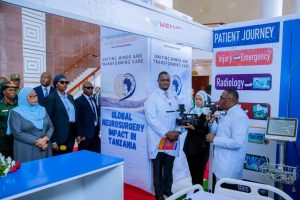
The WFNS conference is expected to run for several days, and has in the past three days conducted training and free medical services in some areas before the official opening ceremony that is bringing together specialists from around the world to share expertise, explore innovations, and strengthen partnerships aimed at improving neurosurgical care globally.