

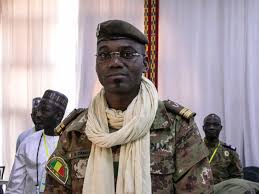
Malian authorities have confirmed the death of the country’s Defence Minister, General Sadio Camara, following coordinated attacks by jihadist fighters and separatist rebels.
The Malian government confirmed the minister’s death in a statement released on the Defence Ministry’s Facebook page and through state-run television, where military spokesperson Gen. Issa Ousmane Coulibaly announced the development.
The government expressed condolences to his family.
The attacks mark a significant escalation in violence in the junta-led country.
Mali has for years faced persistent insecurity driven by militant groups linked to al-Qaeda and the Islamic State, alongside a long-running separatist insurgency in the north.
The latest developments raise fresh concerns over the government’s ability to maintain control in key regions.
The development comes amid reports that pro-government forces have been pushed out of a strategic town in the country’s north.
According to official statements, “the Defence Minister is reported to have been killed during a large-scale offensive in which armed groups seized several towns and military bases.”
Mali was struck on Saturday by one of the most coordinated attacks on its army in the capital, Bamako, and several other cities and towns, in an assault that also challenged Mali’s security partner, Russia, which maintains forces in the West African country.
Authorities say “the attacks appear to have ended, although questions remain over control of a key northern city that separatists claim to have taken.”
The government has not provided a death toll from Saturday’s violence, but earlier said at least 16 people were wounded in what it described as terror-related attacks.
The separatists have been fighting for years to create an independent state in northern Mali, while al-Qaeda and IS-aligned militants have been fighting the government for over a decade.
According to the government statement, General Camara’s residence was targeted by a suicide car bomber and other attackers on Saturday.
It said; “He engaged in an exchange of fire with the assailants, some of whom he managed to neutralise.
“During intense clashes, he was wounded and then transported to the hospital, where he unfortunately succumbed to his injuries.”
Separatists claim control of the northern town of Kidal.
A spokesperson for the separatist Tuareg-led Azawad Liberation Front, or FLA, said the Russian Africa Corps troops and the Malian military withdrew from the city of Kidal following the attack on Saturday, after an agreement was reached for their peaceful exit.
“Kidal is declared free,” said FLA spokesperson Mohamed El Maouloud Ramadan.
In a statement on state television, the Head of the Armed Forces, General Oumar Diarra, confirmed that the Malian Army had withdrawn from Kidal and was repositioning in Anefis, about 100 kilometres south of the city.
Kidal had long served as a stronghold of rebellion before being retaken by government forces and Russian mercenaries in 2023, a development that was previously presented as a major symbolic victory for the junta and its allies.
Saturday’s attacks also marked the first reported coordinated operation involving both separatist fighters and al-Qaeda-linked JNIM militants, who said they took part in assaults across several locations, including Kidal and areas near Bamako.
The FLA confirmed coordination with JNIM, saying the operation was aimed at opposing the military authorities in Bamako.
Security analyst Wassim Nasr of the Soufan Center said the level of coordination appeared unprecedented, noting simultaneous attacks across multiple regions and political alignment between the groups.
“This operation is being carried out in partnership with the JNIM, which is also committed to defending the people against the military regime in Bamako,” Ramadan said.
READ ALSO:US Lifts Sanctions on Mali’s Top Military Leaders
The separatists called on Russia to “reconsider its support for the military junta” in Mali, saying its “actions have contributed to the suffering of the civilian population.”
Wassim Nasr, a regional specialist and senior research fellow at the Soufan Center, said the level of coordination—simultaneous attacks across the country—the joint push by both groups, and the call for Russian forces to withdraw, marked a first.
It extended beyond the military, he said, to the political level because both groups “acknowledged that they worked together.”
Following the attacks, a three-day overnight curfew, from 9 p.m. to 6 a.m., was also announced for the Bamako district.
Mali’s government spokesperson, Coulibaly, said civilian and military personnel were among the 16 wounded and that several militants were killed. He did not provide a death toll.
The Economic Community of West African States condemned Saturday’s attacks in Mali and called on “all states, security forces, regional mechanisms and populations of West Africa to unite and mobilise in a coordinated effort to combat this scourge.”
Following military coups, the juntas in Mali, Niger, and Burkina Faso turned from Western allies to Russia for help in combating Islamic militants.
But the security situation in the region has worsened in recent times, with a record number of attacks by militants. Government forces have also been accused of killing civilians they suspect of collaborating with militants.
In 2024, an al-Qaeda-linked group claimed an attack on Bamako’s airport and a military training camp in the country’s capital, killing scores of people.
Africanews