

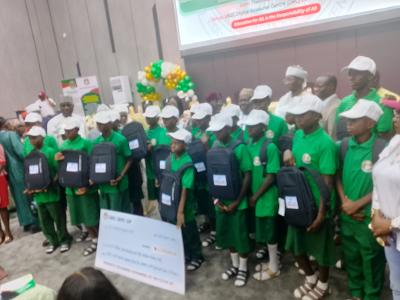
The Universal Basic Education Commission (UBEC) has disbursed over ₦5 billion to 518 communities across Nigeria under the School-Based Management Committee–School Improvement Programme (SBMC-SIP).
This is part of efforts to strengthen basic education delivery and address the challenge of out-of-school children.
UBEC’s Executive Secretary, Aisha Garba, who was represented by the Deputy Executive Secretary (Technical), Rasaq Olajuwon Akinyemi stated this at the national flag-off of the 2025 SBMC-SIP implementation in Abuja.
She said the intervention underscores the Federal Government’s renewed commitment to improving school infrastructure, deepening community participation, and ensuring that children not only enrol in school but remain there until completion.
According to her, the ₦5.18 billion earmarked for the 2025 programme will support 518 communities nationwide, with each state and the Federal Capital Territory benefiting from 14 schools.
READ ALSO: UBEC Unlocks Over N100bn for Basic Education Funding
Garba said the intervention would prioritise underserved areas, focusing on the rehabilitation of dilapidated structures, provision of classroom furniture, and improvement of water, sanitation, and hygiene (WASH) facilities.
“This represents a renewed national commitment to strengthening community participation in school governance, improving learning environments across the Federation, and ensuring that every Nigerian child not only enrols in school but remains in school to successfully complete basic education.
“The event brings together four significant moments in one: a review of implementation progress under the 2023 and 2024 SBMC-SIP cycles; the formal disbursement of the final tranche of support funds for that cycle; the national flag-off of the 2025 School-Based Management Committee–School Improvement Programme; and the official launch of the Learner Retention Programme.
“Collectively, these actions reflect a deliberate and integrated strategy to strengthen school governance, improve infrastructure, deepen community ownership, and systematically address the barriers that keep children out of school or push them out before completion,” she explained.
Impact
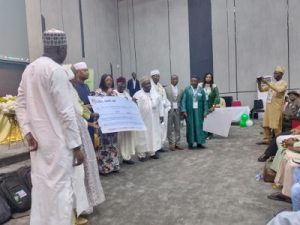
The UBEC boss noted that the SBMC-SIP has continued to demonstrate impact as a community-driven initiative, with over 1,112 schools supported across the country and more than ₦1.5 billion disbursed in previous cycles.
“A total of 13,670 projects have been initiated nationwide, many of which are expected to attract over 400,000 children back to school.
“As we complete one cycle and begin another, we must ensure that implementation is guided by transparency, accountability, and timeliness,” she said,
According to her, UBEC will continue to work closely with State Universal Basic Education Boards (SUBEBs) and local stakeholders to ensure effective delivery.
Garba also announced the disbursement of ₦434.5 million as the final tranche of the 2023 and 2024 SBMC-SIP funds, which will support the completion of 11,484 ongoing projects across the country.
Learner Retention Support Programme
Beyond infrastructure, the Commission used the occasion to launch the Learner Retention Support Programme, targeting one million pupils across eight states in its first phase, with a budget of ₦5 billion.
She explained that the initiative was designed to address socio-economic barriers that hinder school attendance, reduce dropout rates, and encourage sustained participation in education.
In his remarks, the Minister of Education, Tunji Alausa, described the initiatives as critical components of the Federal Government’s strategy to strengthen basic education and achieve inclusive learning outcomes.
He said the programmes align with national education policies, including the Universal Basic Education Act and the National Policy on Education, as well as global commitments such as Sustainable Development Goal 4.
Alausa, who was represented by the Director of Basic Education, Folake Olatunji-David, emphasised that the SBMC-SIP promotes decentralisation and community ownership of school development, while the retention programme directly targets the reduction of out-of-school children, particularly in high-burden states.
The Minister urged stakeholders, including SUBEBs, local authorities, and community leaders, to ensure transparency and accountability in the use of funds.
He stressed that the success of the interventions depends on effective implementation and monitoring at the grassroots.
Stakeholders at the event reaffirmed their commitment to strengthening collaboration, improving school environments, and ensuring that education reforms translate into measurable outcomes for Nigerian children.
The Board Chairman of UBEC, Tanko Al-Makura, urged communities to partner with the government in providing for schools, noting that government alone cannot do it.
He said the money given to the communities represents trust to provide a safe, inclusive, and supportive learning environment for children.
Al-Makura also called on the School-Based Management Committee to follow UBEC minimum standards in utilising the funds to ensure accountability and transparency.