

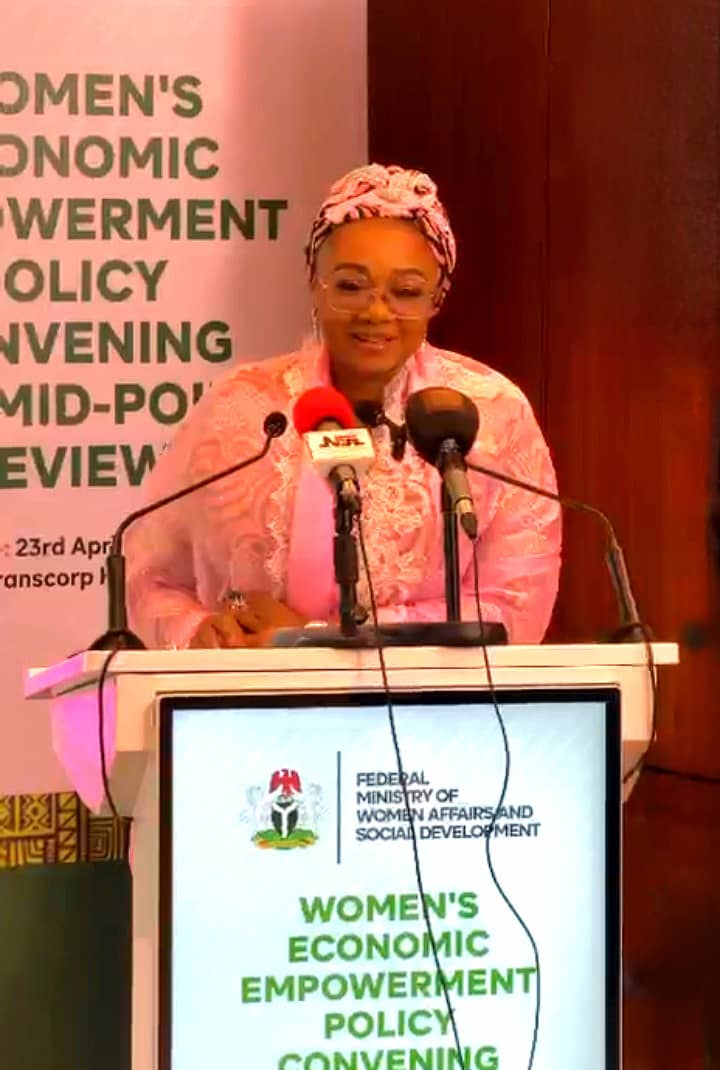
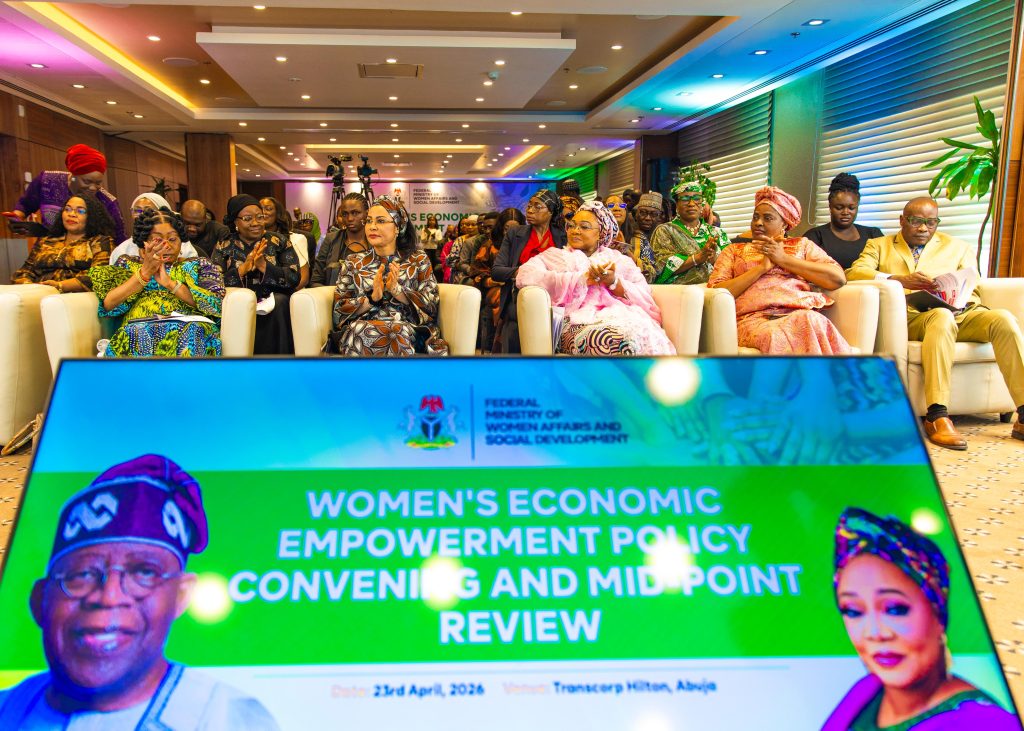
The Nigerian Government has restated its commitment to advancing the National Women’s Economic Empowerment (WEE) Policy to boost women’s participation in the economy.
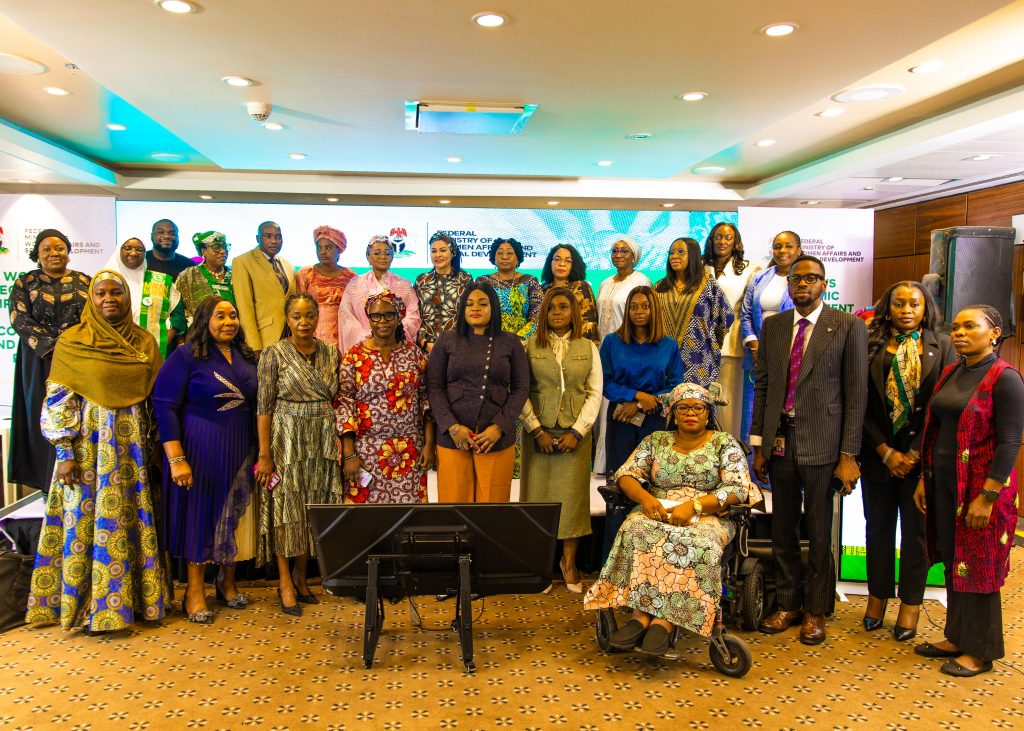
The Minister of Women Affairs and Social Development, Hajiya Imaan Sulaiman-Ibrahim, made this known while speaking at the high-level “Women’s Economic Empowerment Policy Convening and Mid-Point Review” in Abuja.
The Minister described the gathering as a convergence of “promise” and “performance,” noting that the policy is lifting women from the margins of the economy to the centre of national development.
She reaffirmed that implementation of the policy is anchored on the leadership of President Bola Tinubu, whose Renewed Hope Agenda positions women’s economic empowerment as a key pillar of the country’s economic strategy.
On implementation, the Minister said that “the WEE framework has been domesticated in Kaduna, Kano, Lagos and Kwara states, with more than two-thirds of states committing to its adoption.”
“Domestication is not procedural; it is transformational,” Sulaiman-Ibrahim said, stressing that the process is critical to translating national policy priorities into tangible impact at the grassroots level.
On institutional alignment, the Minister cited the Presidential High-Level Advisory Council on Support for Women and Girls as central to coordinating public, private, and donor resources, “positioning WEE as a whole-of-government priority.”
Sulaiman-Ibrahim, underscored persistent structural gaps, noting that women make up over 70 percent of Nigeria’s agricultural labour force but face limited access to resources, while owning over 40 percent of MSMEs yet receiving less than 15 percent of formal financing.
“These are systemic economic inefficiencies that constrain national growth,” she stated.
Sulaiman-Ibrahim outlined several integrated policy instruments, including EmpowerHer, WAVE 774, PowerHer 774, Her SafeHaven, Families First Initiative and DigitalHer, describing them as “execution pathways designed to drive inclusion, productivity and resilience at scale.”
She further linked WEE outcomes to broader national priorities, referencing the Presidential declaration of 2026 as the Year of Families and Social Development and the approval of the Affirmative Procurement Policy as mechanisms to expand women’s access to economic opportunities.
On delivery, the Minister said “the Ministry is “evolving from a policy institution into a platform for alignment, accountability, and delivery, ensuring measurable outcomes nationwide.”
“This agenda extends far beyond women alone… Women’s economic empowerment is therefore not optional; it is foundational to National Development,” she explained.
Calling for accelerated execution, she said, “This midpoint is not a pause; it is a call to accelerate action… What remains is disciplined execution at speed and at scale.”
Minister Sulaiman-Ibrahim said; “Let us commit collectively to building a Nigeria where opportunity is not determined by gender, but by potential; where women are not just participants, but drivers of growth; and where our nation fully realises its promise as the Giant of Africa and indeed the Giant of the world.”