

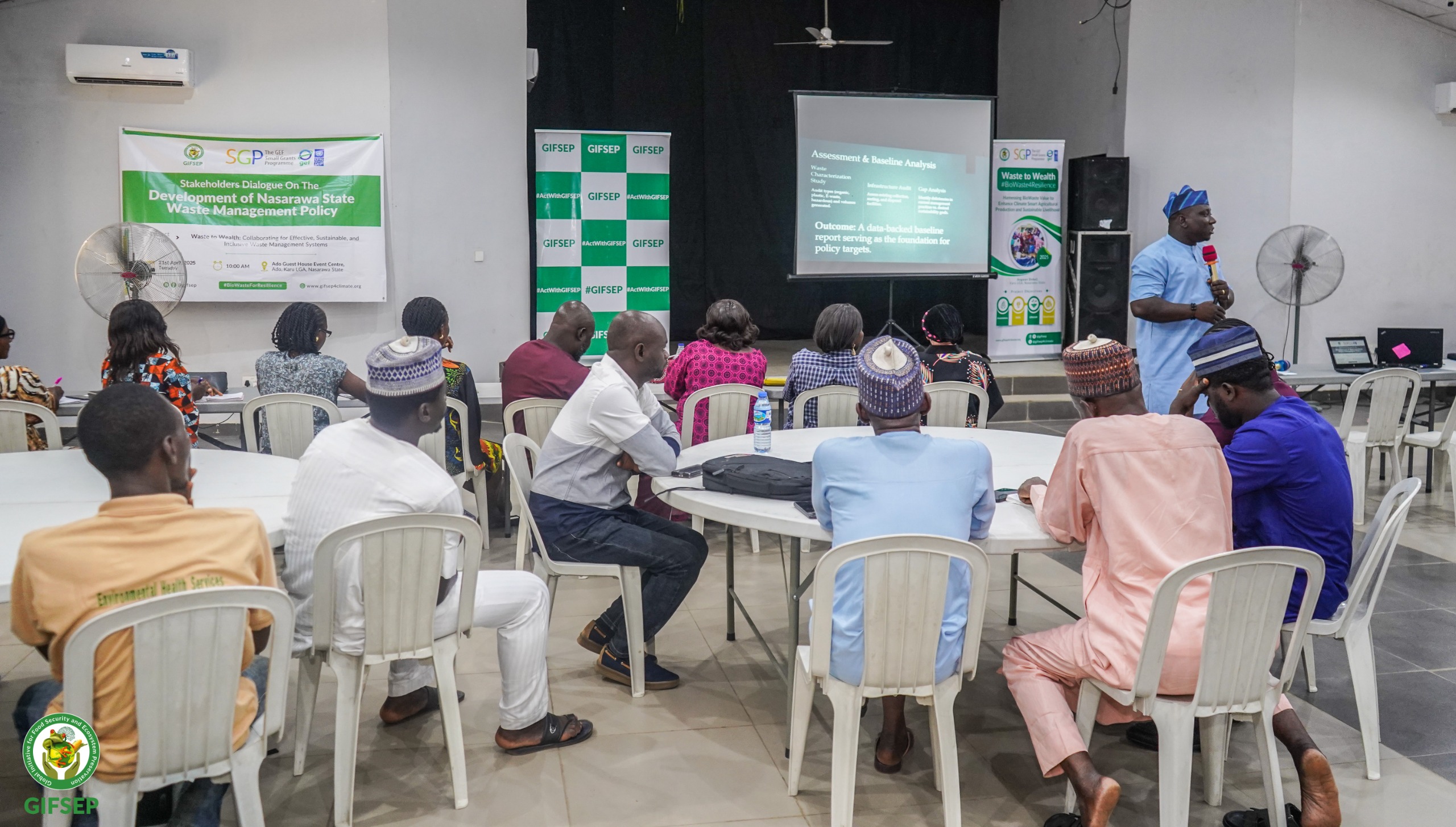
The Global Initiative for Food Security and Ecosystem Preservation (GIFSEP) has convened a high-level stakeholders’ policy dialogue to drive the development of a comprehensive waste management framework for Nasarawa State.
The event brought together key stakeholders from government institutions, including Ministries, Departments and Agencies (MDAs), as well as civil society organisations to deliberate on sustainable solutions to waste management challenges.
In her welcome address, the GIFSEP Acting Programme Manager, Dorcas Nicanor emphasised the urgency of developing a clear, practical, and forward-looking waste management policy in light of the state’s rapid growth.
She noted that “such a policy must extend beyond traditional waste collection and disposal systems to incorporate innovative and sustainable approaches.”
According to Nicanor, “critical components of the proposed policy should include waste reduction strategies, recycling mechanisms, and sustainable financing models.”
She also highlighted the importance of integrating biowaste management into the framework, explaining that organic waste constitutes a significant portion of the waste stream and presents an opportunity for resource recovery.
“With the right framework, organic waste can be transformed into valuable resources such as compost and biogas, while also reducing environmental and public health risks,” she said.
Nicanor further described the dialogue as a participatory platform designed to harness the collective expertise of stakeholders.
She encouraged participants to actively contribute by sharing insights, proposing policy statements, and offering practical recommendations that would ensure effective implementation.
The Nasarawa State Commissioner of Environment and water Resources Dr Margaret Elayo said the state is currently confronted with the growing challenge of climate change, which poses significant risks to its environment, economy, and public health.
According to her, addressing this threat requires a comprehensive approach that combines both mitigation and adaptation strategies.
Dr Elayo said; “The impact ranges from irregular rainfall patterns to increased flooding and environmental degradation—demand urgent and coordinated action at all levels of governance. Without decisive intervention, these challenges could undermine the State’s aspirations for sustainable development and improved quality of life.”
She explained that the State has developed a strategic framework to tackle climate change through the Nasarawa State Policy on Climate Change (NASPOCC).
Dr Elayo added that the State is seeking enhanced collaboration with private sector actors and development partners to build capacity and mobilise resources.
The Director General, Nasarawa State Waste Management and Sanitation Authority NASWAMSA Mr Mohammed Isa Bello emphasised that the future of waste management in the state lies in collective commitment to innovation, collaboration and sustainability.
Isa said; “If we manage our waste properly we do not only clean our environment we create wealth, protect public health and secure the future generations generations yet unborn.”
According to him Waste Management in Nasarawa State has evolved significantly over the years particularly with the establishment and strengthening of the Nasarawa State Waste Management and Sanitation Authority NASWAMSA.
The State Coordinator of the Nasarawa State Network on Environment and Climate Justice (NASNECJ), Mr. Enovh Okolo in his remarks reaffirmed the association’s unwavering commitment to promoting proper waste management practices across Nasarawa State.
According to him, NASNECJ will continue to collaborate with government agencies, civil society groups, and local communities to raise awareness on responsible waste handling, advocate for stronger environmental policies, and monitor their implementation.
Dr. Asonibare F.O., in his paper presentation titled “Framework for Developing a Comprehensive Waste Management Policy,” explained that the proposed framework is specifically designed to guide the formulation of an effective and sustainable waste management policy for Nasarawa State.
Asonibare emphasised that the framework goes beyond a mere outline, serving as a structured approach that integrates environmental, social, economic, and institutional considerations.
According to him, it provides a systematic process for identifying existing gaps in waste handling practices, assessing the volume and types of waste generated, and establishing clear roles for government agencies, private sector participants, and local communities.
The dialogue also underscored the need for public awareness and behavioral change as key drivers of successful waste management systems in Nasarawa State.