

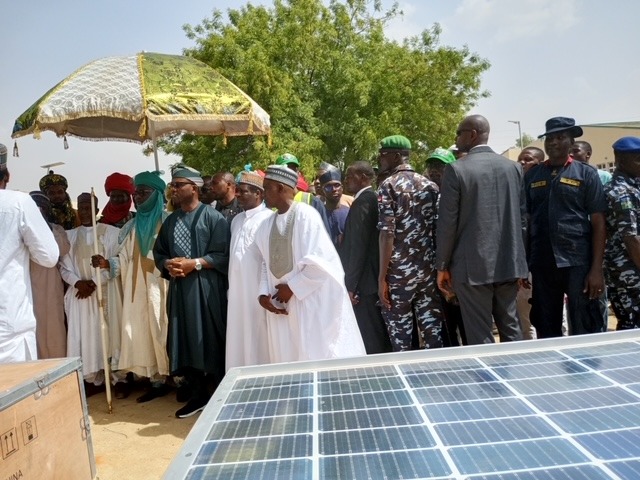
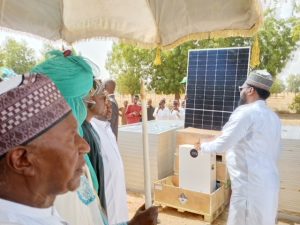
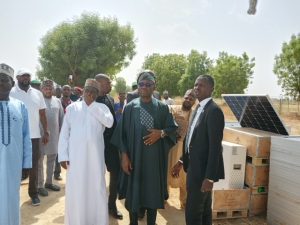
The Federal Government has intensified its renewable energy drive with the groundbreaking of a 2-megawatt solar mini-grid project at Aliko Dangote University of Science and Technology (ADUSTECH), Wudil, Kano State, under the Renewed Hope Solarisation Programme.
Speaking at the ceremony, the Minister of Innovation, Science and Technology, Dr. Tochukwu Udeh, said the project underscores the Tinubu administration’s commitment to powering institutions of higher learning and advancing innovation through sustainable energy.
Dr. Udeh described the project as more than a power intervention, calling it “a strategic national policy and national action.”
He said, “We are not installing solar panels in isolation. What we are delivering is a complete, comprehensive, intelligent energy system incorporating energy storage, smart distribution architecture, and a SCADA supervisory control system.”
The minister noted that the 2MW project is the third under the initiative in Kano State, following similar interventions at Aminu Kano Teaching Hospital and Bayero University Kano.
According to him, a reliable energy supply is critical for universities to drive research, innovation, and global competitiveness.
“President Bola Ahmed Tinubu’s Renewed Hope agenda is built on the conviction that Nigeria cannot compete in the 21st-century economy while its institutions of higher learning struggle to keep the lights on. Today, we act on that conviction,” Udeh stated.
He added that the project would also strengthen local technical capacity, noting that students and staff would be equipped with practical skills in sustainable energy management.
The Director General of the Energy Commission of Nigeria, Dr. Mustapha Abdullahi, said the project was designed as the first phase of a broader 7-megawatt solar solution recommended for the university.
He noted that “Phase One is not a ceiling; it is a starting point deliberately designed for expansion.”
Dr. Abdullahi disclosed that the university currently has an energy demand of between 12.3 and 16.4 megawatts, while spending an average of N22.4 million monthly on electricity bills.
He said the N3.8 billion contract awarded to Safiatu Global Resources Limited has a strict three-month completion deadline.
“To the contractor, you have your mandate: three months, to specification, with no excuses. When we return for commissioning, the panels will be generating and the SCADA centre will be live,” he said.
He explained that the mini-grid would feature solar photovoltaic arrays, battery energy storage, decentralised clusters, and solar streetlights, while university personnel would be trained for operation and maintenance.
Welcoming the intervention, the Vice Chancellor of ADUSTECH, Professor Musa Yakassai, described the project as the single biggest intervention received by the university in its 25-year history.
“This landmark event represents not just an infrastructural milestone, but a bold step toward sustainable energy, innovation, and academic excellence,” he said.
Professor Yakassai commended Dr. Abdullahi, an alumnus of the institution, for what he described as “remarkable interventions and unwavering support” to the university.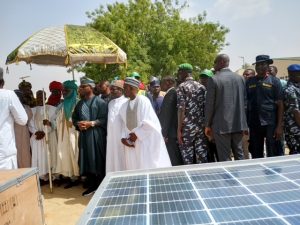
In recognition of his contributions, the Vice Chancellor announced the renaming of the Faculty of Engineering Complex after the Energy Commission boss.
“Henceforth, it shall be known as the Dr. Mustapha Abdullahi Engineering Complex,” he declared.
He also revealed plans for a Centre of Excellence for Renewable Energy Research in collaboration with the commission, alongside ongoing partnerships on clean cooking technologies.
The groundbreaking is part of the Federal Government’s broader plan to solarise tertiary institutions and hospitals across the 36 states and the FCT under the Renewed Hope Solarisation Initiative.