

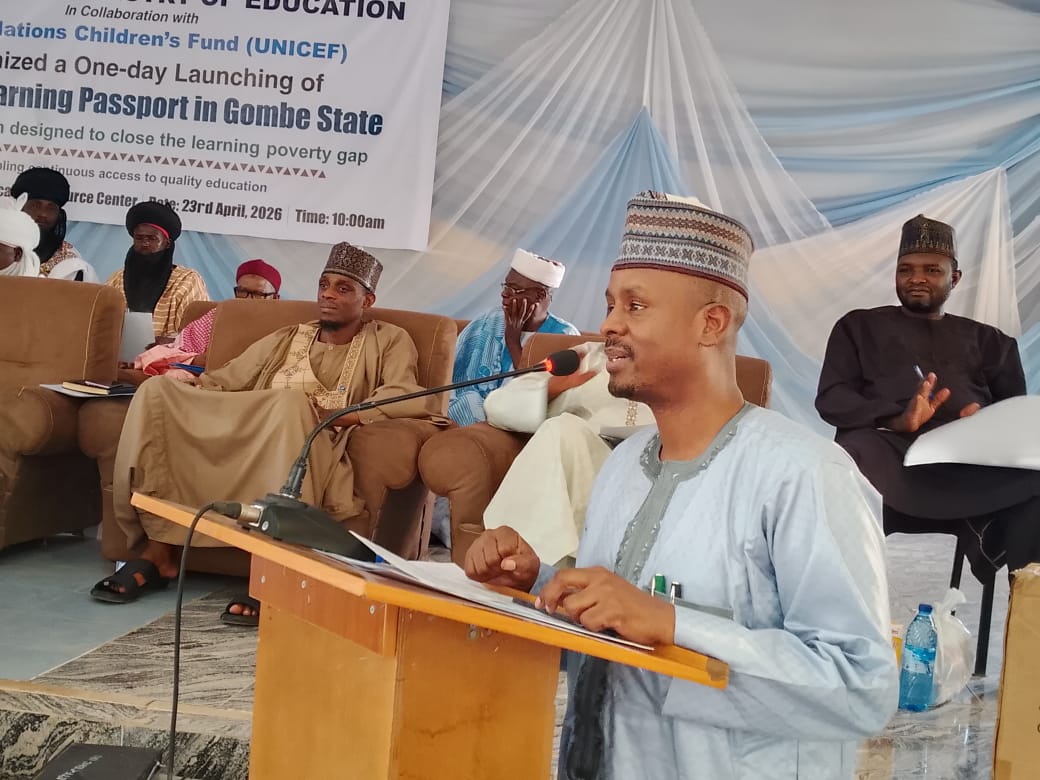
The Gombe State Government, in collaboration with the United Nations Children’s Fund (UNICEF), has officially launched the Nigeria Learning Passport (NLP), a major step aimed at expanding access to digital education and improving learning outcomes across the state.
The introduction of the programme in Gombe is expected to strengthen access to quality learning resources for children, particularly those in remote and underserved communities.
Governor Muhammadu Inuwa Yahaya, represented by the state Head of Civil Service, Professor Mu’azu Shehu, said the initiative aligns with the administration’s vision to expand learning beyond the traditional classroom.
He noted that the programme would ensure that every child in Gombe State, irrespective of location, has access to quality, inclusive, and continuous education through online, mobile, and, in due course, offline platforms.
Professor Shehu described the initiative as a clear demonstration of the platform’s potential to bridge educational disparities and democratise access to knowledge.
“Imagine a girl in Nafada who, with just a mobile phone, can now access the same quality lessons her peers in Gombe City are having. This is the promise of the Nigeria Learning Passport,” he said.
Speaking at the launch on behalf of the Chief of UNICEF’s Bauchi Field Office, Dr. Nuzhat Rafiq, the UNICEF NLP Coordinator in Nigeria, Dr. Harold Kpojime, described the development as a transformative milestone in Gombe State’s education sector and a significant contribution to repositioning learning for the 21st century.
Dr. Kpojime explained that the Nigeria Learning Passport, developed through a partnership between UNICEF and Microsoft, was created in response to the disruption caused by the COVID-19 pandemic, which affected more than 1.6 billion learners globally.
He highlighted early implementation efforts in the state, including the provision of 100 tablets for learners and the training of 30 technical team members in digital literacy, blended learning, and generative artificial intelligence.
With Gombe joining the initiative, the platform is now operational in 24 states across the federation, offering both online and offline access to learning materials.
According to him, up to 1,000 teachers across Gombe State are expected to be trained, while 20 schools will be connected to support the rollout of the platform.
Dr. Kpojime commended the state government’s commitment to education, citing measures such as the declaration of a state of emergency in the sector, the development of a 10-year education plan, and targeted interventions to reduce the number of out-of-school children.
The programme is being implemented with support from partners including IHS Towers and TECNO, alongside UNICEF, Microsoft, and the Global Partnership for Education.
The platform, which already has more than 2.3 million learners enrolled nationwide, is expected to improve literacy and numeracy outcomes while bridging longstanding gaps in access to quality education.
UNICEF also urged the state government to sustain the programme by expanding access to digital devices, strengthening monitoring systems, and investing in school connectivity.
Also speaking, UNICEF’s focal person in the Gombe State Ministry of Education, Lami Garkwa, said the launch represents more than a routine digital rollout.
“Today, we are not just launching a digital platform; we are opening a door that will never be closed. We are here to officially launch the Nigeria Learning Passport, a gateway to the future for every child,” she said.
Mrs. Garkwa stressed that learning can no longer be confined to the four walls of the classroom, noting that the initiative aims to ensure that learning never stops.
She revealed that more than 16,000 lessons have been mapped to the national curriculum, giving students across Gombe State access to high-quality teaching resources at no cost.
Mrs. Garkwa added that the initiative is also designed to bridge the digital divide, with more than 14,000 devices already distributed nationwide, while partners including Airtel and IHS Towers are expected to provide monthly data support.
On teacher development, she said over 70 teachers have already been trained nationwide in digital literacy and innovative teaching methods.
She further emphasised the platform’s cultural relevance, noting that it supports local languages to ensure inclusive access for every household.
She urged students to embrace the platform as a pathway to future careers and leadership opportunities.
“To our teachers and parents, we ask you to be champions of these tools. Encourage your children to engage with the 2.3 million learners already registered across the country,” she added.
The Permanent Secretary, Gombe State Ministry of Education, Abubakar Hassan, said the state has made significant progress in rolling out the Nigeria Learning Passport, with selected teachers already undergoing intensive training.
He noted that officials have worked closely with the UNICEF coordinator to ensure that the initial group of trainees are equipped to extend the programme to more than 1,000 teachers statewide.
The Permanent Secretary also highlighted the establishment of the state’s Information Technology Development Agency as a strategic move to drive digital transformation in education and public administration.
Describing the NLP as an innovative platform, Hassan said it would strengthen teaching and learning by leveraging technology to extend education beyond the classroom.