

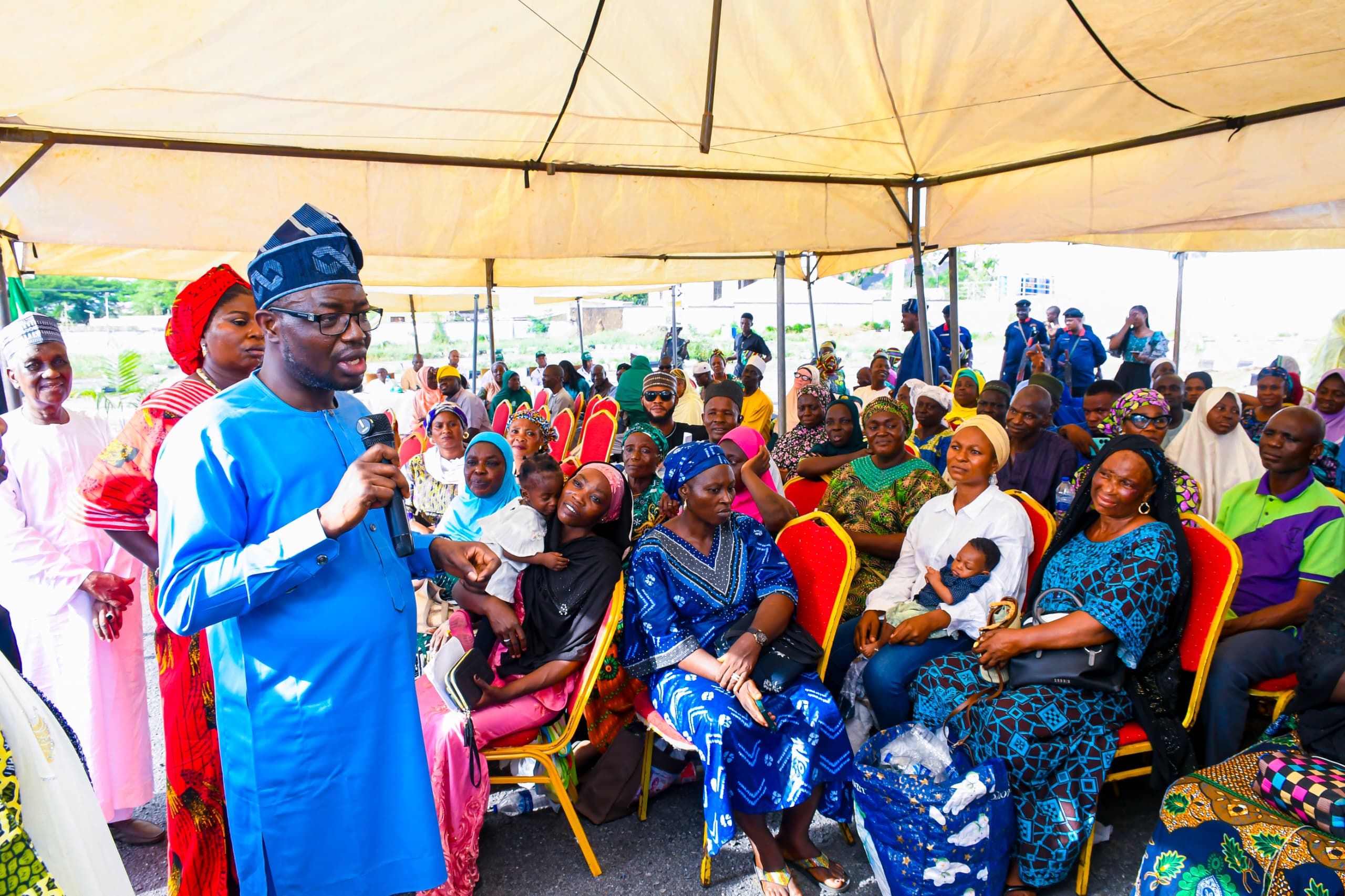
The Minister of Humanitarian Affairs and Poverty Reduction has reiterated the present administration’s commitment towards strengthening national social investment programmes by ensuring that every intervention contributes to a defined pathway out of poverty.
Professor Bernard Doro made the commitment in Kwara State, North-Central Nigeria, during a nationwide engagement with beneficiaries of the HoPE-CT Programme.
Addressing stakeholders, he noted that the engagement was about impact and ensuring that government support translates into real improvements in the lives of vulnerable households.
“I chose to be here personally because leadership must not operate at a distance. I needed to come down myself -to see, to hear, and to understand what is working and what must change. Kwara State holds a unique place in the evolution of this programme, having made significant contributions to shaping its structure and enhancing its delivery.
“Speaking specifically to Kwara State, the programme has reached a significant number of households across multiple phases. In the first tranche, 183,186 households were supported. In the second tranche, 139,812 households received support, while in the third tranche, 141,852 households benefited. The total disbursement across these three tranches stands at N11,482,020,000.00.
“It is important to state clearly that these figures should not be aggregated as entirely separate sets of beneficiaries. Many transition across phases due to the NIN validation process, ensuring accuracy and accountability.”
Professor Doro who expressed excitement over the success achieved so far, said the engagement with beneficiaries of HoPE-CT the Programme aligns directly with the vision of a One Humanitarian- One Poverty Response System.
This, he said, means in simple, but critical terms, that interventions must no longer operate in silos.
They must be connected, tracked, and structured towards a clear outcome. Support must lead somewhere. It must move people forward.
“This direction is directly linked to our poverty exit strategy, which we are strengthening to ensure that every intervention contributes to a defined pathway out of poverty.
We are strengthening the system to ensure that interventions such as livelihood support, training, and cooperative structures are not only delivered, but are aligned towards measurable outcomes.
“What we are building, therefore, is not just a programme, but a graduation system—one that ensures beneficiaries move from support to stability, and ultimately exit poverty with dignity.
“To our beneficiaries, your voices matter and will shape what comes next. Let me reiterate that this programme is entirely free, and any payment request reported immediately,” the Minister urged.
He applauded President Bola Tinubu’s strong leadership and commitment towards strengthening social protection in Nigeria.
He also commended Governor AbdulRazaq for providing leadership and commitment to the welfare of his people, noting that the progress recorded in Kwara reflects deliberate governance and strong alignment with national priorities.
Commissioner for Social Development in Kwara State, Dr. Mariam Nana Fatima Imam, who congratulated all the beneficiaries of the Household Prosperity and Empowerment Cash Transfer (HoPE-CT) Programme, described the initiative as impactful and people-focused.
The Commissioner noted that the programme aligns strongly with the vision of Governor AbdulRahman AbdulRazaq, adding that through the Ministry of Social Development, the State has continued to implement interventions targeted at orphans and vulnerable children, persons with disabilities, and the elderly, while also strengthening juvenile centres.
She explained that, alongside the Kwara State Social Investment Programme (KWASSIP) and in collaboration with HoPE-CT, these efforts are delivering measurable improvements across communities.
According to her, the integration of the State Cash Transfer Unit within KWASSIP has enhanced coordination and improved service delivery.
Dr. Imam further highlighted that HoPE-CT provides timely support through debit cards and direct transfers, enabling beneficiaries to meet basic needs and rebuild their livelihoods.
She said that over 183,000 households benefited in the first phase of the programme, about 139,000 in the second phase, and more than 141,000 in the third phase, covering all 16 Local Government Areas of the State.
“This support has helped families stay afloat, rebuild, and look ahead with more confidence,” she stated.
The Commissioner commended the Minister of Humanitarian Affairs and Poverty Reduction for his leadership in advancing social protection nationwide, noting that his efforts continue to bring relief and hope to vulnerable communities, including those in Kwara State.
Dr. Imam reaffirmed the Ministry’s commitment to delivering inclusive, people-centred interventions and ensuring that more vulnerable citizens benefit from government initiatives.