
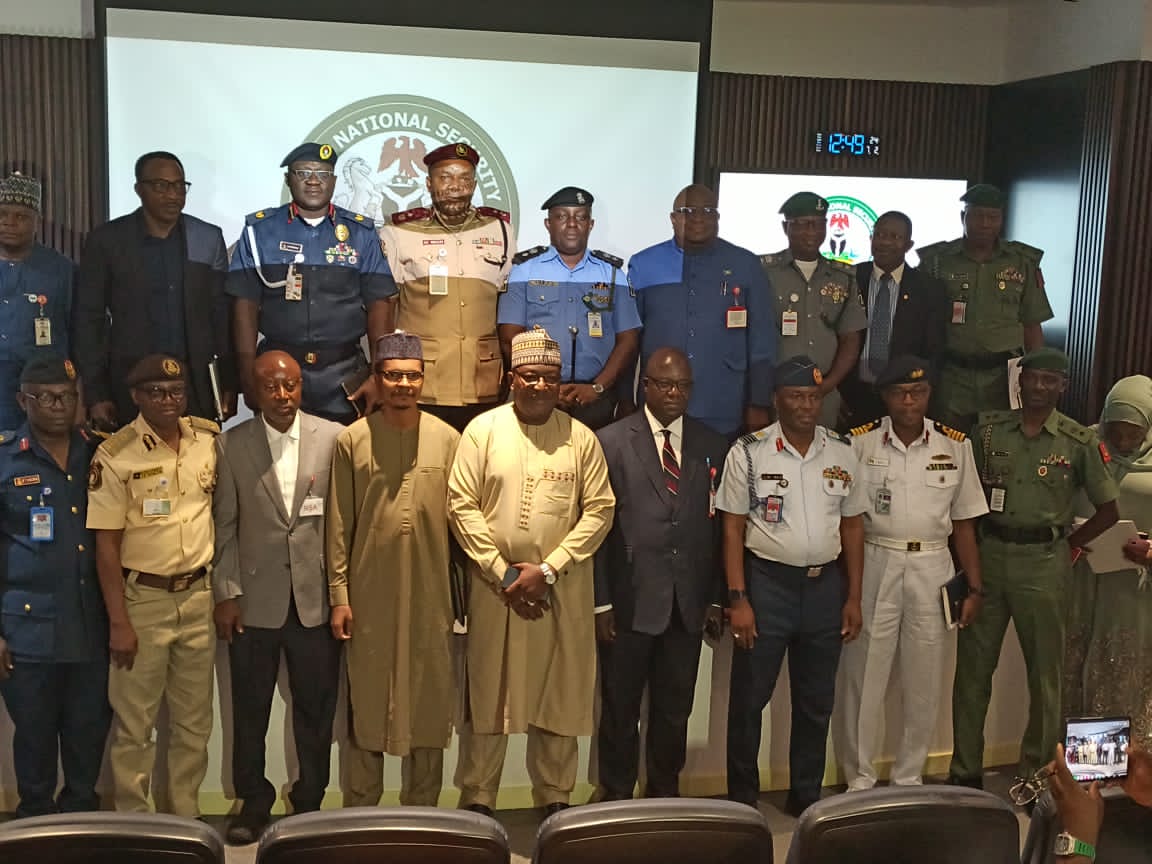
The Office of the National Security Adviser (ONSA) has outlined Nigeria’s security performance for the first half of 2026, highlighting significant gains in counter-terrorism operations, intelligence gathering, criminal prosecutions and law enforcement under the Federal Government’s coordinated efforts to tackle insecurity.
Speaking at the Joint Security Press Briefing organised by ONSA in Abuja on Thursday, the Director of Legal Services, Office of the National Security Adviser, Mr. Zakari Mijinyawa, said the Nigerian Government has secured 1,721 terrorism-related convictions since the launch of the Mass Trial Programme in October 2017.
He noted that “865 convictions were recorded during Phases Nine and Ten in 2026 alone, accounting for more than half of all convictions secured under the programme and surpassing the combined total recorded between 2017 and 2025. He added that the programme has equally upheld due process through discharges and acquittals where the required legal threshold was not met.”
READ ALSO: Security Summit Recommends Urgent Measures to Strengthen Borders
Providing the military operational update, Group Captain K. Ali, who represented the Director, Defence Information, Major General Samaila Uba, said the Armed Forces of Nigeria maintained an aggressive operational tempo between January and June 2026, conducting 14,221 operations across the country. According to him, troops neutralised 1,597 terrorists and insurgents; rescued 1,516 kidnapped victims; recovered 451 firearms, 16,726 rounds of ammunition, and 161 explosives and Improvised Explosive Devices (IEDs); and sustained kinetic and non-kinetic operations aimed at degrading terrorist and criminal networks nationwide.
The Nigeria Police Force presentation, delivered by CSP Aniete Okonkon Edem, Force Public Relations Officer, Force Headquarters, Abuja, highlighted significant gains through intelligence-led policing, including the dismantling of organised criminal syndicates, rescue of kidnap victims, disruption of illegal arms trafficking networks and strengthened collaboration with the Armed Forces, INTERPOL and other security agencies in combating terrorism, banditry, kidnapping and transnational organised crime.
Operational achievements presented by other participating agencies further reflected the broad scope of Nigeria’s security architecture. The Department of State Services reported the rescue of more than 200 kidnap victims, major recoveries of arms and ammunition, disruption of gunrunning and terrorism financing networks, and convictions in several high-profile terrorism and kidnapping cases. The National Drug Law Enforcement Agency announced the dismantling of Nigeria’s largest clandestine methamphetamine laboratory; drug seizures valued at about ₦480 billion; 9,769 arrests; and 1,778 convictions within five months.
The Nigeria Security and Civil Defence Corps reported major breakthroughs against infrastructure vandalism, illegal arms manufacturing and economic sabotage, while the Nigeria Financial Intelligence Unit highlighted Nigeria’s removal from the European Union’s high-risk money laundering list and expanded measures against terrorism financing. The Nigeria Customs Service outlined significant gains in border security, anti-smuggling operations, revenue generation and wildlife protection, while the Economic and Financial Crimes Commission announced 915 convictions for economic and financial crimes during the first four months of the year.
Further updates from the Nigerian Correctional Service, Nigeria Immigration Service, National Agency for the Prohibition of Trafficking in Persons, Federal Road Safety Corps, Federal Fire Service and National Emergency Management Agency detailed improvements in custodial security, migration management, anti-human trafficking operations, road safety enforcement, emergency response and humanitarian interventions, underscoring the complementary roles of non-military institutions in strengthening national security.
Collectively, the briefing demonstrated the federal government’s continued emphasis on integrated national security management, with ONSA coordinating military operations, intelligence, law enforcement, judicial processes, financial surveillance and emergency response into a unified strategy aimed at degrading criminal networks, strengthening public safety and enhancing national resilience.

 has unveiled a comprehensive account of Nigeria's security performance in the first half of 2026, highlighting major gains across counterterrorism operations, criminal prosecutions, intelligence activities and law enforcement as the Federal Government intensifies a coordinated whole-of-government approach to tackling insecurity.)