

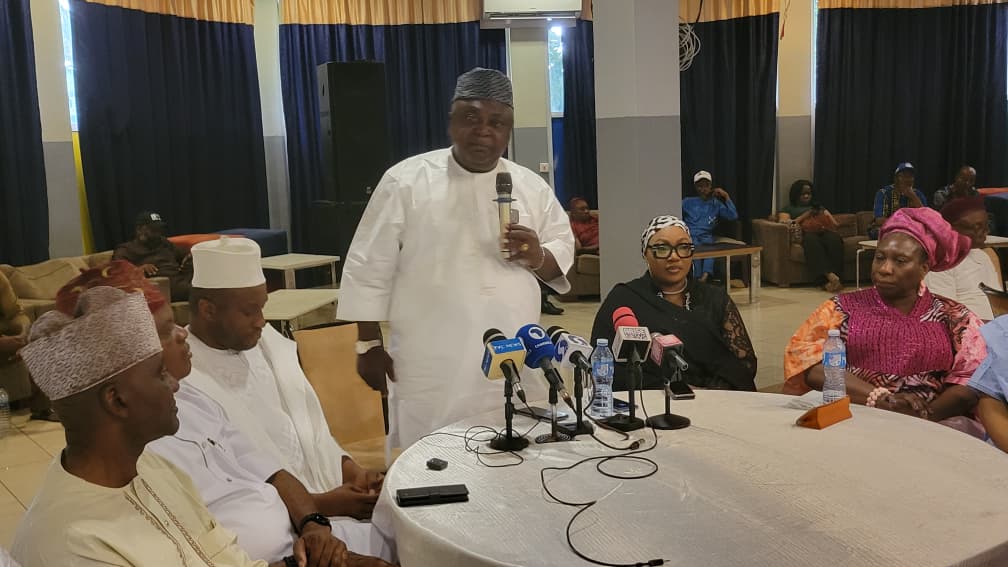
The governorship candidate of the Peoples Democratic Party (PDP) in Ogun State, Oladipupo Adebutu, has unveiled a seven-point development agenda centred on security, local government autonomy, economic inclusion, education reform, healthcare, agriculture and youth empowerment as political activities gather momentum ahead of 2027 general election in Nigeria.
Adebutu, who spoke at a media parley in Abeokuta, the state capital, outlined his vision for the Southwest state, promising to strengthen grassroots governance and address socio-economic challenges if elected governor in 2027.
As one of Nigeria’s highly politically active states, Ogun remains a key battleground in the country’s evolving democratic landscape, where governance performance, economic development and grassroots mobilisation shape electoral outcomes.
READ ALSO: Democracy Day: PDP Says Nigeria’s Challenges Are Surmountable
Adebutu identified insecurity as a major obstacle to development, arguing that sustainable economic growth and social stability can only be achieved in an environment where lives and property are adequately protected.
“Security is the first item on our agenda because without security, nothing else can thrive. We cannot build a prosperous society when people live in fear,” he noted.
The PDP governorship hopeful expressed concern over what he described as inadequate operational support for security agencies, noting that several police formations across the state continue to face infrastructure and logistics challenges.
He noted that years of underinvestment have left some security institutions dependent on interventions from private individuals and communities, saying he had personally supported security agencies through provisions of fuel, vehicle maintenance and other operational assistance.
Adebutu highlighted the role of public infrastructure in crime prevention, revealing that he had also funded the installation of solar-powered streetlights in several communities to improve public safety and economic activity.
On governance reforms, the PDP candidate placed strong emphasis on local government autonomy, describing effective grassroots administration as critical to inclusive development and democratic accountability.
He argued that the local government system is designed to bring governance closer to citizens but has gradually lost effectiveness due to excessive control from state governments.
“The consequences have been weakened institutions, poor service delivery and limited grassroots development. Local governments must be empowered to function independently, transparently and responsibly,” he emphasised.
Adebutu maintained that stronger local governments would enhance service delivery, community participation and rural development.
In the education sector, Adebutu called for reforms that prioritise vocational training, entrepreneurship, digital literacy and technical skills acquisition, arguing that Nigeria’s education system must better align with the realities of a rapidly changing global economy.
“Practical and technology-driven learning will help bridge the gap between academic qualifications and labour market demands, particularly among young people,” he said.
Speaking at the event, PDP senatorial candidate for Ogun Central, Prof. Iyabo Obasanjo, questioned the extent to which industrial growth in Ogun State has translated into tangible benefits for ordinary citizens.
Obasanjo acknowledged the Ogun State status as one of the leading industrial hubs in Nigeria but argued that economic expansion should result in broader employment opportunities, improved welfare and higher living standards.
“Industrialisation is beneficial when it improves the lives of the people. While Ogun has attracted industries and investments, many residents are yet to feel the full benefits through jobs and improved economic opportunities,” she stated.
As political consultations intensify ahead of the 2027 elections, governance, security, economic inclusion and grassroots development are expected to remain central issues in campaigns across Nigeria, with voters increasingly scrutinising policy proposals and leadership credentials in one of Africa’s largest democracies.


[…] country in delivering massive votes for President Tinubu’s re-election in 2027. READ ALSO: Ogun PDP Unveils Seven-Point Plan for 2027 Election Governor Yusuf said the APC administration in the state remains resolute in its support for […]